All Ages, Cash Only, Zoned Commercial
The Marlow closed on Red River after three years, Valhalla is on its way out, Empire is halted, and the block is up for sale. I went down to see who's headlining now.
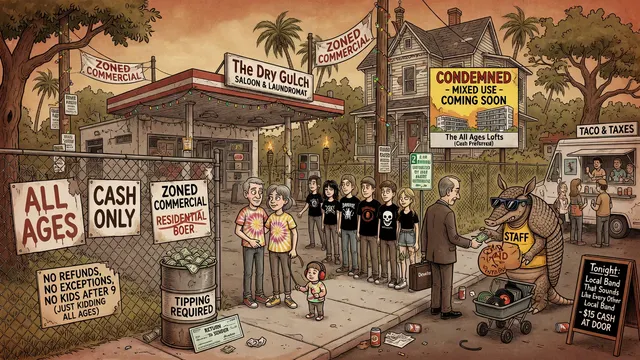
"Who's playing tonight?"
A kid in a black denim vest asked me that at about nine-fifteen, standing on a Red River sidewalk that still smelled like warm beer, wet cardboard and the exhaust fan from a kitchen nobody had shut off yet. He was pointing past me at a building. I turned around to look. I want to be honest about this part. For a full second I tried to read the For Sale sign as a band name.
It works better than it should. For Sale, two words, all caps, a little aggressive. Sounds like a Denton three-piece that breaks up over a van.
"Nobody," I told him. "Real estate."
He nodded like that was a genre. Around here it might be.
The news, plainly
The Marlow, the cocktail bar on Red River, has closed after three years. It joins Valhalla, which has already announced it's closing, and Empire, which has been halted. Meanwhile the block's properties are going up for sale. The Austin Chronicle has it in this week's news roundup, and that's all I know for certain. I'm not going to invent the backstory. The backstory in this town is always the same anyway, and it's printed in the bottom corner of a sign with a phone number on it.
Three years is not a lifespan, it's a lease
I'll confess I'm not the target demographic for a Red River cocktail bar. My idea of mixology is a Lone Star with a lime wedge somebody dropped in out of pity. But I respect anybody who opens a room on that street, puts glassware on a shelf, and bets that people will walk past three loading docks and a security guy on a stool to find it.
Three years. In Austin real estate terms that's not a run, it's a trial period. You barely get the neon broken in. The first year, people are still figuring out where the door is. The second year, regulars start calling the bartender by name. The third year, the building's owner starts calling a broker by name. That's the arc.
A dive bar on this street used to last long enough for the bathroom graffiti to develop layers. You could date the drywall the way geologists date canyon walls. Here's the Clinton administration, here's somebody's phone number from 2004, here's a sticker for a band that later got famous and pretends they never played here. You can't build strata in three years. You can barely get a sticker to stick.
Reading the sign like a gig poster
Since the sign is the main act now, I gave it the respect I'd give any flyer stapled to a pole on Seventh Street. I read the fine print.
A gig poster tells you who, when, how much, and whether there's an opener. A commercial listing tells you square footage, zoning, and "contact for details," which is real estate for "if you have to ask, you are not the buyer and you should go stand somewhere else."
Doors? Locked.
Openers? Whoever shows up with financing.
All ages? Technically, yes. Any age can be priced out.
I kept waiting for the line at the bottom that every good poster has: $10 adv, $12 dos. There's no price on the sign, of course. There never is. The not-saying is the whole point. When a cover charge is too embarrassing to print, it's a good sign the place isn't going to be a venue.
The block, as a set list
Walk it like a set list and you hear the problem.
Valhalla, going. A metal bar named after the hall where dead warriors drink forever. I'm sure somebody in a planning office somewhere found that funny. "Forever" turns out to have an expiration date, and it's whenever the building trades.
Empire, halted. Not closed, the word is halted, which sounds like a train somebody pulled the cord on. I've stood in that yard on a July night when the bass came up through the soles of my shoes and the humidity was so thick it carried the kick drum like a delivery service. Halted is a strange word for a place like that. Rooms like that don't halt. They get turned off at the wall.
And the Marlow, done.
That's three acts on one block, in one news brief, in one week. I've seen fewer cancellations from a festival under a tornado watch.
The economics, as best a grouch can do them
Here's the math nobody puts on a chalkboard behind the bar. A venue makes money one drink and one ticket at a time, in a room that only fills up after ten and only on nights when the band has a draw. A building makes money all at once when somebody signs a check. One of those business models involves loading in amps at four in the afternoon in August. The other involves a pen.
Every city council for twenty years has said the right words about Red River. Cultural district. Live music capital. Something about "preserving." I have no doubt people meant it. But a word like "preserve" doesn't hold up in front of a For Sale sign. The sign doesn't argue. It just stands there, in a nice font, waiting for the speeches to wrap up.
And the city loves the idea of this street. The idea shows up in every tourism video: a sweaty crowd, a guitarist with his eyes closed, a slow pan across a mural. The idea brings in visitors and convention money and gets printed on banners. The idea does not pay a property tax bill. The idea does not buy the building.
The idea, I'm sorry to report, is renting.
Who's actually affected
Not me, mostly. I go to bed early now, and my ears gave up on certain frequencies around the second Bush term. The people who lose the most are the ones you never see in the tourism video: the bartender who knew which regular wanted his tab closed at midnight no matter what, the sound guy who could get a decent mix out of a room shaped like a shoebox, the touring band from Tulsa that had exactly one Austin room willing to book them on a Tuesday. Every closed door on Red River is a Tuesday night that doesn't exist anymore somewhere down the line.
That's who I'm mad on behalf of. The building will be fine. Buildings always land on their feet. They have a lot of feet.
Back on the sidewalk
The kid in the vest hung around a while. He told me he'd driven in from Round Rock to see a show at a place he'd found online, and that the place was one of the ones on this street, and he wasn't sure anymore which one. He said it like he'd gotten the date wrong. He hadn't. The date was fine. The street was wrong. The street had moved without telling anybody, the way streets do now, quietly, one closing at a time.
I pointed him toward the rooms that still had their lights on. There are still some. Go to them. Buy the overpriced beer. Tip the door guy. Stand close enough to the speaker that you regret it in the morning. That's not nostalgia, that's maintenance.
Then he looked up at the sign one more time, read the broker's phone number out loud, and said, "Do you think they'd take a band call?"
Kid, they'll take any call. They just won't let you play.
Keep reading Lost Venues & Dive Bars
Six People Remember the Same Pool Table
An oral history of the lopsided pool table at a closed Airport Boulevard dive, told by the regulars who can't agree on its color. The new tenant can agree on $48 an hour.
5 min read
Somebody Shout Out a Location
The Hideout Theatre lost its 26-year Congress Avenue home to a planned bar and now plays a roughly 40-seat North Lamar annex. Downtown took a suggestion from the audience, and the audience was a liquor license.
5 min read
One Neon Sign, Fully Funded
Mohawk turned 20 and got a new neon sign courtesy of a facade grant, while Red River's leaders begged City Hall to stop the closures. The district now has excellent lighting for its own predicament.
5 min read
Follow the Grouch
Email subscriptions are unavailable. Follow new complaints in your RSS reader instead. We do not collect an email address here.
Open the RSS feedAdd this feed’s address to your reader. Opening the link does not subscribe you automatically.