One Neon Sign, Fully Funded
Mohawk turned 20 and got a new neon sign courtesy of a facade grant, while Red River's leaders begged City Hall to stop the closures. The district now has excellent lighting for its own predicament.
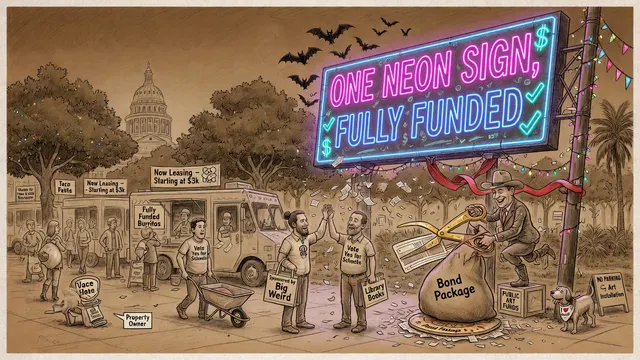
A guy in a conference lanyard stopped dead on the Red River sidewalk Wednesday night, raised his phone, and said to nobody, "Oh, this is the place." He took the picture and walked toward Sixth without going inside.
That is the whole problem with this street, and it fit in under four seconds.
Mohawk turned 20 this week and lit a new neon sign out front to celebrate. A facade grant paid for it. In the same news cycle, Red River's district leaders went to City Hall and asked, in the tone people use when they've been asking for a while, for the city to actually do something after the venue closures. Same week, same block. You could stand under the new glow and read the plea by its light.
I want to be fair to the sign. It's a good sign. Neon is one of the few technologies Austin hasn't figured out how to make worse. It hums, it glows, it looks like 1 a.m. even at 7:30. Mohawk has earned a sign. Twenty years in that spot is longer than most of the condo towers around it have existed, and longer than some of their developers have been allowed to drive.
The word that keeps catching in my throat is facade.
What the Money Will Cover
Somewhere in the civic machinery there's a program that will gladly help a music venue look like a music venue. There is apparently less enthusiasm for helping it stay one. The grant covers the outside, the part the lanyard guy photographed. I am not aware of a matching program for the inside, where the expensive things live: rent, insurance, sound, staff, the electric bill for keeping a room full of sweating people at a survivable temperature in a city whose September is basically a hostage situation.
So we've arrived at a cultural policy you could summarize on a napkin. Exteriors are infrastructure. Interiors are your problem.
Follow that logic a few years out and Red River turns into a studio backlot. Beautiful storefronts, each one lit and lovingly restored, with plywood and a leasing office behind every one of them. Tourists will walk the strip at night and feel the music in their bones, and the music will be coming from a Bluetooth speaker zip-tied to a lamppost, paid for by a separate grant for "ambient activation."
I'm kidding. Mostly. Ambient activation sounds like a line item somebody would approve.
A Brief Tour of the Old Glow
I started going to Red River when the street's lighting plan was "whatever was still plugged in." The block had a texture you could smell: spilled well vodka, hot amp dust, the specific sweetness of a dumpster that's been working a double. You found the shows by sound. You'd hear a kick drum through brick from a block away and just follow it, the way a dog follows a dropped tortilla.
Emo's moved off Red River to East Riverside in 2011, and I remember thinking at the time that it was a sad but isolated event, like a tooth falling out. Nobody tells you the first one is a schedule.
Mohawk, in my memory, was the room where you climbed stairs to watch a band from above and felt briefly like a minor landlord. You'd stand on the upper level with a tallboy sweating through your hand and look down at the crowd, and someone behind you would always be explaining the opening act's previous, better band. That guy is a civic treasure. He should get a grant.
I don't remember the old signs being particularly good, actually. They were in the "flickering because nobody has a ladder" school of design. That was fine. You didn't need the sign. You knew where the place was, because you'd been there last Thursday and the Thursday before, and the bartender knew you as "Shiner, no glass."
The Thing About Lighting a Room
There's an old real-estate trick where a seller replaces the porch light right before the open house. It works. People see a warm glow out front and assume the foundation's fine.
Cities do this too. And I don't think anybody who wrote that grant application meant it cynically. Mohawk got its money and spent it on something real, and good for them; a venue that has made it 20 years on Red River is entitled to light up any part of itself it wants. The cynicism is structural. It's what happens when the help a city knows how to give is the help that photographs well.
Picture the meeting. Somebody from the district stands at the microphone and lays out the closures and the rent and the math, which on Red River has been bad for so long that it has its own parking spot. Council nods. Staff takes notes. Somebody says "stakeholder." Everyone agrees live music is the city's identity, which is what we say about things we've decided to describe instead of fund.
Then the meeting ends, and on the way out somebody suggests a banner.
Things That Should Get a Facade Grant Next
In the spirit of the program, I'd like to nominate:
- The Red River street itself, which could use new neon on the pavement reading "THERE WERE MORE OF US."
- The loading zone, where the touring vans double-park with the haunted look of people who just drove from Tulsa and found out the hotel is in Round Rock.
- The musicians, who could each be fitted with a small, tasteful glowing outline so visitors know where they are. Most of them live in Del Valle now. A light helps.
- City Hall, which deserves an exterior sign spelling out "OPEN" in a font that blinks nervously.
Twenty Years, Lit
Here's what I actually did Wednesday. After the lanyard guy left, I went in. Paid what a ticket costs now, which I won't print because my cardiologist reads this blog. Bought a beer that cost roughly what a whole night cost in my thirties. Stood upstairs. A band I'd never heard of played too loud and a little too fast, and the guy behind me said they were better in their old band, and for forty minutes everything was correct.
On the way out I looked back at the sign. It looked great. It looked like a place somebody wanted to keep.
That's the trouble with a really good sign: it makes everyone feel like the job is done. The light is on. The room is the part that costs money. If City Hall wants to help, it can start by walking past the neon, going up the stairs, and staying long enough to see the bill.
Then fund the inside. Or, knowing this town, fund a mural of it.
Keep reading Lost Venues & Dive Bars
Six People Remember the Same Pool Table
An oral history of the lopsided pool table at a closed Airport Boulevard dive, told by the regulars who can't agree on its color. The new tenant can agree on $48 an hour.
5 min read
Somebody Shout Out a Location
The Hideout Theatre lost its 26-year Congress Avenue home to a planned bar and now plays a roughly 40-seat North Lamar annex. Downtown took a suggestion from the audience, and the audience was a liquor license.
5 min read
Write It on the Little Slip and Hold It Up
Fantastic Fest opens today on South Lamar, and I'm in a line full of lanyards. My head keeps wandering six miles north to a downtown theater where the floor stuck to your shoes and nobody minded.
5 min read
Follow the Grouch
Email subscriptions are unavailable. Follow new complaints in your RSS reader instead. We do not collect an email address here.
Open the RSS feedAdd this feed’s address to your reader. Opening the link does not subscribe you automatically.