
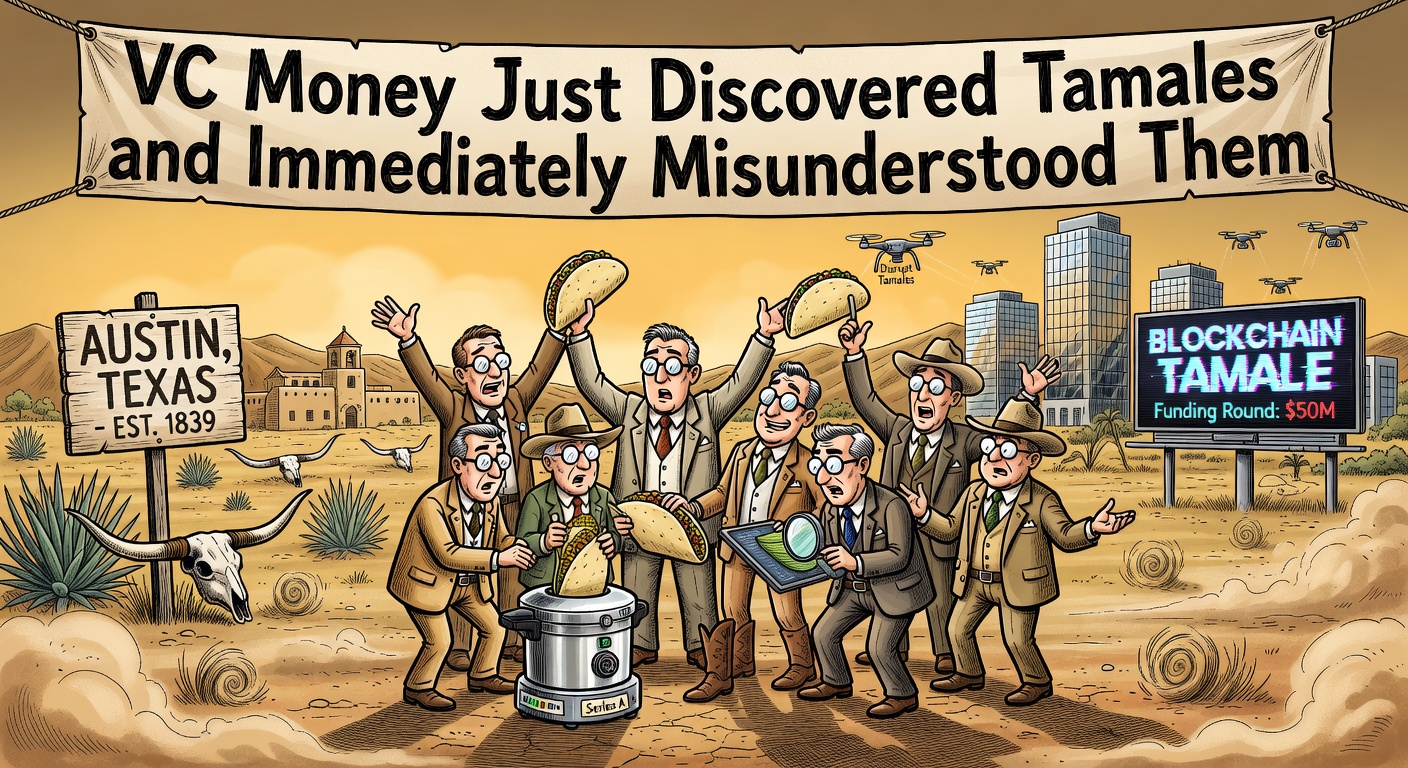
VC Money Just Discovered Tamales and Immediately Misunderstood Them
Bumped into a Series A chaser at the new "elevated street food" stall who was busy explaining how his app could "streamline" the cash-only tamale ecosystem; the woman whose recipes he's trying to tokenize has been selling them from a folding table since before he was born and still refuses Venmo.
The guy was holding court by the condiment station like it was a pitch meeting. "It's not just food delivery," he said, stabbing a plastic fork into the air for emphasis. "It's cultural infrastructure." His avocado-lime crema dripped onto a shoe that cost more than my first car.
This was at the repurposed warehouse on East Sixth that used to be a loading dock for actual trucks. Now it's twelve micro-stalls arranged in a perfect Instagram grid, each one "curating" something that used to come from a cooler in a parking lot. The price for three tamales had somehow reached $13 before tax. He paid with a black card and didn't even blink.
His name is Braden Holt. Moved to Austin in late 2022 after "falling in love with the energy" during a bachelor party that involved too many rooftop bars on Rainey. By day three he'd decided the city needed him. Specifically, the tamale ladies needed him. Or rather, his platform did.
I know the type. They show up in Allbirds that have never touched dirt, carrying Yeti tumblers full of something called "mushroom coffee," and within six months they're experts on whatever local thing they plan to optimize into oblivion. For Braden it's the abuela network. The women who have been making tamales in their kitchens in Northeast Austin and South Austin since the '80s, selling them after dark outside bars that let out at 2 a.m. Cash only. No apps. No ratings. Just a price, a dozen in foil, and the kind of reliability that doesn't need a five-star review.
Braden sees friction. I see a system that worked perfectly for decades.
He pitched the whole thing to me without being asked, the way these guys do. The app would connect "legacy producers" (his term) with "culturally curious consumers" (also his term). GPS-enabled coolers. Real-time masa freshness scores. Dynamic pricing based on demand. The ladies could "scale" by hiring helpers and expanding into branded packaging. Investors were already circling. He'd assembled something called a "tamale advisory board" that appeared to consist of exactly zero actual tamale makers and three white guys from Stanford.
The advisory board gets equity, of course.
I asked what the ladies thought of his plan. He gave me the smile you'd give a confused grandparent. "We're still in the education phase. A lot of them aren't digitally native." Translation: they took one look at his deck and went back to stirring the pot the way their mothers taught them. One woman on the east side has reportedly told him to "go sell your little phone game somewhere else" in Spanish that somehow lost its poetry in his retelling.
The sensory details are what get me. Real tamales smell like corn husks and patience. They come wrapped in the same foil they've used since the Clinton administration. The good ones have a little char from the steamer and a faint taste of the cook's kitchen—maybe some chile de arbol still lingering on the cook's fingers. Braden's version of this experience involves a QR code on the cooler, a $2.99 "platform convenience fee," and a push notification that says "Your heritage is ready!"
The warehouse space itself used to be nothing. Just an empty lot where the tamale truck from Tamale House would sometimes park during South by Southwest before the festival became the corporate trade show it is now. You'd wait in line with sound guys and off-duty bartenders. Ten bucks got you a dozen pork and enough conversation to last the walk back to your car. The new building smells like venture capital and eucalyptus floor cleaner. The Christmas lights they strung up aren't the same.
Braden showed me the pitch deck on his phone. Slide seven features a stock photo of an older Latina woman smiling over a pot. I recognize the type. She's probably someone's actual abuela, but not his. The text overlay reads "From Kitchen Table to Marketplace in Three Taps." The slide after that has revenue projections that would make a cartel accountant blush.
What kills me is the selective reverence. These guys move here and fall all over themselves about "authentic Austin" while simultaneously trying to productize the parts that made it authentic. The food truck scene that gave us Veracruz, the taco stands that operated on a handshake and a Styrofoam plate, the women who could tell you which bar had the best crowd that night based on how many dozens they sold. None of that needed optimizing. It needed parking.
I remember buying tamales in 2008 outside the old Liberty Bar on South Congress, back when that stretch still had more pawn shops than boutique hotels. The lady worked out of a minivan with the side door slid open. Inside: one massive steamer, a cooler of Jarritos, and a handwritten sign that just said "TAMALES $10 DOZ." She had a little radio playing Tejano music. The transaction took forty-five seconds. No login required.
Braden's app would require her to incorporate as an LLC, upload health permits, integrate with Stripe, and maintain a 4.8 average or risk being delisted. All so some tech worker in Mueller can get midnight tamales without having to make eye contact with another human.
The worst part? Some version of this will probably get funded. There's always money for people who want to insert themselves between existing systems and skim. The tamale ladies will mostly ignore it, the way they ignored the first wave of food delivery apps and the second wave and the third. They'll keep their folding tables and their handwritten signs and their 2 a.m. circuits of the bars that still let working musicians drink for free.
Braden will either get acquired or run out of runway. Either way he'll write a Medium post about how Austin "wasn't ready" for his vision. Then he'll move to Denver and discover the breakfast burrito.
The foil-wrapped dozen I bought anyway tasted exactly like they always have. No algorithm touched them. The woman who made them told me her grandson is starting community college in the fall. She didn't mention any advisory boards.
Some things in this town still know how to stay unscaled.