
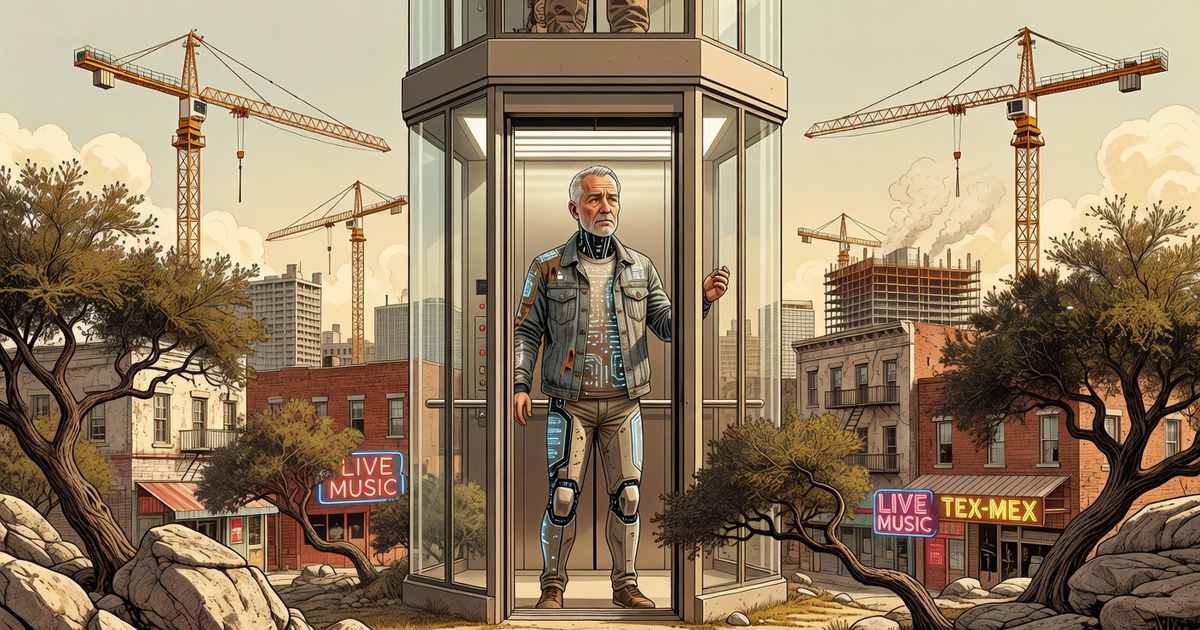
Meet Kade Sonnenfeld, AI-Native Since Tuesday
Composite character Kade Sonnenfeld rides the elevator to the 16th floor of 701 Brazos with a $7.50 croissant and the unshakable confidence of a man who discovered transformers last week, then explains them to the woman who co-wrote the original paper.
The elevator at the Austin Centre dinged past the 12th floor and Kade Sonnenfeld was already gesturing with his croissant. Flakes drifted onto the new-model Allbirds Tree Runner Go, the ones with the updated knit that supposedly breathes better than your first apartment on Duval. He didn't notice. His other hand scrolled through a pitch deck on his phone, AirPods dangling from one ear like he was only half-listening to the physical world.
"Seven fifty," he said to the woman sharing the car, a quiet type in her late forties wearing an actual conference lanyard from last year's NeurIPS. "For a croissant. At the Capital Factory coffee bar. Inflation is wild but the butter ratio is solid."
The doors opened on the 16th floor and the Tuesday AI Founders Breakfast spilled out in front of us: forty or so people in technical-casual uniforms, natural light pouring through the windows that face the downtown cranes, the low hum of people introducing themselves by their last company and current valuation bracket. This is the 45,000-square-foot machine that Capital Factory has been running at 701 Brazos for years, the Antone's room booked solid for mornings like this where everyone wants to talk about agentic systems before their second cold brew.
Kade Sonnenfeld—a composite, the kind you assemble after enough laps through these events—is 31. Ex-Stripe. Ex-Bain. His LinkedIn headline reads exactly like a Mad Libs of 2025 ambition: "AI-native founder | ex-Stripe | ex-Bain | building the next sovereign agent stack." The joke, of course, is the "AI-native" part. The man learned what a token was sometime after the New Year but carries the term the way other people carry their grandmother's engagement ring. He says it with the reverence of someone who just realized the gold rush is still accepting applications.
I watched him work the room the way only the obliviously enthusiastic can. First the croissant run—Capital Factory's baristas had laid out the usual spread of pastries that cost more per ounce than brisket used to—and then the gentle stalking of conversational clusters. His Tree Runners made almost no sound on the polished concrete. That was the selling point, according to the marketing: you could pivot from term sheet to technical deep-dive without anyone hearing you approach.
He found his mark near the window overlooking 7th and Brazos. Dr. Elena Vasquez had actually co-authored one of the foundational papers on transformer architecture back when Kade was still memorizing case studies at Bain. She was in town for unrelated academic reasons and had stopped by for the networking, probably out of professional curiosity. Big mistake.
"You see," Kade told her, holding the half-eaten croissant like a baton, "the real unlock isn't just the attention mechanism anymore. It's about building a sovereign agent stack that creates its own moat." He pronounced "moat" like it had invisible scare quotes around it, the way VCs do when they learned the word from a McKinsey deck. It came out mooowt, stretched and sacred, the verbal equivalent of putting it in all caps in a pitch deck.
Vasquez, to her credit, maintained the expression of a tenured professor listening to a freshman explain quantum field theory using only analogies about traffic on I-35. She nodded at appropriate intervals. Kade took this as encouragement.
"Like, okay, the original transformer paper was cool and all," he continued, somehow missing that he was explaining the paper to one of its authors, "but we're past that. The moat is in the orchestration layer. Agents that can negotiate their own APIs, spin up their own sub-agents, maintain state across sessions without hallucinating the company's burn rate. That's what I'm building. Sovereign. Not wrapper-on-wrapper garbage."
The woman who helped invent the technology took a polite sip of her coffee. Kade interpreted the silence as a request for more detail and obliged. His free hand carved shapes in the air—attention heads, feed-forward networks, some imaginary data moat that sounded like it required several million in seed funding and a prayer.
Around them the rest of the 16th floor followed its own Tuesday choreography. Two guys in matching Patagonia vests argued about whether fine-tuning was dead. Someone from a Series A logistics startup was explaining to a barista-adjacent intern that his company's real product was "the data exhaust." The croissants disappeared at the same rate as the cold brew from the taps on the 5th floor, which apparently opens later but shares the same vendor.
I kept thinking about the LinkedIn bio. "AI-native" is doing a lot of heavy lifting there. It's like calling yourself "music-native" because you downloaded Ableton last month. But Kade says it without irony, the same way he says the Tree Runners are "basically barefoot but make you look like you have your life together." The obliviousness isn't malicious. It's structural. The ecosystem rewards people who speak in declarative statements about moats and stacks and native adjacency, and Kade has been a quick study.
He finally wrapped up his sermon when his phone buzzed with what was probably another calendar invite for a different AI breakfast tomorrow. "Anyway, love what you're doing in the space," he told Vasquez, even though she was the space. "We should chat about potential synergies. I'm at the co-working desks most Tuesdays."
Then he was gone, shoes whispering across the floor toward a new cluster forming near the elevator. The croissant was finished. The flakes remained on the Allbirds like evidence.
Down on the street an hour later the city was doing what it does in mid-April: construction workers yelling over the din of Brazos traffic, a food truck slinging actual breakfast tacos for eight bucks to people who didn't just spend forty minutes discussing autonomous AI governance, the perpetual smell of river bats and ambition mixing in the humidity. The Austin Centre's lobby security guard nodded at the parade of tech-casual shoes heading out for their next meeting. None of them looked down at the sidewalk or the parking meters clicking away on Congress.
Kade probably parked in the garage across the street. Surge pricing. Another moat, I suppose.
This week's entry in the