Shaved Ice Index, Third Quarter, Seasonally Unadjusted
I built a price index for frozen syrup, from a 75-cent church-lot snow cone to a shaved-ice tasting menu with a five-dollar reservation hold. The brain freeze is the only component that hasn't been repriced.
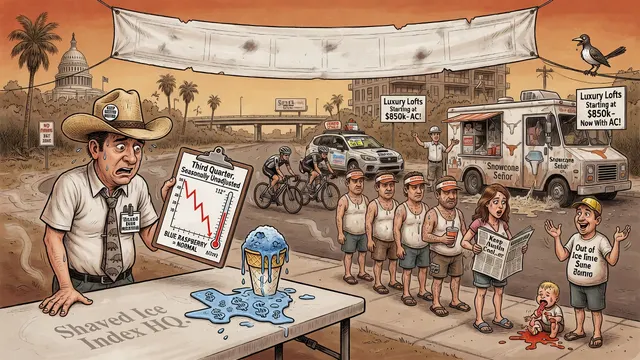
My phone buzzed at 3:41 in the afternoon with a text: Your table for shaved ice is ready. Please check in with the host within 10 minutes or your spot will be released.
I had been standing on the sidewalk for forty minutes. In August. Waiting to be seated for ice.
This is how the statistical work began. The federal government will happily tell you what a gallon of milk costs, and it has opinions about eggs. Nobody in a position of authority is tracking the most important commodity in Central Texas between June and October: frozen water with sugar on it. So I am doing it myself, from a lawn chair, with a spiral notebook and a sticky thumb.
What follows is the first official release of the Austin Shaved Ice Price Index. It is seasonally unadjusted, because there is only one season here and it is the hot one.
Methodology
The index tracks one standard unit: a medium cup of shaved or crushed ice with one flavor of syrup, purchased in Austin and eaten before it turns into a warm puddle. That sets an upper limit of about six minutes on any data point.
Base period is the summer of 1987. Base value is 100. All the vendors here are composites built from memory, ice-induced headaches, and the general feel of a cup going soft in your hand. Nobody below is a real business. If one sounds familiar, that's because every neighborhood had one.
Base Period: The Trailer on the Corner
The 1987 benchmark stand sat in a church parking lot off Manor Road. It was a white trailer with a hand-painted sign. One of the letters in SNO had been repainted in a slightly different blue, and that gave it authority. A generator hummed behind it. Wasps worked the syrup bottles like they were salaried.
A medium cost seventy-five cents. A large cost a dollar. For another quarter you got "the works," which meant the lady put condensed milk on top without making a face about it.
The flavor board had about thirty options, and maybe eleven of them tasted different from each other. Tiger's Blood. Pink Lemonade. Wedding Cake, which tasted like a candle smelled. Blue Coconut, which was not blue in any way coconuts are. And the rainbow, which was every bottle she could reach poured on in stripes until the bottom of the cup turned into a single brown flavor called Regret.
There was no menu description. There was no origin story. The ice came out of a machine that sounded like a garbage disposal eating a fork, and you ate it on the curb while your little brother cried because his fell over.
Index value: 100.
1999: Minor Inflationary Pressure
By the end of the decade, the benchmark had moved to a trailer in a gas station lot on East Riverside. A medium was a dollar fifty. That's double, but you have to account for the new product innovation of a straw-spoon. It was a straw with a little shovel on the end. It worked as neither a straw nor a spoon, but it was a single object, and America loved that.
The pickle juice option appeared here too. I want it on the record that the index treats pickle juice as a quality improvement and not inflation.
Index value: 200.
2012: The Food Truck Correction
Then the food truck years arrived and repainted everything matte black.
The 2012 benchmark was a truck on South First with a chalkboard menu and a logo of a snowflake wearing sunglasses. A medium was four dollars. The syrups were "house-made," which meant someone had bought a bigger pot. One flavor was called Hibiscus Hustle. You could add chamoy and Tajín, which, fine. Those had been on the East Side for decades before anyone wrote them on a chalkboard in cursive. This is where the index first measures the Lettering Premium, a surcharge that tracks how fancy the handwriting is.
The truck was still parked in a gravel lot. There was still a generator. The wasps were still there and still not paid.
The truck also had an Instagram, and that changes the economics of a snow cone.
Index value: 533.
2026: The Concept
We now return to the sidewalk, the text message, and the host.
The current benchmark is not called a snow-cone stand. It's called a "shaved ice concept," and it sits on the ground floor of a mixed-use building near a stretch of East Cesar Chavez where I used to buy tamales out of a cooler. The space has polished concrete floors and a single potted olive tree that looks as nervous as I feel. It was 104 outside, and the line was managed by a host with a tablet.
To join the waitlist, you put down a five-dollar "reservation hold." It gets credited toward your order, much the way a hostage fee gets credited toward the hostage.
The menu has one page and three sections: Foundations, Expressions, and Seasonal. A Foundation, which is ice and one syrup, costs eleven dollars. An Expression costs sixteen. It's ice "layered" with things like yuzu curd, toasted rice milk, and something called "Hill Country stone fruit gel." As far as I can tell, that's a peach that went to grad school. The Seasonal was nineteen dollars. It was described as "a meditation on Texas summer." The irony meter on my wrist went off on its own.
Before we ordered, the server explained the ice. The ice has a block-shaving process. The ice has a temperature at which it is "most expressive." The ice, I was told with real sincerity, is "never crushed."
The trailer lady used to crush ice like it owed her money. I miss that energy.
I ordered a Foundation in a flavor called Lychee Petal and paid with the hold, plus tax, plus a suggested tip screen. Its lowest option was twenty percent, for a service that had involved being handed a bowl. Total out the door: $14.38. The cup was beautiful. Inside, the ice was fluffy and pale and dusted with something pink. I got eleven bites before it collapsed. That works out to about $1.31 per bite. In 1987 terms, that's most of a large with the works, per spoonful.
Index value: 1,917.
Component Analysis
The obvious question is where the money goes. My analysis says the ice itself is not to blame. Water is still mostly water, even here, though I'd like to see the utility department try harder.
The increase breaks down roughly as follows:
- Rent. The ground floor of a building with an olive tree is not a church parking lot. Somebody owns that concrete, and somebody's lender wants a word.
- Language. Every word on the menu costs money. "Expression" alone is worth about three dollars. "Meditation" adds four.
- The tablet. Someone had to make a waitlist app for frozen water, and that someone has investors.
- Seating. The trailer offered a curb. The concept offers a curb-shaped bench that cost more than my first car.
- Wasp displacement. The wasps have been priced out. I've been told they're living in Hutto now.
The Trailers Are Still Out There
Before anyone writes in, here's the part the index can't fully capture: the trailers didn't disappear. They moved. They're in strip-center lots off Rundberg and down by Dessau. There's one beside a tire shop out past 183, and one runs out of a converted horse trailer near a laundromat in Dove Springs. A medium at most of them runs three to five dollars. They still have thirty flavors, eleven distinct tastes, and condensed milk poured on without a speech.
Those vendors are paying commercial rent now too, plus permit fees and higher sugar prices, while some city process somewhere bills them for generators. They're absorbing all the same pressures as the concept, and they still hand you the cup without asking you to meditate on anything. If there's a hero in this data, it's them. Go tip the trailers.
Outlook
The index is projected to keep rising through the fourth quarter. A second concept is reportedly "in development." I have no information on that except a feeling in my molars.
I'll end with the only line item that has stayed flat since the base period, across every vendor, at every price point, from the church lot to the olive tree.
The brain freeze is still free, and nobody's found a way to charge for it.
Yet.
Keep reading Things That Used to Cost $3
A Letter to the Bats Under Congress Avenue, Who Are Leaving Without Paying for Anything
Before the free-tailed bats head south for the winter, I wrote to thank them for staying free in a city that now sells tickets to the sky. Please do not tell the rooftop bars where you're going.
5 min read
You Are Number 47. Reply 1 to Confirm You Are Still Hungry.
A Sunday scene report from a South First brunch waitlist, where migas cost $23, coffee refills have been discontinued, and the app texts you more often than your family does.
5 min read
Admission to the Yard Sale Is Fifteen Dollars
I paid a cover charge to enter a parking-lot vintage market off Manor Road, where a Pyrex dish costs $68 and a 2009 fast-food cup is labeled archival.
5 min read
Follow the Grouch
Email subscriptions are unavailable. Follow new complaints in your RSS reader instead. We do not collect an email address here.
Open the RSS feedAdd this feed’s address to your reader. Opening the link does not subscribe you automatically.