Admission to the Yard Sale Is Fifteen Dollars
I paid a cover charge to enter a parking-lot vintage market off Manor Road, where a Pyrex dish costs $68 and a 2009 fast-food cup is labeled archival.
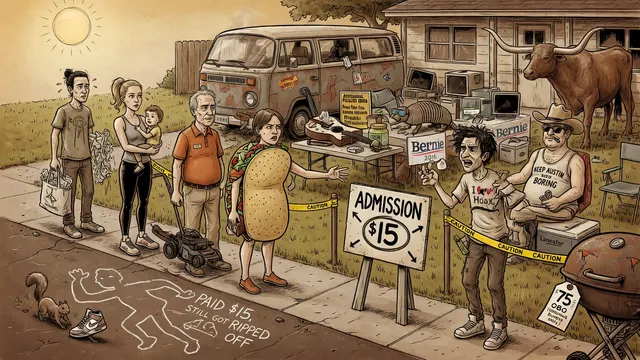
The wristband was neon green, the kind they put on you at a water park so the lifeguard knows you paid. The young woman at the folding table snapped it on my wrist, scanned a QR code off my phone, and said, "Welcome to the Collective. Early access ended at ten, so some of the best pieces are spoken for."
It was 10:40 on a Sunday morning. I had paid fifteen dollars to walk into a yard sale.
They don't call it that, obviously. The banner strung between two light poles said PORCHLIGHT VINTAGE COLLECTIVE: A CURATED MAKERS & FINDERS MARKET, in a font that looked like it had been hand-lettered by a computer pretending to be a sign painter. The venue was the cracked parking lot of a former tire shop off Manor Road, a place that until recently smelled like rubber and Armor All. Now it smelled like cold brew and the inside of a cedar chest.
"Early access" was thirty-five dollars. I want that number on the record.
How it worked before
You found a yard sale in this town by driving around Crestview or Allandale on a Saturday morning with the windows down. The signal was a piece of orange posterboard stapled to a telephone pole at an angle that suggested haste, with the word SALE and an arrow drawn in Sharpie by someone who had clearly run out of Sharpie halfway through the arrow. Sometimes there were three signs with three arrows pointing three directions, and you followed them anyway, because that was the game.
Admission was free. Parking was wherever your tires stopped. The early-access tier was a man named something like Don who showed up at 6:45 a.m. while the family was still dragging the card table out of the garage, and he was not charged a premium for this. He was charged dirty looks, and he paid them gladly.
Paperbacks were a quarter. A lamp was a dollar, two if it worked, and the seller would plug it into an orange extension cord running out the front door to prove it. A box of mismatched coffee mugs went for three dollars, and by noon the box was free and somebody's dad was carrying it to your car whether you wanted it or not. That is what we mean, in this column, by "three dollars." Not a price so much as a social contract: I don't want this anymore, you might, let's not make it weird.
How it works now
Inside the Collective there were forty-some booths under matching white pop-up tents, arranged in a grid so tidy it looked like a refugee camp for throw pillows. A DJ in a bucket hat was playing something with a lot of saxophone. There was a mezcal sponsor. There was a sign, and I copied it down word for word, that said Please Do Not Haggle With Our Makers — Pricing Reflects Labor, Sourcing & Story.
Story. The coffee mugs have a story now. The story is that they cost forty dollars.
The first booth I stopped at had a Pyrex casserole dish in the Butterprint pattern, the turquoise one with the little Amish couple and the rooster, the exact dish every grandmother in Central Texas brought King Ranch chicken over in. Price tag: $68. Lid sold separately. I asked the vendor, a pleasant guy with a waxed mustache and a laminated booth-fee receipt clipped to his tent, whether he'd take fifty.
"I'd love to," he said, very sincerely. "But my booth was two-seventy-five, plus the Collective takes twelve percent of card sales, plus I had to buy the white tent because they require the white tent."
So that's who I'm mad at. Not him. He's a guy who drives to estate sales in Taylor and Lockhart, cleans the stuff, and then pays a landlord, a promoter and a tent-color policy for the right to sell it back to us. The yard sale did not get more expensive. The yard got more expensive. Somebody figured out you could charge rent on the ground under the card table, and then charge cover on the people walking past it.
A short inventory of what was for sale
I walked the whole grid. Highlights, with prices as tagged:
- A 2014 Austin half-marathon finisher shirt, soft and slightly yellowed under the arms, labeled "Y2K-Era Athletic Tee" for $45. The year 2014 is not Y2K. I lived through Y2K. I had a bathtub full of water and a radio.
- A stack of old Chronicle issues, each in a plastic sleeve, $12 apiece. These were free. They were free when they came out. They were free in a box on the corner, and you could take nine of them to line a birdcage and no one would stop you.
- A plastic Whataburger cup from roughly 2009, the big one, displayed upright on a velvet riser beside a card reading ARCHIVAL. Twenty-two dollars. I stood in front of it longer than I have stood in front of some paintings.
- A "curated bundle" of five paperbacks tied with twine, $30, spines facing inward so you couldn't see the titles. You were buying a mystery. Mostly you were buying twine.
- A box fan. A regular box fan, Lasko, beige, the one that's in every rent house window from Hyde Park to Dove Springs in August. It was not for sale. It was cooling the vendor. This was the most honest object in the lot.
The single one-sentence fact that ruined my morning: the mismatched coffee mugs, the box of them, were being sold individually under a sign reading Each One Chose You.
The part where I almost liked it
I'll be fair, which I hate. There was a booth near the back run by a woman selling old Texas road maps, the gas-station kind, folded wrong in the way only a 1970s father could fold them. She had them in a milk crate. They were five dollars. She hadn't put them in sleeves. When I asked about one with the old routes around Bastrop she spent ten minutes telling me where her uncle used to stop for brisket, and she did not once use the word "story," which is how I knew it was one.
I bought two. She threw in a third for nothing because the corner was torn. It was the closest thing to a yard sale on the whole property, and she'd been put in the far corner next to the porta-potties, which I assume is where the Collective seats anyone whose pricing does not reflect enough labor.
Exit through the merch
On the way out there was a table selling Porchlight Vintage Collective tote bags for $28. They were new. They were the only new thing in the place, and they were the thing with the biggest line. People were buying a bag to carry their old things in, from the people who had charged them to look at the old things, to commemorate the day they paid to look.
I kept the wristband on all afternoon out of spite, like I'd been somewhere. My neighbor asked if I'd been at a music festival. I told him I'd been to a garage sale, and he laughed, because he's lived here long enough to know that was a joke, and not long enough to know it wasn't.
Next Saturday he's putting his old recliner on the curb with a sign that says FREE. I told him he's leaving money on the table. Somebody out there would pay forty dollars just to sit in it with a wristband on.
Keep reading Things That Used to Cost $3
A Letter to the Bats Under Congress Avenue, Who Are Leaving Without Paying for Anything
Before the free-tailed bats head south for the winter, I wrote to thank them for staying free in a city that now sells tickets to the sky. Please do not tell the rooftop bars where you're going.
5 min read
You Are Number 47. Reply 1 to Confirm You Are Still Hungry.
A Sunday scene report from a South First brunch waitlist, where migas cost $23, coffee refills have been discontinued, and the app texts you more often than your family does.
5 min read
Worth a Special Journey, If You Have Exact Change
Michelin gave first stars to a French-Japanese spot and a vegan restaurant, bringing Austin to seven. I went undercover to inspect the cheapest dinner in town, then and now. My expense account is a Big Red.
5 min read
Follow the Grouch
Email subscriptions are unavailable. Follow new complaints in your RSS reader instead. We do not collect an email address here.
Open the RSS feedAdd this feed’s address to your reader. Opening the link does not subscribe you automatically.