Seasonally Adjusted Potato and Egg
I built a thirty-year breakfast-taco price index with proper methodology: base year, hedonic adjustment, substitution bias. The economics are sound. The tortilla is not.
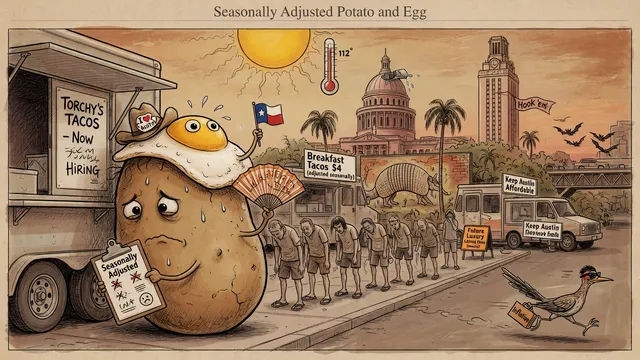
The iPad swiveled toward me before the foil was even folded. Six dollars and seventy-five cents for one potato, egg and cheese, and the screen wanted to know whether I'd like to add 18, 22 or 25 percent, or enter a custom amount, or perhaps simply weep in the parking lot like a person with options.
I tipped, because the kid behind the window did not set the rent on that window. Then I drove home and did what any reasonable man does after a breakfast taco costs more than his first car insurance payment: I built a price index.
Economists have the Consumer Price Index. I have thirty years of pocket change, a decent memory and a filing system that is mostly glovebox. What follows is the official methodology for the Potato and Egg Index, or PEI, which I am confident will be adopted by the Federal Reserve as soon as somebody there gets hungry on a Sunday.
Base Year
Every index needs a base year, a fixed point where the number equals 100 and everybody felt fine.
Mine is 1996. A trailer on an East Austin side street, generator droning like a lawnmower in another dimension, a hand-lettered sign with the prices painted directly on plywood, which tells you everything about how often anyone expected them to change. Potato and egg: ninety-nine cents. Bacon, egg and cheese: a dollar and a quarter, which felt decadent, like ordering dessert.
You paid in cash. The cash went into a cigar box. If you were short a dime, the woman at the window waved you off and said you'd get her next time, and you did, because the system ran on the assumption that you would come back tomorrow. You always came back tomorrow.
PEI, 1996: 100.
The Basket
A proper index tracks a fixed basket of goods. My basket is two tacos, red salsa, a coffee and whatever napkins were within arm's reach.
In 1996 that basket ran about $3.25 with the coffee. Hold that number in your mind the way you'd hold a photo of a dog that has since gone to live on a farm.
By 2006 the same basket, from a different trailer near Manor Road because the first one had been asked to relocate by a landlord with a vision, ran about five bucks. The tacos were $1.75 apiece. Salsa still free. Coffee still came in a styrofoam cup that would outlive us all. PEI, 2006: roughly 175, which annoyed me at the time and now looks like a typo in my favor.
By 2016 the basket was nine dollars and the trailer had a logo. Not a sign. A logo. Somebody had been paid to make the egg in the illustration wink.
This morning the basket came to $17.40 before the tip screen got involved. PEI, 2026: north of 680.
That is not inflation. That is a breakfast taco attending graduate school.
Hedonic Adjustment
Here is where real economists get clever. When a product improves, they discount part of the price increase, on the theory that you're paying for quality, not just paying more. A laptop that costs the same but runs twice as fast is, technically, cheaper.
So I applied hedonic adjustment in good faith.
The tortilla is now "house-pressed," which is a quality improvement, except that it is roughly the thickness of a dry-cleaning receipt and gives up structurally around the second bite, sending potato into my lap like a dump truck taking a corner too fast. Deduct.
The eggs are now "pasture-raised," which I believe, and which is genuinely better, and which I'm told explains some of the increase, especially after the egg-price spike that hit everybody a while back when the birds got sick. Fair. Add a point back. I am a reasonable index.
The salsa used to sit in a squeeze bottle the color of a stop sign and burned like a minor legal dispute. It is now part of a "salsa program." There are four of them. They arrive in two-ounce ramekins. One has mango in it. The fourth one, the actually hot one, costs seventy-five cents extra, so the quality of the salsa has gone up and the quantity of salsa you can obtain without negotiating has gone down. Net hedonic adjustment: a wash, but a wash with mango in it.
Potatoes are now "crispy smashed fingerlings." In 1996 they were cubes that had been sitting in a hotel pan since dawn developing a personality. I preferred the personality.
Substitution Bias
Economists warn that when prices go up, consumers switch to cheaper goods, so a fixed basket overstates how much worse things really are. Fine. I tested this.
I substituted the gas station. There's one off Airport Boulevard with a warmer case by the register, tacos wrapped in foil and labeled in Sharpie, and for a brief, shining stretch they were the last two-dollar taco in my orbit. This year they are $3.49, and the Sharpie has been replaced by a printed sticker with a QR code, which I scanned out of spite and which took me to a page asking me to rate my experience.
I substituted home cooking. I bought a dozen eggs, a bag of tortillas, potatoes, cheese, and a jar of salsa I will be ashamed of until it expires. Total: about twenty dollars, plus the forty minutes, plus the pan, plus my wife pointing out that I'd just reinvented a breakfast taco at a per-unit cost that was somehow still north of three bucks, with no generator noise and no one to say good morning to.
Substitution bias is real. It just isn't cheaper. It's lonelier.
Core vs. Headline
The Fed likes to strip out volatile items like food and energy to see the "core" rate. I have done the same, stripping out the taco itself.
What's left in 2026 is the core: a $1.25 "service fee" for paying with a card, the tip screen, a branded paper sleeve, a loyalty app that wants my birthday, and a line that in 1996 was two roofers and a guy in a Longhorns cap, and is now eleven people holding their phones up to photograph something wrapped in foil, which, I want to stress, looks exactly the same as foil did in 1996.
The core rate, in other words, is up even more than the headline rate. You are paying more for the parts of breakfast that are not breakfast.
Where the Money Went
I asked around, the way you can when you've stood at enough windows. The answer is the answer it always is. The rent on the lot tripled. The lot sold. The new owner's lawyer sent a letter. The commissary kitchen went up. The permit went up. Everybody who actually touches a tortilla is getting about the same deal they always got, and everybody who touches a lease is getting a better one every single year.
That's the part the index can't show. The taco didn't get greedy. The dirt under the trailer did.
Findings
The Potato and Egg Index rose about 580 percent over thirty years. Over the same stretch, wages for most of the people in that line went up, sure, though nobody I know got a raise that came with mango salsa.
My official recommendation to the Federal Reserve is to raise interest rates until the tortillas get thick again.
My unofficial recommendation is to find the last trailer in your part of town that still has prices painted on plywood, go tomorrow, and go the day after that. A sign is only permanent as long as somebody keeps showing up to read it.
Bring cash. The iPad can't swivel at a cigar box.
Keep reading Things That Used to Cost $3
A Letter to the Bats Under Congress Avenue, Who Are Leaving Without Paying for Anything
Before the free-tailed bats head south for the winter, I wrote to thank them for staying free in a city that now sells tickets to the sky. Please do not tell the rooftop bars where you're going.
5 min read
You Are Number 47. Reply 1 to Confirm You Are Still Hungry.
A Sunday scene report from a South First brunch waitlist, where migas cost $23, coffee refills have been discontinued, and the app texts you more often than your family does.
5 min read
Admission to the Yard Sale Is Fifteen Dollars
I paid a cover charge to enter a parking-lot vintage market off Manor Road, where a Pyrex dish costs $68 and a 2009 fast-food cup is labeled archival.
5 min read
Follow the Grouch
Email subscriptions are unavailable. Follow new complaints in your RSS reader instead. We do not collect an email address here.
Open the RSS feedAdd this feed’s address to your reader. Opening the link does not subscribe you automatically.