
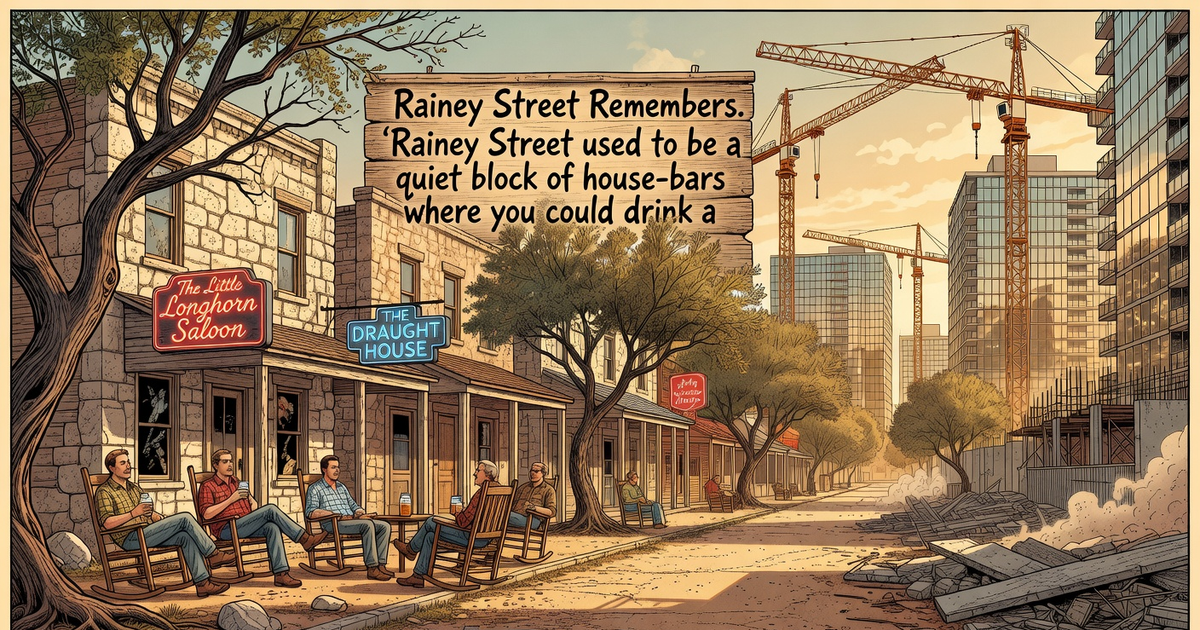
Rainey Street Remembers
Rainey Street used to be a quiet block of house-bars where you could drink a Lone Star on a porch. Now the porches are in the shadows of 40-story towers.
"Rainey Street didn't gentrify. It got swallowed whole and the towers didn't even burp."
If you squint — really squint, like you're three
For about six years, it was perfect.
Not "Austin City Limits taping" perfect. Not "curated experience" perfect. Rainey Street perfect, which meant: Christmas lights stapled to a porch railing, a dog asleep under your bar stool, a guy in a lawn chair selling tamales out of a cooler, and absolutely zero concern about a dress code. You could walk from Lustre Pearl to Craft Pride to Half Step and never once feel like you were in a place that had been designed.
That was the whole point. And that, of course, is exactly what killed it.
The Canyon
Stand on Rainey Street today and look up. Go ahead. Tilt your head back until your neck hurts. That's the new Rainey Street: a wind tunnel of residential towers that blot out the sun by 3 PM and fill the sidewalks with people who moved to Austin in 2021 and think this is what it always looked like.
The towers have names like "The Independent" and "Vesper" and "Natiivo," which sound like cologne brands marketed to men who describe themselves as "serial entrepreneurs." They are, architecturally speaking, the equivalent of a reply-all email — loud, unnecessary, and impossible to ignore.
Here's what the towers brought:
- Shadow. Literal shadow. The bungalow bars that survived now sit in permanent twilight, which would be atmospheric if it weren't so on-the-nose
- A population density that turns the one-block street into a physical bottleneck every Friday night, like trying to pour a keg through a cocktail straw
- Rent increases that forced out half the original bars, replaced by concepts with single-word names and $19 cocktails served in vessels that require explanation
The Survivors
Credit where it's due: some of the originals hung on. You can still drink a beer
at a few of the bungalows, still find a porch to sit on, still pretend it's 2013
if you don't look up and don't check your bank account. But the vibe has shifted
from "neighborhood secret" to "theme park version of what Austin nightlife used
to be." It's the
The city rezoned Rainey for high-density residential in 2005, back when "high-density" sounded progressive and forward-thinking instead of what it actually turned out to be, which is a policy decision that trades a neighborhood's soul for property tax revenue. The developers showed up with renderings that included "street-level retail" and "activated green space" — phrases that, in practice, mean a CVS and a patch of sod between parking garage entrances.
"Rainey Street didn't gentrify. It got swallowed whole and the towers didn't even burp."
There's a lesson in Rainey Street, and it's the same one playing out on
Rainey Street remembers what it was. The towers don't care. They never do.