
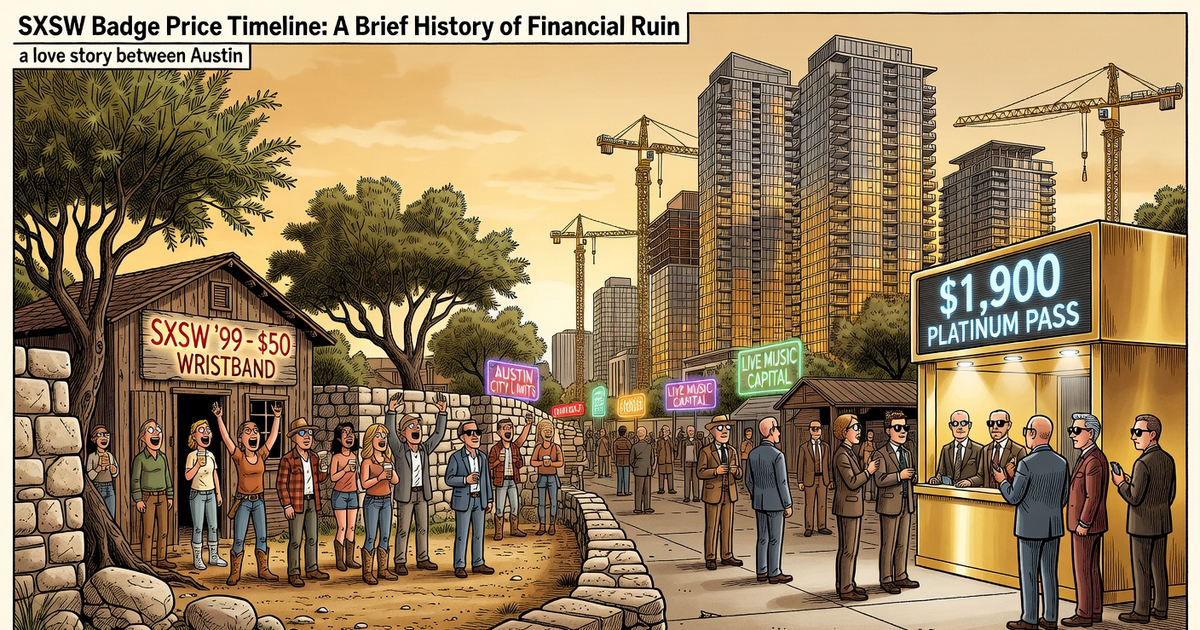
SXSW Badge Price Timeline: A Brief History of Financial Ruin
From $50 wristbands to $1,900 platinum passes — a love story between Austin and your empty wallet.
"In 2002, a SXSW badge cost less than your monthly Wi-Fi bill. Now it costs more than your monthly rent. Adjust for vibes, not inflation."
In 1994, you could walk into a SXSW showcase with $50, a handshake, and the vague promise that your zine would mention the event. In 2026, the Platinum Badge costs $1,899, does not include parking, and the handshake has been replaced by an NFC tap that logs your movement data for "experience optimization." Progress.
Let's trace the arc of this beautiful grift, shall we?
The Golden Era (1987–2001): When Badges Were Suggestions
The original SXSW wristband was a cloth bracelet that cost roughly what you'd
spend on a pitcher of Shiner at
Badge price in 1995: approximately $75. Average Austin rent in 1995: $485. Ratio: survivable.
The Pivot Years (2002–2012): When "Interactive" Got Its Own Badge
This is where things got cute. SXSW realized that tech people had money and feelings about both, so they carved out Interactive as its own vertical with its own badge tier. Suddenly you needed to decide: Are you a Music Person, a Film Person, or a Person Who Says "Disruption" Without Irony?
Three badges meant three price points, which meant one beautiful thing —
artificial scarcity in a city that was 80% parking lots. Speaking of which,
remember when
- 2003 Interactive Badge: ~$450. Got you into panels where bloggers explained blogs to other bloggers.
- 2008 Interactive Badge: ~$750. Twitter launched here. The badge price absorbed the cultural moment like a sponge absorbs spilled Topo Chico.
- 2012 Platinum Badge: ~$1,450. All-access, all-vertical, all-ego. The birth of the "I'm not here for the music" attendee.
The Corporate Singularity (2013–Present): When the Price Became the Point
By 2016, the Platinum Badge crossed $1,600. By 2023, it hit $1,795. The 2026 price sits at $1,899, which is — and I cannot stress this enough — more than a round-trip flight to the actual South by Southwest compass point from Austin.
But here's the trick: the badge price has to be absurd. It's not a bug. It's a velvet rope made of digits. The entire SXSW economy now depends on corporate expensing. Nobody pays for their own badge anymore. If you're paying out of pocket, you are either a hopeless optimist or laundering something. Possibly both.
The real cost isn't the badge. It's what the badge replaced. It replaced the $3
cover at Emo's. It replaced
The Share Line
In 2002, a SXSW badge cost less than your monthly Wi-Fi bill. Now it costs more than your monthly rent. Adjust for vibes, not inflation.
If you want to see how corporate sponsors filled the gap that your wallet
couldn't, check out the