
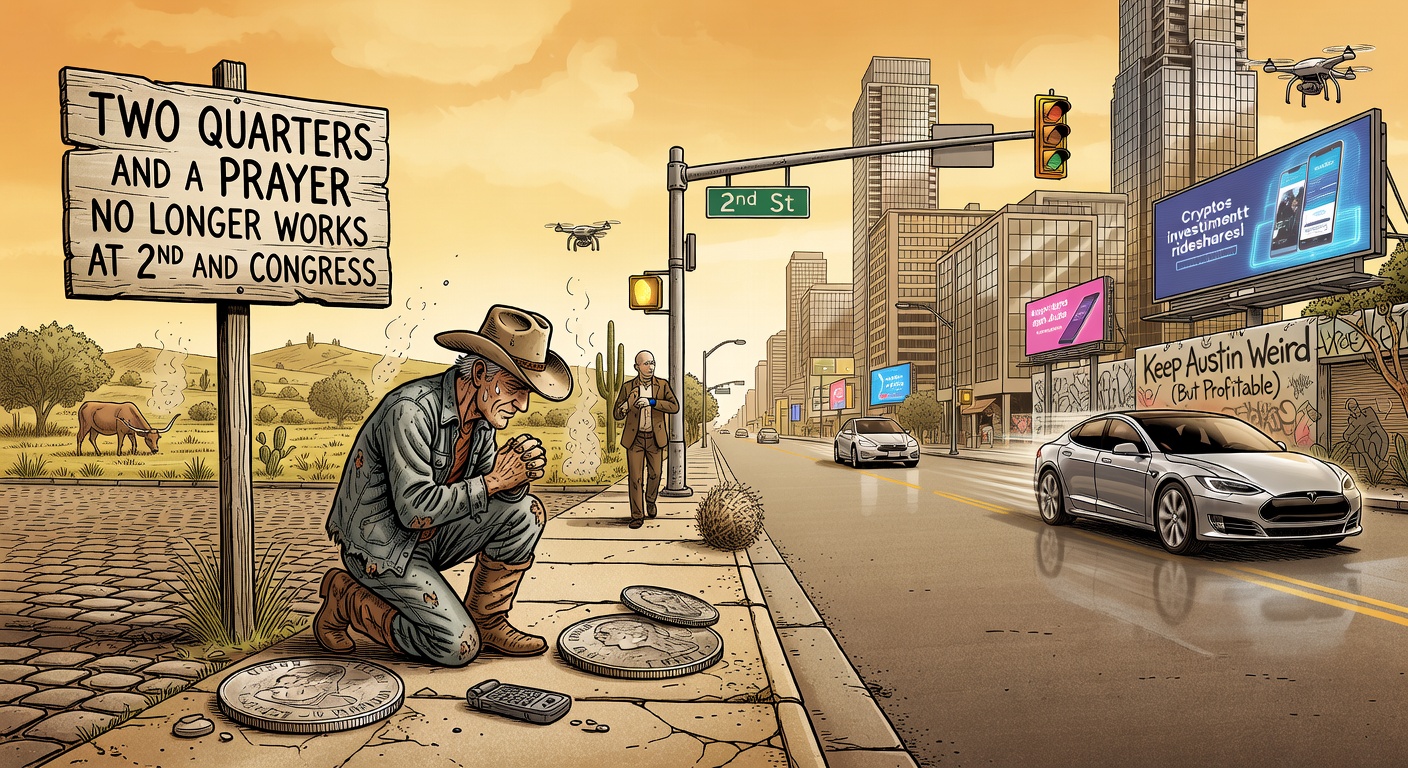
Two Quarters and a Prayer No Longer Works at 2nd and Congress
I fed quarters into the 2nd and Congress meter only to watch them fall through while a QR code demanded I download an app for $4.75 an hour; the same spot in 2007 bought three hours, a Shiner Bock, and enough change left for breakfast tacos.
The quarters hit the tray inside the meter with that familiar hollow clink, then kept falling. No click, no lever, no little red flag popping up to say you'd bought yourself some time. Just a sticker slapped over the coin slot that read "Use the App" in the same font every new tenant uses for their QR menus.
I stood there on the southeast corner, the one where the curb used to crumble just enough that you'd stub your toe if you weren't paying attention, and opened my phone like a man admitting defeat. The sun was doing that April thing where it still feels honest. Traffic on Congress was its usual impatient self. A guy in a Rivian honked at a pedestrian who had the audacity to use the crosswalk. Behind me, the new tower at 2nd and Congress cast its predictable afternoon shadow across the sidewalk where the old barbecue joint used to leave its smoker parked until 3 p.m.
The app wanted my license plate first. Then my credit card. Then it asked if I'd like to create an account so future parking could be "frictionless." I typed in the zone number—somewhere between 312 and 478, the kind of bureaucratic nonsense that makes you long for the days when zones were just "near the Capitol" or "by the river"—and watched the rate appear: $4.75 per hour. Two hours minimum. A little countdown clock started ticking before I'd even hit confirm. The total for what I needed, just long enough to grab a beer and hear a set at the Elephant Room, hit $9.50 before taxes and whatever mystery convenience fee they sneak in.
This used to be the spot where you'd drop seventy-five cents for the afternoon. The meters were honest machines with gears you could almost hear working. Feed them, twist the knob, and you were free to disappear into the city for a while. In 2003 that same meter bought you until 6 p.m. if you got there before noon. Enough time to browse at Waterloo Records on 6th, walk over to the original Whole Foods for a slice of pizza that actually tasted like it came from somewhere specific, then circle back to your truck without checking your phone once.
Now the system knows exactly where you are, how long you've been there, and whether you've ever parked in a "premium event zone" during F1 weekend. The data gets sold, aggregated, and turned into a heat map that tells developers exactly which blocks to price next. The company running half these meters isn't even based in Texas. Their headquarters might be in San Francisco or Seattle for all I know, some glass box where nobody has ever parallel parked in their life.
I finally paid the $9.50. The app sent me a receipt I didn't ask for, a push notification thirty minutes later asking if I'd like to extend my session for another $4.75, and a cheerful suggestion that I "consider going cashless next time." I was three blocks away by then, eating a breakfast taco from the truck that used to park behind the old post office before that lot became a twenty-story glass stack called The Independent with retail space no local retailer can afford. The taco cost $4.25. The parking for the time it took to eat it cost more.
The surface lot behind the old Woolworth's building used to be five bucks all day if you got there before nine. The attendant was a guy named Mike who kept a coffee can for exact change and would let you slide if you were a buck short. He'd remember your truck, ask about your dog, and tell you the band playing at the Hole in the Wall that night was worth the cover. Now that address is a mixed-use development with underground parking that charges $18 if you leave before 10 p.m. and $29 if you stay for a show. The signage is all sans-serif and backlit. It looks expensive even when it's empty. The smell of concrete and old oil has been replaced by whatever chemical lavender scent they pump through the elevators.
My friend Danny still refuses to update his parking app. He drives around for twenty minutes looking for the last remaining coin meters like some kind of urban wildlife photographer. Last month he found one on 3rd Street that still worked, dropped in four dimes and a nickel he'd been saving, and came back to a $35 ticket anyway. The citation said the meter was decommissioned and any payment made after decommissioning would be treated as a donation to the city's mobility fund. He actually laughed when he told me. The laugh of a man who knows the joke's on all of us and has decided to keep showing up anyway.
The new meters don't even look like meters anymore. They're these slim gray totems with solar panels on top, collecting more data than the census. One of them near the Paramount started talking to me the other week. Not kidding. A cheerful recorded voice suggested I "consider the eco-friendly benefits of the nearby bike-share station." I was standing next to a twenty-year-old F-150 with actual dirt from a ranch in Dripping Springs still caked on the running boards. The contrast felt like a personal attack.
What gets me isn't even the money, though Lord knows $9.50 for two hours would have covered a decent lunch and two beers in 2008. It's the constant negotiation. Every errand downtown now comes with this little tax on your attention. Open the app. Enter the code. Watch the clock. Get the notification. Decide if whatever you're doing is worth another $4.75 or if you should just cut the night short and drive home frustrated. The old system had its own math. You carried a roll of quarters in the console next to the lighter and the cassette tapes. You knew which meters the city had deliberately set to run ten minutes fast. You understood that parking on the west side of Congress after 6 p.m. somehow became free if you knew which unmarked pole to look for. There was folklore to it. Muscle memory. A shared low-level resentment of the parking enforcement lady who patrolled on a bright green bicycle and somehow never needed to look at her watch.
None of that translates to an app. The app has no sense of humor. It doesn't care that you're trying to buy records at Waterloo or see if your buddy's band is any good at the venue that keeps changing names every three years. It just wants your plate number and your consent to "location services" so it can better serve you personalized parking experiences and targeted ads for nearby upscale lofts.
Last Tuesday I watched a couple in their late fifties try to figure it out in front of the old Paramount Theater. The wife kept saying "It used to be so simple" while the husband yelled at his phone like it was a person. A tech kid in expensive sneakers walked by without breaking stride, scanned, paid, and kept scrolling. The gap between those two experiences felt wider than the Colorado River. The meters have become another way the city sorts its people into those who have adapted to the new rules and those still mourning the old ones.
They've even started putting the scannable codes on the walls outside bars now, in case you want to pay for street parking while standing in line for a $14 cocktail that comes with a QR code for the backstory of the gin. The code doesn't know you just want to hear a band that still plays for the door and not a sponsor. It doesn't remember when this block smelled like cigarettes and river bats and the particular fryer grease from the Mexican place that closed in '09. It just knows you're there. And you're late on your session by forty-three seconds.
I sat on a stoop near the old Texas Chili Parlor location—now some kind of matcha bar with a line out the door and a bouncer who checks IDs at 2 p.m.—and watched three different people do the same dance I had. Scan. Swear. Download. Pay. One woman in her sixties actually pulled out a physical credit card and tried to insert it into the meter like it was 1997. The machine just blinked at her with a little animation of a waving hand. She walked away shaking her head, probably calculating whether the errand was still worth it. I wanted to tell her I felt the same way but the moment passed.
The parking garage at 4th and Guadalupe used to have an attendant who played Willie Nelson tapes on a boombox and charged flat rates after 5 p.m. You could leave your car there, walk to the Broken Spoke for two-steps and chicken fried steak, and come back without selling your soul to an algorithm. That garage is gone now, replaced by another tower with "smart parking" that texts you when your car is "ready" like it's been to the spa. The rates fluctuate based on demand. I've seen them hit $35 on a random Thursday when some tech conference lets out.
Even the free street parking in certain pockets near 12th and Red River has been hunted down and eliminated. What once let you park for a gig at the Mohawk or the old Liberty Lunch site now requires an account tied to your email so they can send you weekly newsletters about sustainable urban mobility. The word "mobility" gets thrown around a lot lately. It sounds like freedom until you realize it means paying more to move less.
Some days I miss the simple friction. The sound of coins dropping. The small victory of beating the system by thirty minutes because you knew the meter maid took her lunch at 1:15 near the taco stand on 6th. The sense that the city belonged to the people feeding meters and arguing about whether that last quarter bought you until 5:45 or 6:00. Those little negotiations felt human. They connected you to the place in a way that tapping a screen never will.
The truck started on the first try, same as it has since 2003. I drove west on 2nd feeling the particular relief that only comes when you escape downtown without a ticket, a boot, or a $27 surprise charge for "extended zone usage." In my rearview the new buildings kept rising, all steel and promises, throwing long shadows across the meters that don't take quarters anymore.
Progress is a $7.50 minimum, a two-hour maximum, and the quiet knowledge that even sitting still in this town now requires a subscription.