Somebody Finally Sent the Gulfstreams a Bill
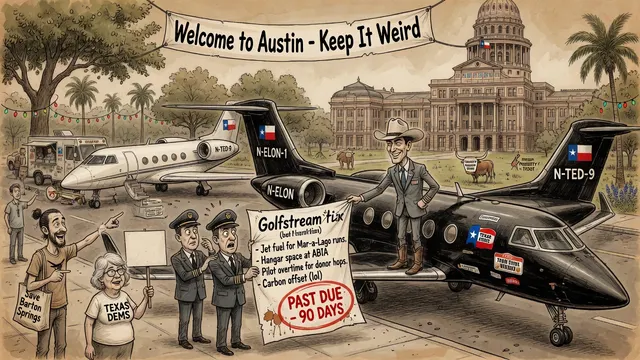
Austin plans new fees for private and corporate planes, possibly starting October 1, to help pay for the airport expansion. I remember when parking at Mueller cost about what a jet now spends on hand towels.
The gate arm at Mueller went up with a wheeze, like a ceiling fan that had seen things. A woman in the booth took my crumpled bills without looking up from a paperback, handed back coins warm from the sun, and the whole transaction smelled like jet fuel, hot asphalt and a breakfast taco someone had abandoned on the dashboard of the Buick in front of me.
My memory says it was three dollars. My memory is not an auditor. My memory also insists the Armadillo was a short drive from everywhere and that I looked good in pleated shorts. But three dollars is the number that lives in my body, the way some people remember their first phone number, so three dollars is the number we're going with.
I bring this up because KUT reports that the city plans to start charging new fees to corporate and private flyers at the airport, possibly beginning October 1, to help pay for the airport expansion. Landing fees. Fuel fees. A small, polite tap on the shoulder of people who have never once circled a parking garage looking for a spot near the elevator.
Somebody finally sent the Gulfstreams a bill.
What three dollars bought you at Mueller
People who moved here after 1999 think of Mueller as a neighborhood with a nice pond, a farmers market and townhomes in colors a paint company would call "Restrained Optimism." Fair enough. It's pleasant. But before it was a planned community it was an airport, and the old control tower is still standing over there like a retired uncle who refuses to leave the party.
The airport was close. That was the whole personality. You could leave a house in Hyde Park, get mildly lost near Airport Boulevard, still make your flight, and have time to buy a newspaper you would not read. The terminal was small enough that "Gate 3" was less a destination than a suggestion. Your aunt could walk you most of the way to the plane and cry at you in person.
Parking was a lot. Not a structure, not a garage with levels named after Texas wildflowers so you'd forget you were on the roof. A lot. You parked, you walked, you got a sunburn on the part of your arm that hung out the window. When you came back four days later your steering wheel was hot enough to brand cattle, and that was included in the price.
There was no app. There was no "premium covered experience." There was a guy, a booth, an arm, and the low hum of a city that had not yet discovered it could charge you for standing still.
What the jets have been paying, roughly, in vibes
Now. I'll admit I don't know what the folks on the private side of the airport currently pay down to the dollar, and I'm not going to make up a number, because the fun of this news is that the city itself decided the number should go up.
What I do know is the general choreography. A plane the size of my first apartment lands. A car the size of my second apartment pulls up next to it. Someone in a fleece vest that cost more than my Mueller parking for a decade steps directly from one leather seat into another, never touching a terminal, a carpet, a TSA bin or a fellow Austinite. They are in a Westlake living room before the rest of us have found our ride-share pickup zone, which is located, as far as I can tell, in Bastrop.
Meanwhile the rest of us fund the expansion one way or another. We walk the long walk. We pay for the concourse and the gate shuffle and the twelve-dollar sandwich in its little plastic coffin. We stand in a security line that snakes so far back you can hear the baggage carousels from three terminals in the future. We are, in other words, the customers.
The jets have been more like guests. The kind who show up at your house, use your bathroom, eat your queso and leave a thank-you note that says only "Thx."
On the phrase "help pay"
What I love about this proposal is how gently it's worded. Help. Pay. Help pay. It's the tone you'd use on a nephew who has been living in your garage since 2019. "Hey, buddy. Totally no pressure. Maybe throw a little at the water bill?"
And look, I'll take it. A city that spent the last decade inventing new ways to bill regular people, from parking meters that run until a time nobody can read to garage rates that rise every time a festival hiccups, has finally pointed the meter the other direction. Up. At the sky. At the people who arrive in town for one weekend a year, park a forty-million-dollar machine on our tarmac, and leave before the hotel towels are dry.
Will the fees be enough to matter? I have no idea. Will the jets notice? Probably the way I notice a penny on the sidewalk in August, which is to say, I see it, I consider my knees, and I keep walking. A fee you can absorb without blinking isn't a cost. It's a cover charge.
But that's fine. Cover charges are an Austin tradition. Every one of us paid five bucks at a door on Red River to hear a band named after a kitchen appliance. Let the Learjets pay at the door too. Get a little stamp on their wing. Black light optional.
A modest proposal from a guy who paid in quarters
If we're really going to do this, I'd like to suggest the city honor its own history. Build a little booth on the private side. Wooden, ideally. Slightly leaning. Staff it with someone reading a paperback who does not look up.
Every jet that lands rolls to the booth. The arm does not go up until payment clears. Exact change is encouraged. The booth accepts cash, check, and nothing that requires a QR code.
Then make them park in a lot. Not a hangar, a lot. Let them walk across hot asphalt in the late afternoon, past a Buick with a breakfast taco on the dash, and come back four days later to a steering yoke hot enough to brand cattle.
That's the real Mueller experience, and frankly they're getting it cheap.
Keep reading Things That Used to Cost $3
A Letter to the Bats Under Congress Avenue, Who Are Leaving Without Paying for Anything
Before the free-tailed bats head south for the winter, I wrote to thank them for staying free in a city that now sells tickets to the sky. Please do not tell the rooftop bars where you're going.
5 min read
You Are Number 47. Reply 1 to Confirm You Are Still Hungry.
A Sunday scene report from a South First brunch waitlist, where migas cost $23, coffee refills have been discontinued, and the app texts you more often than your family does.
5 min read
Admission to the Yard Sale Is Fifteen Dollars
I paid a cover charge to enter a parking-lot vintage market off Manor Road, where a Pyrex dish costs $68 and a 2009 fast-food cup is labeled archival.
5 min read
Follow the Grouch
Email subscriptions are unavailable. Follow new complaints in your RSS reader instead. We do not collect an email address here.
Open the RSS feedAdd this feed’s address to your reader. Opening the link does not subscribe you automatically.