How to Cross a Street in Texas Without Enjoying It
Austin painted over Crosswalk on the Lake, its last piece of roadway art, after TxDOT said no exceptions. Here's a pedestrian's guide to the state-approved street, now with zero feelings per square foot.
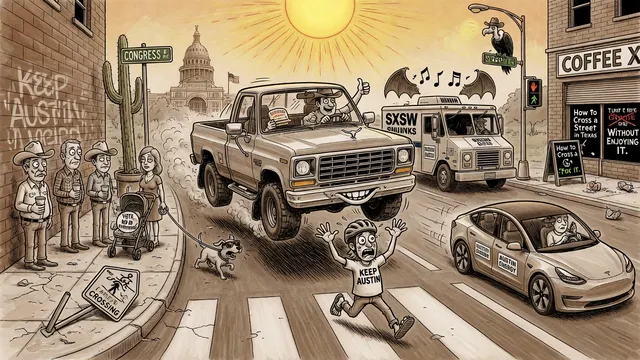
The walk signal at my corner chirps like a smoke detector that has given up on you. I stood there this morning in 88-degree air at 7:40, coffee sweating through the cup, and looked down at the crosswalk: eight white bars on gray asphalt, plus one flattened Topo Chico cap pressed into the tar like a fossil. That bottle cap was, as of last week, the most artistic thing allowed on a public roadway in this city.
On August 27, Austin removed Crosswalk on the Lake, the last roadway art installation left in town. The city had asked TxDOT for an exception to the state directive that's been scrubbing painted street art off Texas pavement. TxDOT said no. So the paint came up, and with it went the last spot in Austin where looking down at your feet felt like anything besides checking for broken glass.
I'm no traffic engineer. I'm a man who has jaywalked across Lamar since the Armadillo was still standing. Still, I can read a policy when it's written in white thermoplastic, and the policy says your walk across the street should be as emotionally neutral as a DMV hold queue.
So here's a guide. The state has made the rules. Somebody has to explain how to follow them.
Step one: understand what counts as a distraction
The general idea behind scrubbing roadway art is that streets are for safety, and safety is gray. I accept that a crosswalk should tell a driver "people walk here." What I can't get my head around is the theory that a driver on a phone, doing 47 in a 35, eating a breakfast taco with the hand that isn't scrolling, gets his focus back once the paint under him turns beige.
Here is a partial list of things still legal in a Texas driver's sightline:
- A billboard for a personal injury lawyer with a name like a tow-truck brand
- A second billboard for a different personal injury lawyer, glaring at the first one
- A digital sign showing five apartment amenities in rotation, one of them "dog wash"
- A wrapped sedan advertising an ice bath studio
- The sun, directly in your eyes, every day at 6:15, at no charge
Paint on the ground that somebody in the neighborhood picked out at a meeting with folding chairs is apparently where the line gets drawn.
Step two: learn to identify the approved palette
The approved colors for an Austin crosswalk are white, and the color white turns after a summer of Texas sun and pickup tires, which is a sort of nicotine ecru. Yellow gets used for lines you shouldn't cross. Red is saved for curbs where you can't park, which describes every curb within a mile of anything you'd want to do.
I used to joke that this town had too many colors. You had purple grackles, orange Topfer-era MoPac construction barrels, the green of Barton Springs before the algae got political, the pink of a Valentine's sale at Big Bertha's in a strip center that's now a cryotherapy lounge. Now the state has quietly settled that complaint for me, at least on public asphalt.
The barrels stayed orange, by the way. Nobody filed a directive about the barrels.
Step three: requesting an exception
The city followed the proper process here, and that deserves credit. It asked. It filled out whatever form TxDOT uses for "please let us keep one nice thing," and TxDOT answered the way the state usually answers Austin: politely, firmly, and with all the warmth of an HOA letter about your trash can being visible from the street.
If you want to try it yourself, my experience with exception requests in this state goes roughly like this:
- Find the correct agency. It's not the one you called.
- Explain why your situation is unique. It isn't, according to them.
- Wait.
- Receive a decision that's already been carried out.
What strikes me isn't that the state won. The state wins all the time in Austin, the way the house wins in a casino with very good parking. What strikes me is how small the prize was. A crosswalk. A painted stripe of local stubbornness that told you somebody on this block cared enough to fight with a public works department about it. That is what Texas dug in to remove, at a time when I can name about forty intersections where the paint is so faded the zebra has gone extinct on its own.
Overheard at a bus stop on Riverside, from a woman holding a Fiesta bag: "They'll fix the art in a week, but that pothole has been there since my son was in braces."
Step four: find art where the state can't reach it
The rule covers roadways. So for now, art in Austin has to live on the vertical surfaces, the private ones, and the ones the developers haven't gotten to.
Murals are still allowed, mainly on walls that are scheduled for demolition, which gives Austin's public art scene the shelf life of a gas station banana. You can still paint a utility box, as long as you accept that a gray wrap advertising fiber internet will eventually cover it. You can chalk your own sidewalk until the next rain, which at our current pace should arrive sometime around the 2028 bond election.
And you can always buy art. A local gallery on the east side will sell you a print of an old Austin crosswalk for $340, framed, and the placard will call it "a meditation on civic memory." If anybody needs me, I'll be at home meditating on the frame cost.
Step five: cross anyway
This is the part the directive can't touch. People in this city keep walking across the street, the same way they keep going to shows on Red River after the venues close, and the same way they keep swimming in water that gets an advisory every other week. Ordinary Austinites aren't the problem here. They're the ones who showed up to the neighborhood meetings, voted on the colors, and stood out in July holding rollers. They did the thing government always says it wants, which is participate, and then got told participation comes with an approved color chart.
So cross with intent. Look both ways, because the state has made sure there's nothing interesting to look at down below. Hum something if you have to. Wear a loud shirt. Your feet are about the only thing on that crosswalk TxDOT hasn't classified yet.
Give them time, though. Somebody up in a Capitol office is probably drafting the guidance for us already. I'd bet it's in white.
Keep reading The Agenda Item
Prepared Remarks on Item 61, Delivered Shortly Before Midnight
A developer wants Cameron Road's tire-shop stretch rebranded as an "innovation district" with banners and a lowercase logo. I signed up to speak, waited nine hours, and had three minutes to object.
5 min read
Nobody Asked the Ducks to Initial Anything
The city and UT say they're close to a deal keeping Lions Municipal as green space, which means amending a 1989 agreement. I read the news on a bench by the putting green and let a wedge do the editorial.
5 min read
Pop Quiz, Fourth Period, Windows Open
Austin ISD says bond-funded cooling projects at four schools slipped past schedule. I wrote the district a worksheet. No calculators allowed; the calculators overheat.
5 min read
Follow the Grouch
Email subscriptions are unavailable. Follow new complaints in your RSS reader instead. We do not collect an email address here.
Open the RSS feedAdd this feed’s address to your reader. Opening the link does not subscribe you automatically.