Nobody Asked the Ducks to Initial Anything
The city and UT say they're close to a deal keeping Lions Municipal as green space, which means amending a 1989 agreement. I read the news on a bench by the putting green and let a wedge do the editorial.
A man in a pink visor was three-putting from six feet when I read it on my phone, and he took it better than I did.
"Close to an agreement," I said, out loud, to nobody, on the bench by the practice green at Lions Municipal. The visor looked up like I'd announced a rain delay. Then he went back to lining up his fourth putt from a distance a toddler could cover by falling forward.
That's the Muny for you. The news arrives, and the grackles keep walking around like they hold the deed.
What was actually said
Wednesday, Fox 7 reported that negotiators for the City of Austin and the University of Texas said they were close to an agreement to keep the Muny as green space. Getting there means changing a development agreement from 1989.
That's the peg, and it's a good one. "Close" isn't "done," and people in West Austin have heard "close" about this golf course roughly as often as they've heard a ball hit the screen on Lake Austin Boulevard. Still, it's the nicest civic sentence I've read all month. Nobody got evicted from anywhere in it. Nobody got a "rooftop activation." It's a real estate story where the real estate stays put.
On the subject of 1989
I'd like a word about 1989, since 1989 apparently has a say.
In 1989 you could park at Barton Springs without an app. Sixth Street was mostly loud in a way you could dance to. I owned a car whose air conditioning was a theory. And somewhere downtown, people in short-sleeve dress shirts sat in a conference room with a pitcher of water and a ceiling tile that had obviously met a leak, and they wrote down a future for this land.
I'm sure they meant well. Long-range planning documents always mean well. They're like a horoscope with a notary.
What bugs me is how long a piece of paper gets to steer things. There are dogs who had full, happy lives in Tarrytown and Clarksville, were buried under pecan trees, and whose grandpuppies are now old, and the 1989 agreement has outlived all of them. It's still on file, still binding, still there in the drawer like a casserole dish nobody returned to the neighbor. It took the city and a university with its own football budget something like a generation to agree that maybe the dish could stay where it is.
The paperwork is the most Austin part of the whole thing. We don't lose places to bulldozers first. We lose them to clauses. The bulldozer just shows up later to sign.
A brief tour, for the ones who've never been
If you've never been to the Muny, here's the visit, best done on a weekday when the light comes in low over the trees.
You come in off Lake Austin Boulevard, past the stretch where every SUV is on its way to the Hula Hut or back from it. You pull into a lot that was never a "mobility hub" and never will be. The clubhouse looks like what happens when a municipal building and a fishing cabin go splitsies on a beer. Inside there's a counter, a guy behind it, and a hot dog situation I won't describe because you deserve to find out for yourself.
The course isn't fancy, and that's the point. The fairways have the texture of a Little League outfield in August. Nobody's wearing anything that cost more than the round. You'll see retirees, kids learning to swing, a couple of guys from a restaurant kitchen who've got two hours before their shift, and one man who has plainly been out here since the Carter administration and has opinions about the wind off the river.
It's also historic, which is the part people skip. The Muny was one of the first public golf courses in the South to desegregate, and it's on the National Register of Historic Places. It's a city-run course on university land, open to whoever shows up with a few clubs and some patience. A place like that becomes a landmark by being plain and open for a long time, and then everybody's surprised when it turns out the plainness is the landmark.
What the green-space crowd hasn't mentioned
Here's the part where I nitpick a good thing, because it's my only hobby that's still cheap.
"Green space" is a lovely phrase. It's also exactly what a rendering says right before the building shows up in it. I've read enough development proposals to know that every glass tower comes with three watercolor trees and a woman in a sundress walking a whippet across a "landscaped plaza." Developers love green space. They put it in the brochure every time, usually about forty feet wide, with a sculpture you're not allowed to sit on.
So when a city and a university agree on the words "green space," I want somebody to spell it out. I'd like it to mean fairways, bad bunkers, and that one tree on the back nine that has personally ruined more marriages than Sixth Street. I don't want a "golf-adjacent wellness experience." I don't want a "reimagined links concept with elevated food and beverage." If anyone hands me a QR code to order a $19 Topo Chico and gin while I wait to tee off, I'm lying down in the cart path and they can amend me too.
I'm saying this because I've lived here long enough to watch "preserve" turn into "reimagine" over one budget cycle. The Muny doesn't need reimagining. It needs mowing.
The view from the bench
The visor sank his putt on the fifth try and pumped his fist like he'd won the Masters at Augusta and not a small private war against a slope near the 19th-hole sign. A grackle screamed at him for it. MoPac hummed in the distance, hauling a few thousand people who will never know the man made par, more or less, if you round generously.
That's what the deal protects, if it closes. It doesn't protect an idea of Old Austin or a plaque or a hashtag. It protects a slightly brown piece of public ground where a guy in a pink visor can be bad at something in the open air, next to the river, for a price that doesn't need financing.
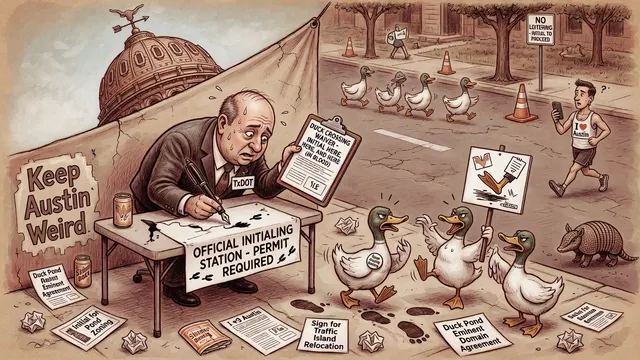
The negotiators say they're close. Fine. I'll believe it when somebody amends 1989 in ink and the ducks keep their pond.
Until then, I'm staying on this bench. It isn't zoned for anything, and that's the most valuable thing about it.
Keep reading The Agenda Item
Prepared Remarks on Item 61, Delivered Shortly Before Midnight
A developer wants Cameron Road's tire-shop stretch rebranded as an "innovation district" with banners and a lowercase logo. I signed up to speak, waited nine hours, and had three minutes to object.
5 min read
Pop Quiz, Fourth Period, Windows Open
Austin ISD says bond-funded cooling projects at four schools slipped past schedule. I wrote the district a worksheet. No calculators allowed; the calculators overheat.
5 min read
My Emergency Quarter Has Been Called Up
CapMetro approved its first fare increase since 2015, so the 2015 quarter that has lived in my cupholder for eleven years finally has a job. I gave it a briefing. It did not take it well.
5 min read
Follow the Grouch
Email subscriptions are unavailable. Follow new complaints in your RSS reader instead. We do not collect an email address here.
Open the RSS feedAdd this feed’s address to your reader. Opening the link does not subscribe you automatically.