Heat Lamp Reservations Open at Noon
A survival manual for Austin's first real norther of the season, when warmth arrives in tiers, blankets need a deposit and the oil-drum fire has been replaced by a 90-minute heater window.
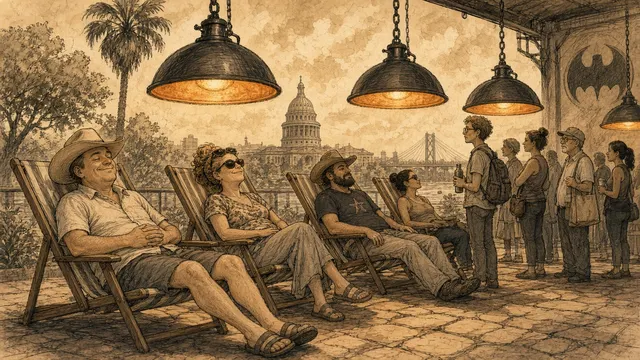
"Is the heater included," the woman at the next table asked, "or is that a tier?"
It was a tier. It was, in fact, three tiers, laminated and propped against the napkin dispenser on a patio off Manor Road: Ember, Glow and something called Hearth Reserve, which as far as I could tell was the same propane tower as the other two but closer to the outlet where you charge your phone. The front had blown in around two in the afternoon. By six it was forty-nine degrees, the wind was coming sideways out of the north, and a young man in a branded quarter-zip was walking the rows with a tablet, quietly reassigning warmth.
Every November the city gets its first real norther, and every November a new set of people learns what one feels like. This is a manual for them. It is also a manual for those of us who remember when getting warm on a bar patio cost the same as getting cold on one, which was nothing. You just stood closer to the fire and somebody's dog moved over.
Recognizing the front
You will know it's coming because the air goes still and slightly wrong around lunch. The grackles get loud, then quiet. Then the wind swings around and the temperature falls twenty-some degrees before your afternoon meeting is over, and the person in the cubicle next to you says "whoa" at the window like a man watching a ship come in.
This is a blue norther. It is one of the last genuinely free events in Austin. Nobody sells tickets to it. Nobody has yet figured out how to make you scan a QR code to feel the wind, though I would not bet my lease on that holding through 2028.
Enjoy it on the walk to your car. That's the last part of the evening that won't have a price.
The heater is now a product
At the Manor Road patio, Ember was a $40 food-and-beverage minimum for "heater-adjacent seating." Glow was $65 and put you directly under the lamp for a ninety-minute window. Hearth Reserve was $110 and came with a blanket, a s'mores board and what the card called "priority radiance."
I asked the young man what happened at minute ninety-one.
"We do a gentle transition," he said.
A gentle transition, it turns out, means he comes over and turns the dial down to the little blue pilot flame and smiles at you like a nurse. The lamp keeps standing there, tall and expensive, giving off the warmth of a disappointed parent.
I went with Ember. Ember is a seat about eight feet from a heater that belongs to someone else. You can see the heat. You can watch it fall on a couple in matching shearling jackets who are splitting a $19 mulled cider. Some of it drifts your way when the wind dies, and you feel it on one cheek for half a second, like a rumor.
Somebody, somewhere, built a pricing model for that half-second.
The blanket program
There is a blanket program. It has a name I will not repeat because I refuse to help it. The blankets are gray, folded into tight rectangles in a wire basket by the host stand, and each one carries a small woven tag with a QR code. You scan the code, put down a $15 deposit, and accept terms which include a line about "natural fiber care expectations."
The deposit is refunded when you return the blanket "in comparable condition." I don't know what comparable condition means for a blanket on a patio where people are eating barbecue nachos in the wind. I don't think anybody does. I think the fifteen dollars is just gone, and the blanket is a souvenir of having briefly been warm.
We used to have a lost-and-found box. Every bar had one. Behind the counter, usually a milk crate, usually containing one Carhartt jacket of unknown origin, a flannel, four sunglasses and a single glove. On a cold night you asked the bartender, she nodded at the crate, and you walked out to the patio wearing a stranger's flannel that smelled like Marlboro Lights and mesquite. You brought it back at close. Or you didn't, and next winter it was in somebody else's crate across town, which is how Austin's coats migrated, like the bats do, only less documented.
The s'mores board
Twenty-six dollars. House-made marshmallows, "artisan graham crisps," a chocolate described with a percentage, and a tiny ceramic burner the size of a votive candle that you are expected to toast over in the wind.
The burner went out four times. The marshmallow never got past lukewarm and faintly sweaty. At one point the man in the quarter-zip came by and offered to "re-flame" us, which I am fairly sure is billed separately.
The old version was a bag of grocery-store marshmallows somebody brought, opened with teeth, and a coat hanger bent straight and held over the oil drum. Somebody always caught one on fire. Somebody always ate it anyway. The total cost to the bar was zero, and the total cost to you was the hanger, which you got back.
A word on the oil drum
I'm not going to name the backyards where these lived, partly because half of them are now townhomes with a pocket park and partly because I don't want anyone retroactively applying for a permit. But on cold nights in the right places there was a fifty-five-gallon drum with holes punched in the sides, a pile of split oak and pallet scraps against the fence, and a guy whose whole personality for one evening was "keeping the fire going." He was not employed by anyone. He took the job seriously. He had opinions about cedar.
You stood in a circle around it with people you didn't know. You turned like a rotisserie, front then back. Your jeans got hot enough to hurt on the shins while your ears went numb. Nobody had a tier. The warmth was arranged by who got there first and who was willing to move over, which is the only seating policy I have ever believed in.
I know why that's gone. Insurance, fire code, neighbors who moved in next to a bar and discovered a bar. Fine. Some of that is even reasonable. What isn't reasonable is the leap from we can't have an open fire to therefore warmth must be a subscription. There was a lot of room between those two positions, and somebody filled it with a dial and a tablet.
For the newcomers, sincerely
You will see people at Barton Springs on a forty-degree morning and think they're showing off. Some are. Most just know the water stays around 68 year-round, so it feels warm when the air doesn't. That's free too, give or take the entry fee. Bring a towel.
If you lived here in February 2021, you already know cold in this city isn't really about jackets. Millions of Texans lost power when the state grid failed during that storm, and the people who were supposed to keep the lights on mostly held hearings about it. So when a front comes through, a lot of us check the forecast twice and look at the faucet. That's not quaint. It's memory.
Everything else is just weather, which is supposed to be shared.
Minute ninety-one
The couple in shearling hit their window around 7:40. The young man came over, knelt, and turned their dial down to the pilot. They sat there a minute under the dead lamp, looking at each other with the stunned dignity of people who'd been told their table was needed.
Then the man in the shearling picked up his chair and dragged it eight feet over to my Ember seat, where it was exactly as cold as where he'd just been, and said, "Mind if we share yours?"
I told him I didn't have one.
He said that was fine, he'd stand close.
Keep reading Things That Used to Cost $3
Your Bird Has Entered Its Rest Phase
Thanksgiving morning in a smokehouse pickup lane off East Cesar Chavez, where a $189 turkey has a QR code, an assigned window and a mandatory nap before it can come home.
5 min read
I Paid Sixty-Five Dollars to Be Cold on Purpose
A boutique cold plunge off South Lamar charges $65 for three minutes in a cattle trough of 39-degree water, while a spring a mile away has been doing the same job at 68 degrees for roughly forever.
5 min read
A Quarter Gets You Nothing Now
An oral history of a coin laundromat off Airport Boulevard, told by the people who used to fold there before it became a members-only 'garment wellness collective' with a scent curator and booking windows.
6 min read
Follow the Grouch
Email subscriptions are unavailable. Follow new complaints in your RSS reader instead. We do not collect an email address here.
Open the RSS feedAdd this feed’s address to your reader. Opening the link does not subscribe you automatically.