Fallen Nut Retrieval Is Reserved for Residents
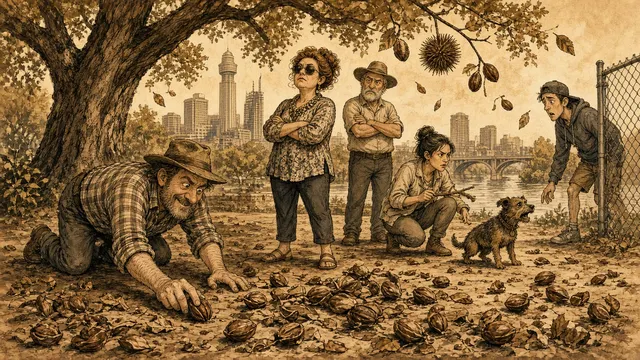
A ninety-year-old pecan tree off Manor Road survived a condo build, only to have its nuts declared an HOA asset, harvested by a vendor and sold back in the lobby at $19 for eight ounces.
The sign is brushed aluminum, waist height, staked into the mulch ring like it's marking a grave. It reads, in a sans-serif font that has never once been rained on:
FALLEN NUT RETRIEVAL IS RESERVED FOR RESIDENTS. HARVEST CONDUCTED BY OUR GROVE PARTNER. THANK YOU FOR HONORING THE CANOPY.
Under it, on the sidewalk, which is public, a single pecan sits in the crack between two slabs. I look at it. A doorman in a quarter-zip looks at me looking at it. Neither of us moves. Somewhere above us a squirrel drops a husk on the hood of a Rivian, and I swear to God it's the only honest act committed on that block all week.
The tree
This tree is a pecan, and a big one. It sits on a lot off Manor Road, in that soft zone where Cherrywood starts pretending it isn't next to a commercial corridor. I'd put it at ninety years old if you made me guess, but I'm not an arborist, I'm a man who has been picking nuts off this exact patch of ground every November since the Clinton administration.
For most of that time, the tree stood in the side yard of a pier-and-beam house with a green porch swing and a chain-link fence that leaned outward, like it was trying to hand you something. The fence had a gap near the corner post. Everybody knew about the gap. Kids, retirees, a guy with a Nut Wizard on a broom handle who rolled the yard like he was mowing it. You brought a Fiesta bag. You took what you'd crack. You left the rest for the next person and for the squirrels, who had seniority.
Nobody called this foraging. It was just November.
The preservation
Austin does protect heritage trees. A pecan of that girth isn't something a developer gets to flatten because it's in the way of a parking ramp, and to their credit, they didn't. The house went. The swing went. The fence went. The tree stayed, and the building was poured around it in a horseshoe, four stories of fiber cement wrapped around a trunk like a hand cupping a candle.
The leasing brochure, which I picked up because I'm a masochist, calls the tree "the emotional center of the property." The courtyard is called The Grove, singular tree notwithstanding. There is a plaque on the trunk with a QR code. The QR code takes you to a page that says the tree has "witnessed nearly a century of East Austin stories," which is a lovely sentiment from a company that bulldozed most of the storytellers' houses.
I'll grant them this much: the tree looks great. Its roots got a fancy aerated soil system. It probably gets better healthcare than I do.
Then fall arrived, and the tree did what pecans do, which is produce pecans, and the HOA discovered it owned a crop.
The harvest
The nuts are now classified as a common-area asset. I know this because it's in a laminated FAQ taped inside the lobby glass, facing out, so the public can read about the thing the public is not allowed to touch.
According to the FAQ, the harvest is handled by a "grove partner," which as far as I can tell is two guys and a tarp. They come on a weekday morning, shake what they can, sweep up the rest with a leaf blower set to a gentle hum, and haul everything off to be "cleaned, sorted and finished." Finished. As if a pecan is a hardwood floor.
The pecans come back in the second week of November in kraft-paper pouches with a little twine bow and a sticker that says ESTATE PECANS — THE GROVE AT MANOR — HARVEST 2026. They sit on a reclaimed-wood shelf next to the package lockers. Eight ounces, shelled, nineteen dollars. Residents get a 15 percent discount and, quote, "first access."
First access. To the tree in their own courtyard. Which drops nuts on their own heads.
Nineteen dollars for half a pound. I went and checked the bulk bin at the H-E-B on 51st and came back somewhat calmer, but only because I'd been sitting in the car for a while.
The squirrels
What I want to know, and what the FAQ does not address, is who enforces this against the squirrels.
The squirrels have not been briefed. The squirrels have not signed the lease addendum. I watched one sit on the edge of a planter, fourteen inches from the RESERVED FOR RESIDENTS sign, eat an entire estate pecan, and drop the shell in the mulch. Nineteen dollars' worth of nut, roughly a dime per bite, consumed by a rodent with zero equity and absolutely no first access.
The doorman watched it too. He did nothing. There's a limit to what anybody will do for a property management company, and apparently that limit is chasing a squirrel in front of a witness.
So, to sum up the current policy: a human being on a public sidewalk may not pick up a pecan that rolled off private mulch, but a squirrel may strip the tree bare at noon on a Tuesday in full view of the amenity desk.
I'm pretty sure that's the most coherent land-use regime this town has ever had.
The pie
Here is why it matters to me this week in particular, and I promise it's about money and not feelings, mostly.
Thanksgiving is Thursday. For a long run of years, the pecans in my pie came from under this tree. You'd gather a couple of pounds on a cool Saturday like today, sit on the back step with a nutcracker and a cereal bowl, and listen to the Longhorn game bleed out of somebody's garage radio two houses down. Your thumbs went brown from the hulls and stayed that way into December. Nobody's pie was good, exactly. Everybody's was free.
Now I'd be buying the same nuts from the same tree, minus the shells and plus a twine bow, at a markup that would embarrass a stadium concession stand. A standard pie takes a cup and a half, give or take. Call it six ounces. That's about fourteen bucks of estate pecan in one pie, before the corn syrup, before the crust, before the dog gets into it.
Fourteen dollars in pecans from a tree I used to be able to reach through a fence and touch for nothing.
The gap
There is no gap in the fence anymore, because there's no fence. There's a planter wall, a camera dome and a gate fob reader that chirps when it rejects you, which I know because I have tested it, for journalism.
But here's the thing about pecan trees, and I'd love for someone at the HOA to explain this to the grove partner: they don't respect property lines. The canopy on this one reaches clean over the planter wall, over the sidewalk, and about four feet into the bike lane on the side street. Pecans fall where gravity puts them. And gravity, as far as I know, has not been given a seat on the board.
So this morning, at about 7:15, before the leaf blower arrived, I stood in the public right-of-way with a grocery bag and caught what came down. Not from the mulch. Not from the courtyard. From the air, over a city sidewalk, where for one brief second every pecan in Austin still belongs to nobody.
I got about a pound. The doorman saw. He gave me a small nod, the kind you give someone you're not supposed to recognize.
The pie will be bad. It will also be free, which is the more important thing to be.
Keep reading Condos of Shame
Please Direct All Concerns to Juniper
A $310 rent hike taped to a Hyde Park fourplex door sends one tenant down a staircase of LLCs, a Frisco mailbox and a chatbot, looking for the person who owns the place.
5 min read
Seasonal Conifer Activation, Level P2
The old Christmas tree lot on Manchaca is now a tree experience in a parking garage, where a six-foot Fraser fir comes with a handler, a wellness assessment and a four-hour delivery window.
5 min read
Residents May Gather Up to One Cup
A field guide to the native Texas pecan, a state tree whose nuts now come with a harvest policy, a QR code and a one-cup limit at a new Bouldin apartment complex.
5 min read
Follow the Grouch
Email subscriptions are unavailable. Follow new complaints in your RSS reader instead. We do not collect an email address here.
Open the RSS feedAdd this feed’s address to your reader. Opening the link does not subscribe you automatically.