Residents May Gather Up to One Cup
A field guide to the native Texas pecan, a state tree whose nuts now come with a harvest policy, a QR code and a one-cup limit at a new Bouldin apartment complex.
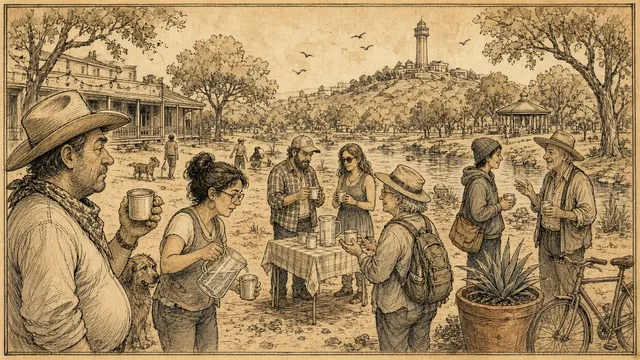
The first pecan of the season cracked under my boot on South Fifth this morning. It made that small, satisfying pop, like a knuckle or a cheap firework. I bent down out of reflex, the way you bend for a quarter, and that's when I saw the sign zip-tied to the courtyard fence:
SEASONAL HARVEST POLICY. Pecans are a resident amenity. Residents may gather up to one (1) cup per day. Please scan to log your harvest. Non-residents, thank you for respecting our canopy.
The tree behind the sign is about ninety years old. The fence is about ninety days old. The tree was here when the lot was a yard with a chain-link gate, a dented Buick and a woman who would hand you a grocery sack and say "take what you want, the squirrels don't need all of it." Now there's a five-story building wrapped around it like a fist around a tennis ball. It's called something with "Canopy" in the name, because if you're going to box in a tree, you might as well name the box after it.
So it's November, the pecans are falling, and someone has decided they need a policy. As a public service, here is a field guide for anyone who hasn't seen a pecan up close since it started needing a key fob.
Identification
The native Texas pecan is small, hard and stubborn. It is not the fat, glossy, paper-shell pecan in the grocery bag with a cartoon farmer on it. The native one is about the size of the last joint of your thumb, striped dark at one end like it's been smoking, and it fights you at every stage. You don't shell a native pecan. You negotiate with it.
The meat is worth it. It tastes like butter that grew up rural.
The pecan has been the state tree of Texas since 1919. As far as I know, that title has never come with a cup limit.
Habitat
Historically the pecan thrived along creeks, in old yards, behind churches, in schoolyards, in the median of roads nobody had widened yet, and in any place in Central Texas where someone's great-grandfather put one in the ground and then died before he could see a harvest. That's the deal with pecans. You plant one for people you'll never meet.
Lately the pecan has adapted to a new habitat: the "preserved heritage tree courtyard." This is a rectangle of decomposed granite with four teak benches, a dog relief station and a plaque that says the developer is proud to have kept the tree. That's like being proud you didn't steal the car, just the driveway.
The tree has been fenced in for its own protection. Something has to protect it from the people who used to protect it.
Season
Pecans drop from roughly late October through the end of the year, depending on rain, wind and the tree's mood. Back when I lived off South First, you could hear the season start at night as they hit the tin roof of the shed out back: one plink, then nothing for an hour, then four in a row like the tree was sending Morse code. My dog thought the house was under attack every November for eleven years and was never once wrong in spirit.
At the Canopy, the season starts when property management sends an email. I know because a resident showed it to me over the fence. She was very nice and visibly embarrassed, the way people get when they've been made to carry their landlord's nonsense around in their phone. The subject line was "🍂 Harvest Season Is Here!" It invited her to an "Autumn Gathering" featuring a "local pecan pairing," a DJ and a one-time harvest basket for $12, charged to the resident ledger.
She pays rent to live beside a tree, and the tree is on the invoice.
Predators
Natural predators of the pecan include squirrels, crows, blue jays, the pecan weevil and a certain kind of retired man who carries a folding stool and a coffee can and has opinions about which tree on the block "runs sweet." I love that man. I plan to become that man.
Recent predators include:
- The amenity fee. It used to cover a pool and a sad treadmill. Now it covers weather. If anything falls from the sky onto property, someone will try to charge for it.
- The QR code. Every pecan you log apparently feeds into something called "community harvest insights." I don't know what a landlord learns from knowing I took eleven pecans on a Tuesday. Maybe it goes into the rent algorithm. Maybe the software notices that people enjoy free things and corrects for that.
- The leaf blower crew at 7:15 a.m. Twice a week they blow every fallen pecan into a pile and haul it away in contractor bags so the decomposed granite stays "clean." By the end of the season more pecans go into the dumpster than into anyone's pie. Management has sent all those future trees to the landfill to protect the look of a courtyard that only exists because of the tree.
Proper Handling
The traditional way to handle native pecans is this. Pick them up and put them in a bag. Bring the bag home and leave it on the porch for two weeks while you mean to get to it. Then sit at the kitchen table with a nutcracker your aunt gave you in 1987, a bowl, the radio and a whole Sunday afternoon. Crack them. Swear. Pick the meat out with a nutpick or, in an emergency, a bent paper clip. You will end up with about a cup and a half of pecans, sore thumbs and a sense of having earned something.
Some people skipped the swearing and took their bags to a feed store or an old shelling operation out east, where a machine would crack them for a reasonable per-pound fee while you stood around talking about rain. That counted as a social life.
The new way is to pre-order the "Canopy Reserve" holiday tin from the leasing office. I'm told it holds pecans from "our very own heritage tree," candied with chili and Texas honey, wrapped in kraft paper with a twine bow and the building's logo stamped in gold. It costs $28.
That's twenty-eight dollars for the tree's own nuts, sold back to the street the tree grew up on.
Field Notes
I went back around four this afternoon. The light was doing that low November thing where everything on South Fifth looks like a postcard someone mailed in 1974. There was a kid on the sidewalk outside the fence, maybe seven, crouched down and collecting the pecans that had rolled through the bars onto public concrete. He had a full pocket and was working on the second one.
A leasing agent came out holding a tablet and watched him for a second. I braced. Then she looked at the sign, looked at the kid, looked at me, and went back inside without a word. I choose to read that as a person deciding not to enforce a policy she didn't write. Those are the small mercies we get now. They happen one employee at a time, usually near closing.
The kid's mother called him from down the block. He stood up, patted his pockets and announced to nobody, "I got like a thousand."
He had about thirty. They were all on the sidewalk, which as of this writing is still free.
Nobody has scanned it yet.
Keep reading Condos of Shame
Vote Here, Past the Dog Spa, Left at the Kombucha Tap
I followed the laminated VOTE HERE arrows on South Lamar this morning and ended up casting my ballot between a shuffleboard table and a wall that says Live Your Best Story. Nobody asked me to tour a two-bedroom, but it was close.
5 min read
My Neighbor Is Going as a Bungalow
My neighbor Ruthie built a Rainey Street bungalow costume out of H-E-B boxes for Halloween. Before she got it past the mailbox, it attracted two buyers, a rezoning request and a rooftop bar.
5 min read
Advance Survey of Porch Lights, Bouldin Creek, Halloween Minus Five
Five days before Halloween I walked my old trick-or-treat route off South Second to count porches that might still open. I found lockboxes, a doorbell that talks back and one bowl of Big Red.
5 min read
Follow the Grouch
Email subscriptions are unavailable. Follow new complaints in your RSS reader instead. We do not collect an email address here.
Open the RSS feedAdd this feed’s address to your reader. Opening the link does not subscribe you automatically.