
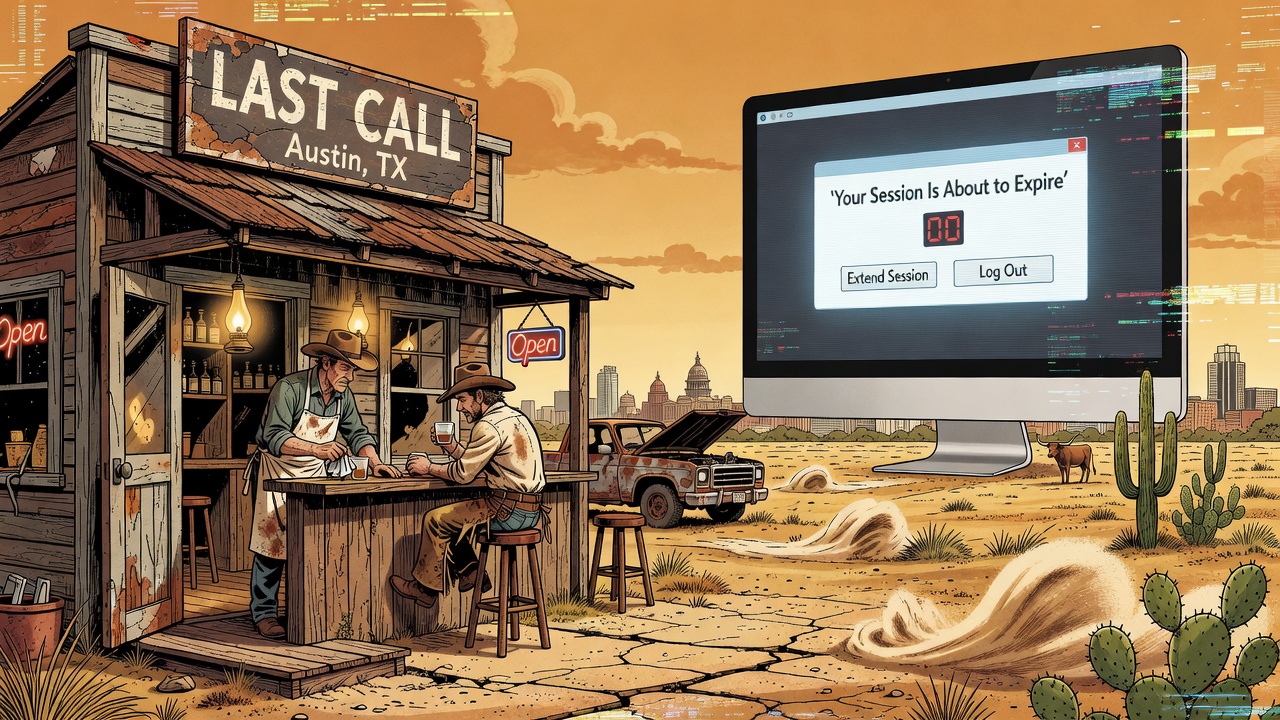
'Your Session Is About to Expire' Is the New 'Last Call'
The parking kiosk outside the Continental Club demanded my license plate, a credit card, and a 45-minute minimum before it would let me stand still for a set; what used to be three quarters dropped into a rusty meter on South Congress for two hours of freedom is now $17.50, geofenced enforcement, and passive-aggressive texts asking if I'd like to extend my "curbside experience."
The kiosk on South Congress blinked its little red eye at me while I fumbled for change that no longer had a home. Three quarters in my palm, edges worn smooth from sitting in the console since the second Bush administration. The slot was gone. In its place sat a touchscreen demanding my plate number, my email, and whether I was feeling "regular" or "peak demand" pricing.
I downloaded the app. Of course I did. The alternative was the $65 tow that swallowed my neighbor's Tacoma last month. The thing loaded with the enthusiasm of a dial-up modem, then immediately asked for location permissions, camera access, and whether I wanted push notifications about "mobility insights." I picked the cheapest tier—ninety minutes for $17.50—and watched it auto-populate my vehicle's make and model like it had been waiting for me specifically.
Back in '98 that same stretch outside the Continental didn't ask for anything but a little faith. You'd nose your Civic against the curb, feed the meter fifty cents for the first hour, and another two quarters if Steve from the Resentments stretched "Long Black Veil" past the break. Nobody timed you with satellites. The worst that happened was a handwritten warning from the meter maid we all called Doris, who drove a golf cart with a crooked front wheel and would sometimes accept a warm Lone Star in lieu of the fine if you looked sufficiently sorry.
Now the system knows exactly how long you've been gone. It sent me a text at minute forty-three: "Your session is at 52% utilization. Extend for optimal flow?" Optimal flow. I was standing on the sidewalk listening to a band play actual music, not optimizing anything except the distance between myself and the bar.
The changes arrived with the usual stack of renderings and consultant-speak. City council called it the Curb Management Initiative. Some firm out of Boulder won the contract, the same people who turned parking into a subscription service in Portland and Denver. They painted over the old meters in that aggressive teal color that screams "we hired a branding guy." The new ones look like rejected Terminator props. One of them actually spoke to me last week. Actual robot voice. "Thank you for choosing sustainable mobility."
Sustainable my ass. I watched a guy in Allbirds argue with his phone for six straight minutes because the app wouldn't accept his temporary California plates. Behind him, the line for the Continental stretched past the old South Congress Cafe spot, now a juice bar called Pressed & Worthy. Everybody shifting their weight, staring at screens, paying three bucks every fifteen minutes like it was normal. Used to be you'd pay once, forget about it, and maybe even leave the car overnight if the night got interesting. The worst offense was a parking ticket that fit in your wallet. Now it's a data profile.
I timed it on a recent Saturday. From the moment I killed the engine to the moment the band kicked in: eleven minutes of app nonsense. Enter plate. Verify plate. Watch the map pin jump three feet because the GPS thought I was in the middle of the street. Approve charge. Decline the $2.99 "express renewal" upsell. Get the receipt. Get the second receipt because the first one didn't have the carbon offset icon. All so I could stand in a room that still smells faintly of old beer and wood polish and pretend the Austin in front of me isn't running on someone else's terms.
The old meters had personality. Some ran five minutes fast. Some took the quarters but never ticked down if you jiggled the handle just right. We knew which ones. There was a whole oral tradition about it, passed between bartenders and sound guys and the crew that loaded amps at the Saxon. Now the personality is a push notification that says "Welcome back to the neighborhood!" like it grew up here. Like it ever sat on a tailgate at the Continental listening to James McMurtry complain about the rent.
My buddy Chuy still carries a roll of quarters in his glovebox, a reflex from thirty years of Sixth Street gigs. Last week he tried to jam one into the new kiosk anyway, pure muscle memory. The machine made a sound like a disappointed aunt and spat the quarter into the gutter. He just looked at it lying there in a pile of flattened cigarette butts and new e-bike tire tracks. "Pinche robot," he muttered, then pulled out his phone like the rest of us.
They swear it's about fairness. Reduce circling for spots, lower emissions, free up curb space for "activated street frontage." What it really means is the guy who used to drive down from Round Rock for a Tuesday night show now thinks twice. The working musicians loading in at 7pm can't afford to feed the meter every set break. The bars that once packed them in shoulder-to-shoulder are watching people nurse one drink and bolt before the second set. But the app company gets its per-transaction fee, the city gets its kickback, and some consultant in a WeWork somewhere is getting promoted for "increasing utilization 340%."
I eventually got my ninety minutes. The band was good—tight, loud, the kind of country-punk that used to be the soundtrack around here before everything got focus-grouped. During the third song my phone buzzed again. "Your session is expiring soon. Rate your experience?" I gave it one star and typed "feels like a ransom note" in the feedback box. Doubt anybody reads them. The data scientists are probably too busy graphing how many drivers from the 512 area code will pay surge pricing after 10pm.
There's a particular shame in knowing exactly how it used to work and watching the new version unfold anyway. The smell of those old meters after a rain—hot metal and wet concrete—mixed with exhaust from the occasional lowrider and the distant hiss of a broken neon sign. That smell is gone. Now it's just the ozone whiff of touchscreen cleaners and the faint disappointment of middle-aged men deleting another app they never wanted.
I walked back to my car at 11:47 with four minutes to spare. The kiosk had already reset itself, glowing smugly at the next customer. Somewhere in its cloud, my plate number, my payment method, and my one-star tantrum are probably being bundled with everyone else's to create the perfect "curbside persona."
Doris and her crooked golf cart never needed any of that. She just wanted the quarters and for you to move your damn truck if it blocked the hydrant. I miss her. I miss the simple transaction. Most of all I miss the feeling that the city belonged to the people trying to hear some music, not the people selling access to the curb.
The quarters still rattle in my console. I can't bring myself to spend them on anything else. They're relics now, like pay phones and paper setlists and the idea that you could just show up, park, and stay awhile without negotiating with three different companies first.
One star. Would not extend my session again.