
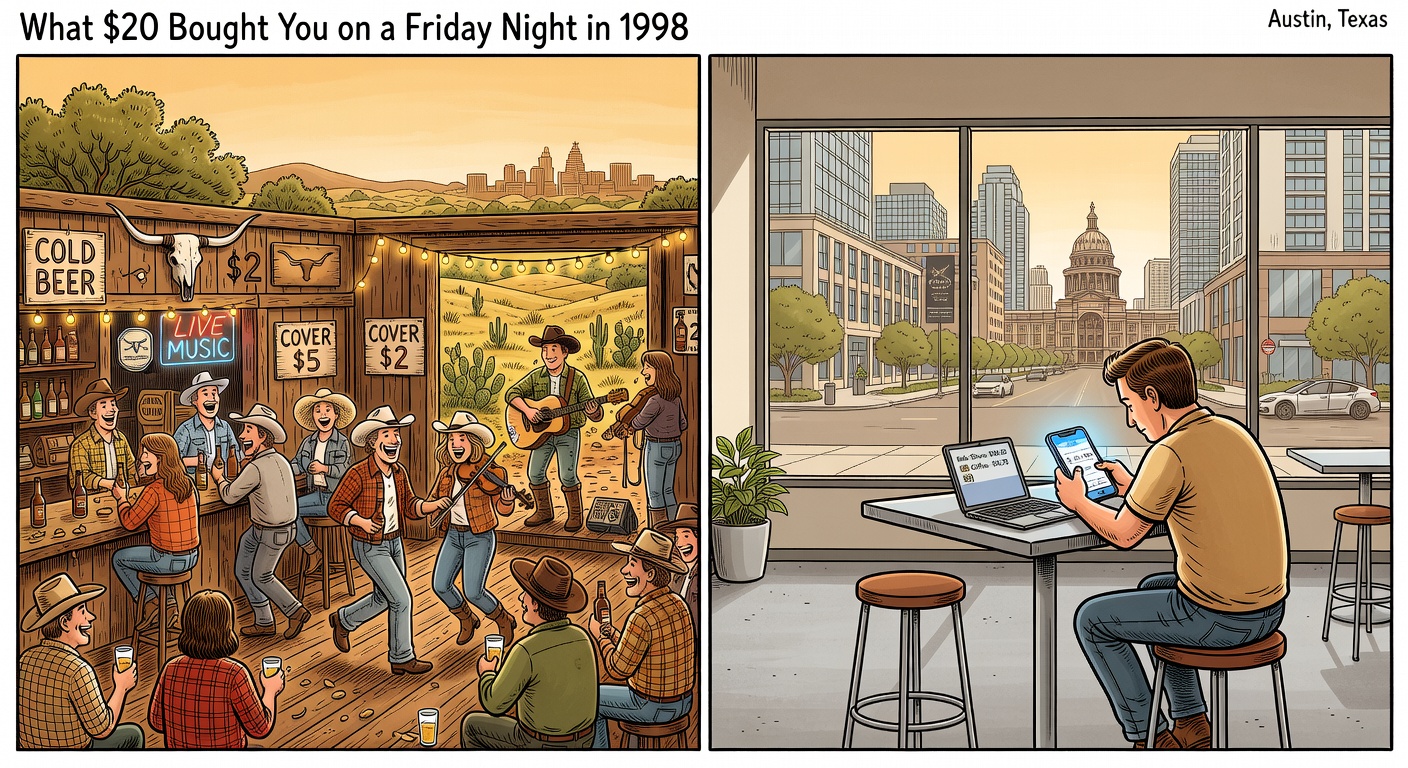
What $20 Bought You on a Friday Night in 1998
I found the crumpled receipt in a coffee can of old stubs—$19.75 including tip—and it detailed a night that now sounds like science fiction: three bands, four beers, two slices from the guy with the pizza box on Red River, and enough left over for gas to get home to Crestview.
I found the crumpled receipt in a coffee can of old stubs—$19.75 including tip—and it detailed a night that now sounds like science fiction: three bands, four beers, two slices from the guy with the pizza box on Red River, and enough left over for gas to get home to Crestview.
The paper itself felt like a relic, the kind of thin carbon copy that left blue ink on your fingers. Dated March 13, 1998. First line: cover, $3. Second: Shiners, $2.25 each. No QR code. No service charge. No upcharge for sitting on a stool that wobbled because half the floor at that joint slanted toward the stage like it was trying to deliver the band straight into your lap.
That night started at the curb on East 6th where the streetlights still buzzed the old sodium yellow. You could park for quarters back then, feeding the meter like it was a slot machine you didn't mind losing to. I dropped three coins into the one outside what used to be a pawn shop that sold guitars out the back door on weekends. The meter clicked its approval and gave me two full hours—enough time to catch a set, walk two blocks, catch another, and still have options.
First stop was the narrow room with the low ceiling where the sound guy chain-smoked and the PA occasionally cut out mid-song. Three dollars at the door got you in to see a local outfit that played loud country with punk edges. The crowd was half mechanics from the shops on Cesar Chavez, half bartenders on their night off, and a few UT dropouts who knew every word to the obscure covers. Beer stayed under three bucks a can. The bartender poured without theater. No one took photos. The only glow came from the neon Schlitz sign that had hung there since the place opened in the late seventies, its glass cracked in one corner but still humming.
From there the night opened up. You stepped back onto the sidewalk and the air hit different—warm March night mixed with distant grill smoke from the taco truck that parked illegally near the alley between Red River and Neches. That truck ran foil-wrapped barbacoa tacos for a buck apiece, no questions, no compostable tray, no suggested tip screen. Two of those and you were set. The guy running it played his radio loud enough that you could hear the conjunto station from half a block away, the accordion cutting through the distant kick drums leaking from every other doorway.
We wandered east. The next spot sat on the corner where the building still stands but nothing else does. Five dollar cover that night because the band had a record out on a local label. Inside, the floor stuck to your shoes from decades of spilled domestics. The air was thick with cigarette smoke and the particular tang of old wood soaked in beer. You could stand at the bar and feel the kick drum in your ribs. The guitar player, a guy who'd been on the scene since the Armadillo days, soloed like he was mad at the strings. Between songs people yelled requests that actually got played. No setlist projected on a screen. No velvet rope. Just bodies and noise and the shared understanding that this was the point of the evening.
By the time we hit the third place—further down where the street starts to curve toward the highway underpass—the twenty dollar bill was still intact enough to buy a round for the group. That bar had a back room with a pool table that listed hard to the left. The jukebox took quarters and still had actual vinyl records in it. We fed it a couple and watched a table of roofers argue over whether Willie or Waylon had the better catalog. Domestic longnecks were two-fifty. The bartender kept a running tab on a green guest check pad, the kind with carbon paper between sheets. He knew half the room by name or nickname. No one asked for ID unless you looked twelve.
The math on that night was simple and forgiving. Three covers. Four or five beers. Food from the street. Gas for the drive back north on Airport Boulevard, past the old airport hangars that still smelled like jet fuel when the wind was right. Maybe a stop at the all-night Walgreens on Koenig for a six-pack to go if the mood struck. Total damage: under twenty bucks. What you got back was louder than any receipt could capture—the way the crowd hollered during the bridge of a song everyone knew, the sound of boots scuffing the floor in rhythm, the particular smell of that East Sixth corridor that mixed fryer grease, exhaust, and fresh spilled beer into something that felt like permission.
Contrast that with last Friday.
I went back to the same three-block stretch for research, not pleasure. The first door now has a bouncer with a tablet. Fifteen dollar cover to get past the velvet stanchions that appeared sometime after 2016. The tablet checks IDs against a database. The stamp is digital, delivered through an app that asks for your email before it lets you order a drink. That drink? Eleven dollars for a can of beer that used to come from the cooler for free if the band knew you. They added a three-dollar "venue preservation fee" that preserves nothing except the developer's margin. The exposed brick walls that once collected cigarette tar and Sharpie phone numbers have been sandblasted clean and decorated with tasteful prints of what the street looked like before anyone who works there could afford to live within ten miles.
I walked the same eastbound route. Every other building now has condos stacked above the bars. The signs out front advertise "luxury micro-units" starting at $2,400 a month for 450 square feet with "authentic Sixth Street views." Those views consist of bachelor parties in matching neon shirts puking into the gutter at 1 a.m. while influencers film it for content. The pizza guy is gone. In his place sits a shipping container turned "artisanal slice concept" that charges fourteen dollars for something called a heritage margherita on a crust baked in a wood-fired oven imported from Naples. The container has better WiFi than most apartments in the neighborhood.
At the third address the pool table has been replaced by a selfie mirror with ring lighting. The jukebox is a tablet that charges two dollars per song. Domestic beer runs nine-fifty. They don't stock Lone Star anymore because the brand doesn't test well with the target demographic of tech transfers from Seattle who want "local flavor" without any actual local aftertaste. I overheard one of them explain to his date that the bar "has so much history." The history in question was apparently the week some celebrity once posted a story from the bathroom here. The actual history—the nights when the power went out and the band kept playing on a generator, the time the roof leaked during a thunderstorm and everyone just moved their stools two feet left and kept drinking—has been edited out.
The parking situation deserves its own ledger entry. The meters now demand credit cards and surge pricing after 7 p.m. on weekends. Twenty-five dollars for three hours in a lot that used to be gravel and goodwill. The tow trucks patrol with algorithms. One driver told me last month they get bonuses for volume. The Civic I used to drive wouldn't last ten minutes now. Its lack of Bluetooth would probably trigger some kind of authenticity violation.
Musicians feel it worst. The guitar player who used to make fifty bucks a night plus tips after splitting the door can barely cover his strings now. The new rooms want percentages of merch sales and demand professional live streams. The crowd spends more time deciding which filter makes the stage look grittier than they do actually watching the band. Last week I saw a pedal steel player packing up his rig at midnight because the bar wanted to pivot to a DJ set for the private corporate event upstairs. The corporate event had its own RFID wristbands. The pedal steel player drove home to a roommate situation in Manor because the old duplex he rented on Holly Street got scraped for townhomes.
The affection I still carry for that older version of the street isn't blind. It had plenty of problems—fights in the parking lots, questionable electrical wiring, bathrooms that required hazmat training. But those problems weren't priced at a premium. The weirdness wasn't a marketing bullet point. It was just what happened when you packed too many oddballs into too small a space with too much cheap beer and not enough adult supervision.
I keep the receipt folded behind my driver's license now. Not as nostalgia porn. As a calibration tool. When some new bar with reclaimed wood from an old East Austin barn tells me they're "honoring the legacy," I pull it out and run the numbers. Twenty dollars in 1998 dollars. One hundred and twenty-seven dollars in 2026 money to approximate the same experience, except the legacy part got evicted sometime around the time they installed the pour-over coffee station next to the stage.
The street still closes to cars on weekends. The lights still flash. The music still thumps. But the transaction feels different. You're not buying a night anymore. You're renting a simulation of one, complete with terms and conditions and a processing fee.
East Sixth didn't die. It got acquired.
The only thing that still costs three dollars on that stretch is the bottle of water the guy sells out of a cooler near the underpass. He doesn't take cards. Doesn't ask for your email. Just cold water for three singles, no receipt, no lecture, no upcharge for remembering what the street used to feel like when the night still fit in your pocket and the music didn't come with an app. I buy one every time I go down there. Tastes like 1998. Tastes like escape velocity. Tastes like the last honest thing on the block.