
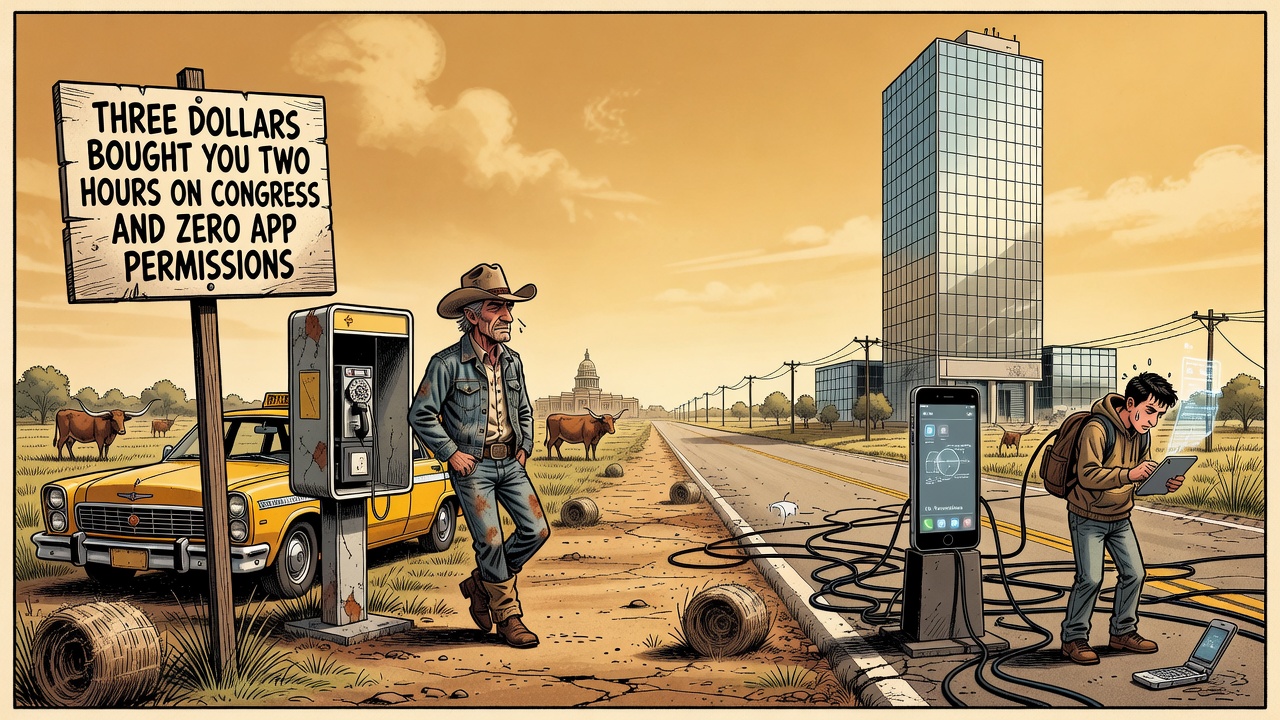
Three Dollars Bought You Two Hours on Congress and Zero App Permissions
Stood at the meter on 3rd and Congress feeding actual quarters into a machine that rejected two of them before spitting out a slip good for twelve minutes; that same stretch in 1995 let three singles buy you a lazy afternoon of record stores, cheap lunch, and no surveillance, before the city outsourced its sidewalks to a company whose app now knows your license plate, your credit score, and exactly how long you've been gone.
The machine at 3rd and Congress gave me that hostile little chirp reserved for people who still carry change. Two of the quarters came back like they'd been insulted. I dug for a third while a guy in Allbirds and a Patagonia vest waited behind me, phone already out, ready to scan, pay, and move on with his life.
I dropped the coins anyway. The dial barely moved. Twelve minutes. Not even enough time to get a decent breakfast taco and eat it without panic.
In 1995 the same meter took three dollars and gave you two honest hours. No login. No geofence. No push notification sighing at you like a disappointed parent. You slid the coins in, the mechanism clunked like an old Coke machine, and a paper ticket popped out with the expiration time printed in faded purple ink. You wedged it on the dash of your pickup or your beater Civic and walked away. The city didn't follow you.
That three dollars was admission to an afternoon that didn't feel timed like a bomb. Park near the old BookPeople location on North Lamar before it moved, but hell, even downtown you could leave the truck, duck into Waterloo Records, flip through the used bin for twenty minutes, grab a slice at the joint on 4th that smelled like grease and cigarette smoke, then wander over to Les Amis for coffee that cost a buck and came in a real cup. The meter never once texted you.
Nobody called it "curated urban mobility." It was just parking. The enforcement guy on the west side of Congress used to be named Ray. Ray wore a straw hat even in February and would sometimes let you slide if your truck had a UT parking sticker from three semesters ago. He'd lean in the window, smell the Whataburger bag, and say, "You gonna move this before three, right?" Then he'd walk off whistling. Ray didn't have an algorithm. He had opinions and a bad back.
Now the system is run by a company headquartered in Atlanta that also handles parking for three other cities that hate their residents. The new meters look like rejected prototypes from a Terminator film. They want your plate number, a credit card, and permission to track you across the grid "for safety." Pay $4.50 an hour during lunch or $7 during any festival. Surge pricing for a Thursday afternoon because some conference is in town. The app calls it "market-responsive rates." I call it getting mugged by your phone.
Last month I watched a woman in her sixties try to pay cash at one of the new kiosks on 2nd Street. The screen kept timing out. She muttered, "This is worse than the damn DMV," and I felt my soul nod so hard it nearly detached. The kid behind her in line sighed the sigh of someone who has never once needed exact change in his life. He waved his phone, tapped twice, and the kiosk thanked him by name. Welcome back, Tyler.
The worst part isn't even the money, though $18 to park while you get a haircut and buy socks is highway robbery with extra steps. It's the constant low-level surveillance. The city map in the app shows little green dots for every spot. It knows when you're early. It knows when you're late. Overstay by six minutes and the ticket appears on your phone before the ink would have dried on the old paper ones. No human being even writes it. The camera just rats you out to the cloud.
I keep a coffee can of quarters in the truck anyway. Habit. Some of them still have the 1990s shine. They feel heavier than the new ones, like they remember when they bought something real. Every so often I pull one out and look at it the way old people stare at rotary phones. My nephew, who thinks anything before Bluetooth was the Paleolithic, asked why I didn't just "use the app like a normal person." I told him normal people used to be able to afford to be absent-minded.
The change mirrors everything else. Sixth Street didn't become a nightmare overnight; it got metered, then apped, then priced until only the people filming content could linger. The old surface lots behind the Continental Club used to charge five bucks for all night. You could see two bands, eat at the taqueria that operated out of a converted gas station, and still have gas money to get home to Hyde Park. Now that same patch of dirt holds a mixed-use development with retail space for "experiential coffee" and a sign promising "live local music" that means a guy with a MacBook playing playlists.
Even the residential streets near the old neighborhoods have permit stickers now. Used to be you could visit your friend in Travis Heights, park on the hill, and not come back to a $75 ticket because you didn't pay the neighborhood protection racket. The new system assumes every car without a sticker is an enemy combatant.
I drove past the corner of 4th and Guadalupe yesterday. The meter there still has a faint sticker residue from some long-ago SXSW poster. In '98 I parked in that exact spot for a buck seventy-five, saw a band at the Electric Lounge whose name I can't remember, then sat on the curb eating a breakfast taco from a guy with a cooler. The whole night, including the taco, cost less than a single surge-priced parking session does now. The taco guy is gone. The lounge is gone. The curb got redesigned by someone who went to design school in Scandinavia.
The app developers probably call this progress. They use words like "frictionless" and "ecosystem." I call it death by a thousand QR codes. Every time I tap to extend my session I feel another small piece of the city I moved to in the '80s flake off and blow down the street toward the river.
But damn if I don't still love the place enough to argue with a parking meter that doesn't care. Some afternoons I feed it the old quarters anyway, just to hear the mechanical clunk instead of the digital bleat. For twelve minutes I'm a free man in a city that once let you linger for the price of three cold ones at the Hole in the Wall back when longnecks were still a buck fifty.
Then the app reminds me my time is almost up.
The machine doesn't know your name. It never did. But it used to at least pretend.