
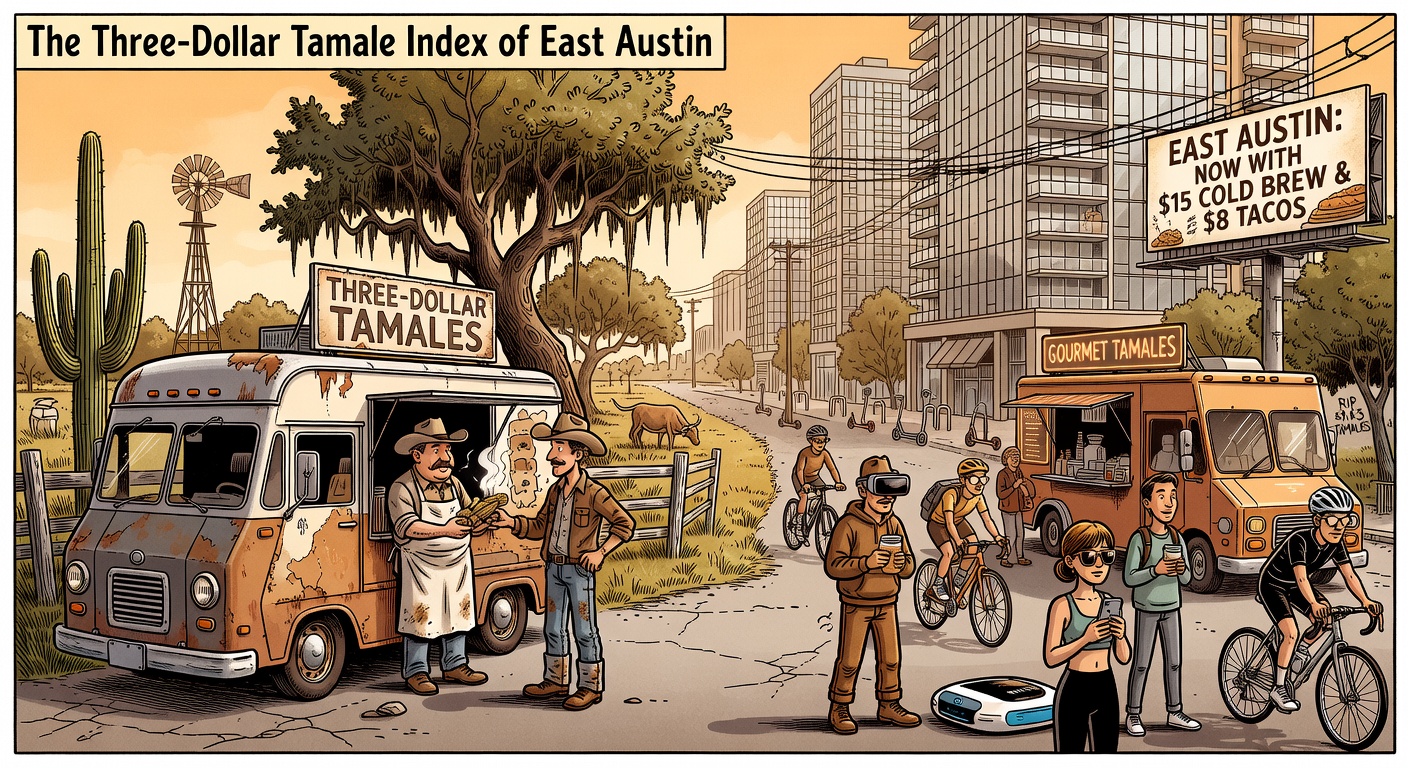
The Three-Dollar Tamale Index of East Austin
Miss Rosa's blue cooler at Cesar Chavez and Chicon moved a dozen pork tamales for three singles, no receipt, no questions; the block's new 'heritage masa collective' just rang me up $19 for half that many, complete with a compostable tray, a QR feedback link, and a wall mural of the exact cooler they helped price out of existence.
The guy behind the counter wore a black apron with a tiny embroidered corn stalk and asked if I wanted the tamales "deconstructed." I just stared at him. Twenty minutes earlier I'd been thinking about the old setup under the pecan tree, where the only decision was red or green sauce from a squeeze bottle that had probably been there since the Clinton administration.
Last Saturday the Three-Dollar Tamale Index officially broke $19. The new place calls itself Nixta Collective. Brick walls, pendant lighting, a playlist that sounds like someone fed cumbia into an AI and asked it to "chill." Six tamales, a side of pickled onions the size of a postage stamp, and a horchata that costs more than the old lady used to make in an entire morning. My receipt had more footnotes than a grad-school thesis.
Back in 2006 you just showed up. Miss Rosa kept the cooler in the shade of that twisted pecan at the southeast corner of Cesar Chavez and Chicon. She'd have the lid propped open with a brick so you could see the neat rows wrapped in foil and newspaper. Three dollars got you a dozen. Four if she liked your face. Five if you brought her a cold Coke from the gas station across the street. The newspaper was always from that week; she'd save the sports section for her husband.
The smell hit you before the visual. Steamed corn, cumin, pork shoulder that had been cooking since 4 a.m. in somebody's backyard kitchen over on Robert Martinez. No one was talking about "elevated street food." No one was taking pictures. You just stood there with the neighborhood—roofers with their shirts off, nurses coming off night shift at Brackenridge, the guy who sold raspas from a cart that looked like it survived three floods. Everybody waiting their turn without performing patience for an audience.
The new owners kept the pecan tree. Of course they did. It's in every rendering. They even named one of their tasting menus after it. But the tree is now surrounded by a low concrete planter that costs more than Miss Rosa's trailer, and there's a small plaque explaining its "cultural significance." The plaque doesn't mention that the woman who actually fed the neighborhood for twenty-seven years now lives with her daughter in Manor because the property taxes on her little place off of 2nd Street tripled.
I watched a woman in $300 sneakers explain the concept to her friend. "It's like, they honor the abuelita energy but make it accessible." The friend nodded solemnly while taking a video of her plate. The only abuelita energy I felt was the ghost of Miss Rosa side-eyeing the entire operation from wherever good tamale ladies go when developers discover their corner.
Parking deserves its own paragraph. Used to be you could pull that dented Ford Ranger halfway onto the grass and nobody said a word. Now there's a paid lot behind the building that charges $8 for the first thirty minutes. The app demands location permissions, camera access, and your firstborn just to complete the transaction. Last week some tech kid in a Rivian blocked the whole thing arguing with the valet about whether his "historical neighborhood" discount applied. The valet, who looked about nineteen, just kept repeating "It's in the terms, bro."
The ingredients supposedly come from the same farms. That's what the menu says in that careful sans-serif font. But the old tamales tasted like somebody's actual kitchen at 5 a.m.—the slight char on the outside from being kept warm in a repurposed Igloo, the unexpected raisin if you got lucky. These new ones are perfect. Uniform. Each one the exact same size, like they came off an assembly line designed by people who have never been hungry at 2 a.m. after last call at the Carousel.
The city loves to brag about supporting street vendors. They've got a whole permitting process now that requires insurance, commissary kitchen access, and a food handler's certificate that costs more than three months of old Rosa's profits. Meanwhile the developers who bought the lot for $2.4 million get tax abatements for "preserving cultural assets." The only asset they preserved is the right to charge whatever the market will bear.
My grandfather used to say you could judge a city by what poor people could afford to eat on a Tuesday. By that standard we're becoming some other place entirely. The new tamale costs more than the hourly wage of the kid making them. The old ones kept three generations of one family in shoes and school supplies. One version feeds a neighborhood. The other feeds an Instagram account.
The worst part? The new place isn't bad, exactly. The masa is fine. The filling has that careful balance of spice that suggests focus-group testing. But it's the difference between a love letter and a press release written by someone who researched love on Wikipedia.
I still have one of the old foil wrappers in my glove box. It's crumpled and stained and smells like nothing anymore, but I keep it anyway. Proof that the Three-Dollar Tamale Index didn't always live in the land of make-believe.
Progress always comes with better lighting and worse value.
The pecan tree looks the same from a distance. Up close you notice the little metal cage around it so no one can actually sit under the damn thing. Miss Rosa's cooler is long gone. In its place stands a $9,000 stainless steel refrigeration unit with app-controlled temperature alerts.
I miss the newspaper. I miss the squeeze bottle. I miss the feeling that you were participating in something that had nothing to do with anyone's brand strategy.
Next time I might just drive to Manor and see if Miss Rosa's daughter kept the recipe. Bet she still charges three bucks. Some indexes refuse to update.