
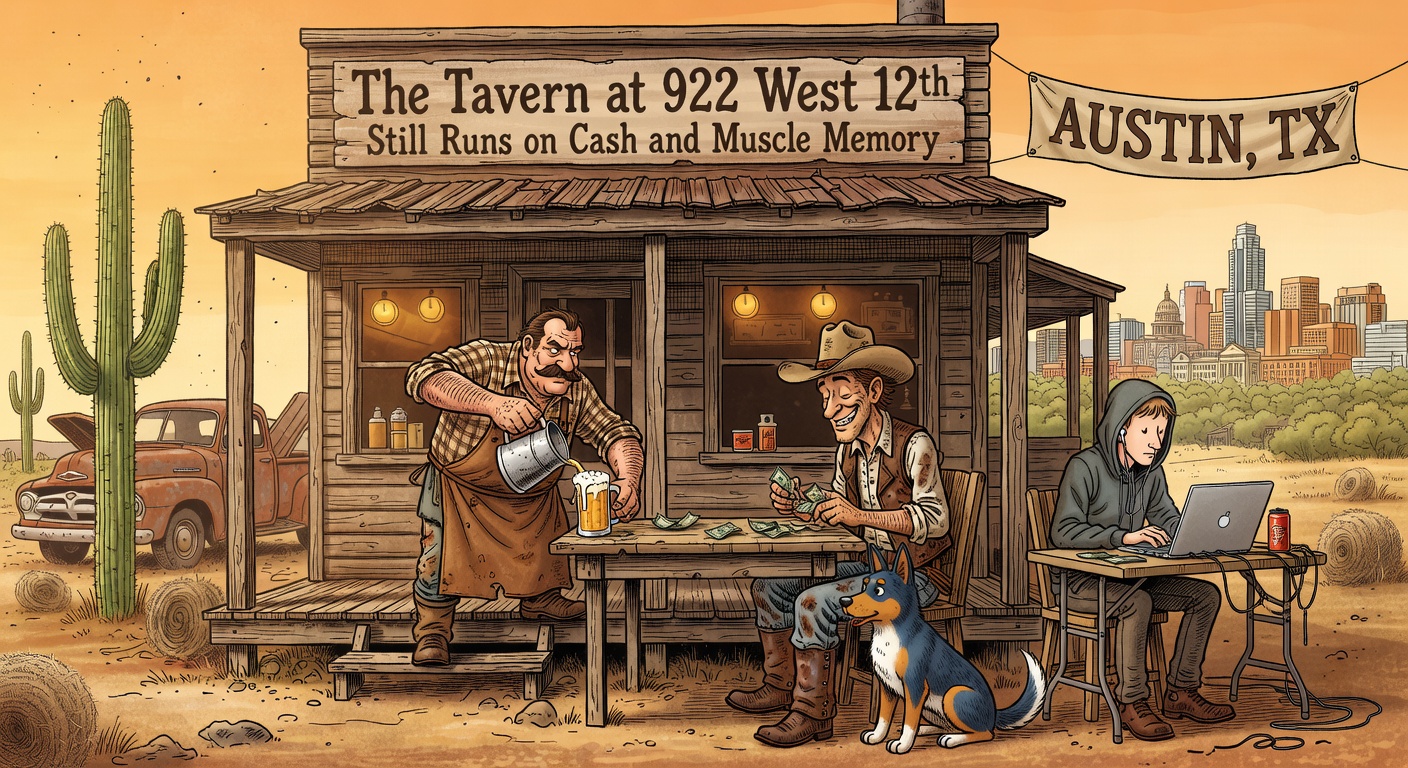
The Tavern at 922 West 12th Still Runs on Cash and Muscle Memory
Pushed through the heavy door on a sticky Tuesday to find Frank sliding over a $5.25 Shiner without being asked, while a table of remote workers in expensive sneakers debated whether the WiFi password might be "tavern1923"; the fryer oil hasn't changed since the Clinton administration, the jukebox still eats actual quarters, and the new condos across Lamar already cast long shadows over the back patio at 4 p.m.
The pool balls cracked in the back like they always have, two retirees arguing over whether 1987 was peak Longhorns, when Frank hit the button on the ancient register that sounds exactly like a '92 Buick trunk slamming shut. I took my usual spot under the faded Pearl Beer sign and watched a woman in Lululemon ask if the house margarita had "small-batch" triple sec. She received a look usually reserved for people who try to pay with Apple Watch.
The Tavern sits at the corner of 12th and Lamar in a low-slung brick building that somehow dodged every wrecking ball from the '70s through the most recent gold rush. The floor still tilts slightly toward the front door. The Christmas lights never quite come down. The air carries that specific perfume of old fryer grease, Pine-Sol, and whatever the guy three stools down is smoking on his third trip to the patio. You notice it the moment you walk in, that smell that no amount of new development can replicate or franchise.
You used to be able to park on either side of 12th for free until 6 p.m. Now the meters want an app, a credit card, and your firstborn. Last month I watched a man in a Tesla spend nine minutes trying to feed the meter while his brisket sandwich got cold on the dash. The sandwich cost $14.75. In 2008 it was $6.99 and came with chips. The meter itself is one of those sleek stainless steel models with a touchscreen that freezes when it's hot, which in Austin is roughly April through October. By the time you finish cursing at it, you've already burned through the time you came here to waste productively.
Frank has worked the day shift since at least 2004. He remembers when the UT kids wore flip-flops instead of $180 minimalist sneakers. He remembers when the back room hosted actual bands instead of "unplugged sessions" for a tequila brand. The last time I saw a real band in there was a Tuesday night in 2017 when some three-piece from San Marcos played for $150 and half the bar's tips. The guitar player kept stepping over a loose board near the monitors that still hasn't been fixed. That's the thing about places that last. They develop muscle memory, quirks and all, that no consultant could ever plan.
I've been coming here since my first apartment on 14th street when rent was still under $600 and the biggest decision was whether to ride my bike down to the river or just stay on the patio until last call. Back then the bar attracted a pretty even mix of state workers, musicians, and townies who could trace their Austin roots to the '60s. The jukebox was stocked with actual 45s for a while before it upgraded to CDs that still feel ancient now. You'd drop in after work and find three generations of the same family at one table, arguing about barbecue and football with equal heat. Those tables are still here but the families have mostly been priced out to Pflugerville or further.
The menu is a single laminated page that looks like it was typed on an IBM Selectric. No QR codes. No "chef's inspiration." Just a cheeseburger that arrives exactly the way it did when you were skipping poli-sci lectures in '99. The fries are skinny and perfect and taste faintly of every other fry that's ever been in that basket. I don't want them to change. Changing would be a betrayal on the level of turning the old Liberty Lunch site into yet another mixed-use development with a coffee concept on the first floor. The chicken fried steak is still on the menu though they raised the price to $16.95 which would have bought you three meals and a pitcher in the early 2000s. But it comes with cream gravy that tastes like home if your home was a grandmother who didn't care about calories or trends.
Being so close to the pink granite dome means it catches the lobbyists and the staffers on Fridays, but even they complain that the new development has turned what used to be a quick walk from the office into an obstacle course of construction barriers, abandoned scooters, and pop-up patios serving eighteen dollar cocktails with dehydrated citrus wheels. The Capitol itself looks unchanged from the outside but the streets feeding it have been rewritten. What was once a straightforward grid of bars and small businesses is now a corridor of glass facades and signage that screams "elevated Austin experience" at anyone with a disposable income.
The new residents wander in sometimes. They order Topo Chicos with lime and ask if we "do natural wine." Frank tells them the list is on the wall: Miller Lite, Shiner, Bud Light, and whatever local IPA is currently $6.50. They usually take a picture of the neon sign outside, post it with the caption "Real Austin found," then leave before the happy hour rush of actual locals who got off work at the Capitol or the tag agency or the tire shop that somehow still operates two blocks down. One guy last week tried to explain cryptocurrency to a retired DPS officer who just wanted to watch the Rangers game in peace. The silence that followed was more eloquent than any TED talk.
The patio used to be gravel and hope. Now it's got those string lights that make everyone look like they're in a Netflix original about finding themselves in Austin. The condos loom so close you can hear their residents' Nespressos grinding in the morning. One of them has a rooftop deck where they do "sunset sound baths" every Thursday. I know this because the chants drift across Lamar and mix weirdly with whatever George Strait song is playing inside the Tavern. The contrast is never lost on the old timers who simply raise their cans a little higher as if toasting the absurdity of it all.
There's a photo near the bathroom of the place in 1973. Same sign. Same brick. Different cars out front. The prices on the board in the photo are so low they feel like a prank from another dimension. But the faces at the bar look exactly the same as the faces there now — tired in the right way, skeptical of anything too new, quietly thrilled that the beer is still cold and the company doesn't require a subscription. That continuity is getting harder to find. Venues like the old Emo's on Red River or the original Hole in the Wall had their own versions of this same stubborn endurance before the ground shifted under them.
Frank himself is an Austin archetype that's disappearing — the bartender who doesn't perform personality for tips, doesn't have a podcast, and won't remember your name but will remember your drink and whether you tipped well last time. He moves behind the bar with the efficiency of someone who's done the same twenty steps for twenty years. Wipe, pour, ring, repeat. No small talk unless you earn it. No upselling the special IPA that some distributor paid to get on tap. When the remote workers asked about oat milk he didn't even bother with sarcasm. Just a flat "no" that landed like a judge's gavel.
In the corner booth sat a guitar player I recognized from the old Cactus Cafe circuit. He was nursing a hangover and a Lone Star, scribbling lyrics on a napkin the way people used to before notes apps ate our brains. We nodded at each other in recognition of the shared timeline. Around us the afternoon light slanted through the front windows in exactly the same pattern it has for decades, catching dust motes that probably contain particles of every band that ever loaded in through the back alley. The place absorbs its history without making a show of it. No Instagram wall. No QR code linking to a playlist of "Tavern classics." Just the jukebox and the memories it triggers when certain songs hit.
I sat there for two hours and took notes like the grouch I am. The guy next to me wore a name tag from some conference at the Convention Center. His lanyard said "Disrupting Belongingness." He ordered a club soda and lime, then spent twenty minutes explaining to Frank how the bar could "optimize its footprint" with a better point-of-sale system. Frank, who has run this place through two recessions and one pandemic with nothing but a drawer full of cash and a legal pad, just nodded and said, "That'll be seven twenty-five." The exchange summed up more about the city's direction than any chamber of commerce report ever could.
The jukebox still works if you feed it quarters. Someone had loaded it with the usual suspects — Willie, Waylon, Johnny Cash, some Stevie Ray. But some brave soul had also added three Tyler Childers tracks and, God help us, a Post Malone song that somehow feels right at 3 p.m. when the light hits the stained glass just so. The machine is older than most of the people currently renting the $2,400 studios three blocks away on streets that used to hold actual houses with actual yards where kids left bikes unchained.
At least the bathroom graffiti is still funnier than anything on Threads. In the end the place survives because it refuses to become an attraction, which in this town is becoming the rarest quality of all.