
The Sign at 12th and Airport Still Has Oil Stains Underneath
The old Martinez Auto at 12th and Airport did $29 oil changes and let you drink a Lone Star while waiting; now Velocity Workspace charges $549/month for a standing desk where the lift was and calls the grease pit legacy infrastructure.
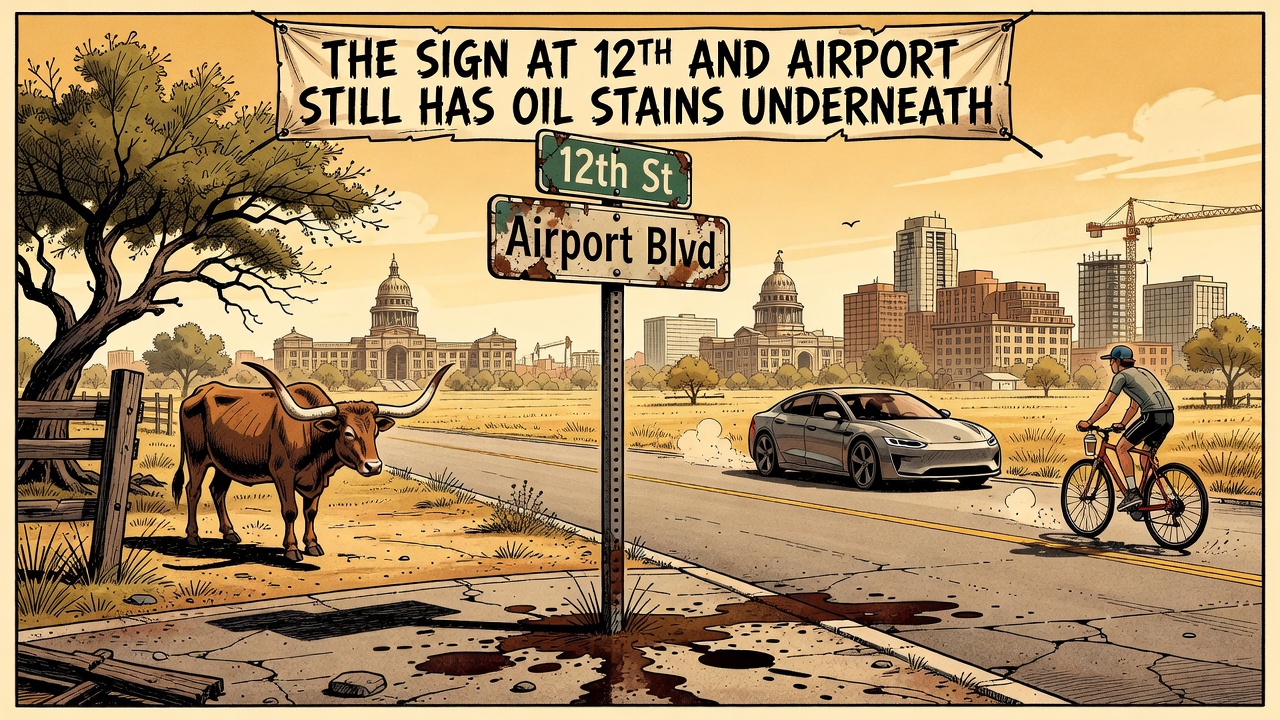
The sign at 12th and Airport still has oil stains underneath.
I saw it yesterday while stuck behind a lime-green Cybertruck that couldn't decide if the railroad tracks were a feature or a bug. The old Martinez Auto banner—hand-painted, sun-faded, letters half peeled—had been replaced by crisp white vinyl screaming "VELOCITY WORKSPACE: Where Momentum Meets Community." They left the original concrete footer, the one with the hydraulic lift anchors still poking up like broken teeth. Progress with footnotes.
Back in '07 you pulled in with a knocking Civic and Eddie Martinez would slide out from underneath somebody else's truck, wipe his hands on a rag that had seen every fluid known to man, and tell you the truth for forty bucks. No appointment. No app. Sometimes he'd wave off payment if you brought him a breakfast taco from the truck that used to park across the street. The radio played norteño loud enough to hear over the air compressor. The place smelled like burned coffee, Pennzoil, and the particular metallic tang of a hundred thousand brake jobs. You left with a working car and a story about the time Eddie's dog stole somebody's hamburger.
Now the dog is gone. The compressor is gone. The smell has been replaced by that unmistakable tech-office odor: fresh paint, oat milk, and quiet desperation.
The guy behind Velocity calls himself "a recovering product manager." His name is Reid. Reid has the regulation three-day stubble, the expensive sneakers that look like they were designed by a committee, and the habit of referring to every square foot of the property as "the footprint." He sent me an email two weeks ago after I stood on the sidewalk too long staring at the construction fence. Subject line: "Hey, fellow Austinite—let's chat about preserving what matters."
I almost deleted it. Then I noticed the signature block listed his pronouns, his former employer, and something called an "angel thesis."
Reid bought the lot for low seven figures after Eddie finally retired. The family had owned it since the late '80s. They fixed cars for cops, cooks, musicians, and the occasional escaped UT professor who didn't trust the dealership. Rent on the adjacent houses used to run $750 for a two-bedroom with a carport. Reid's team now lists similar square footage as "micro-live/work creative nodes" at $4,200. The creative node comes with mandatory networking events and a sensor that tracks how often you use the standing desk.
I went to the open house. Of course I did.
They had those tall tables that nobody actually uses and a cooler full of beverages that all tasted like they were apologizing for having calories. A woman in architect glasses asked if I was "building in the mobility vertical." I told her I was mostly trying to get my 2003 Tacoma to stop leaking transmission fluid. She laughed the way people do when they think you're performing authenticity.
Reid appeared wearing a shirt that said "Operator" in that minimalist font. He wanted to show me the "legacy wall" they'd kept—the one with the old Martinez Auto calendar still tacked up from 2014. Next to it they'd installed a digital screen cycling through renderings of what the space would look like once they raised their Series A. The renderings featured a lot of plants and people who clearly had never changed their own oil.
The only authentic thing left on that wall is the coffee stain in the corner.
He kept using the word "ecosystem." The neighborhood already had an ecosystem. It involved mechanics, line cooks, drywall guys, and the woman who sold paletas from a cooler in a shopping cart. That ecosystem ran on cash, handshakes, and the understanding that sometimes you just need your damn car to start. Reid's ecosystem runs on pitch decks, investor updates, and the unshakable belief that everything improves when you add a dashboard.
At one point he gestured toward the back bay where Eddie used to keep the spare tires stacked like black donuts. "We're thinking that's going to be the founder lounge," he said. "Comfy seating, some IPAs from a local brewery that actually gets distribution in California." He said this without irony. The local brewery he mentioned used to be a garage band practice space before someone decided IPAs needed a direct-to-consumer subscription model.
I asked him what happens to the three guys who used to work on cars here. The ones who spoke Spanish and could diagnose a bad alternator by sound alone. Reid gave me the smile. The one that says I have a deck for that. "We're exploring opportunities in the EV transition space," he said. "These legacy skills will find new expression."
New expression. Like the skills are a poem that just needed better formatting.
The punchline arrived when he tried to sell me a membership. Twelve hundred a year for access to the space after hours, plus the right to attend something called "Maintenance Mondays" where they bring in actual mechanics but only as guest speakers. The mechanics don't get the membership rate. I know this because I asked.
Outside, the July heat sat on everything like a drunk uncle. A guy in a hi-vis vest was pressure-washing the last of the old Martinez Auto signage off the curb. The water ran black for a long time. Old grease doesn't give up easy. I stood there until the runoff ran clear, thinking about the night in 2011 when Eddie let me sleep in my car in the lot after a show at the Mohawk because I was too broke for gas and too proud to call anyone.
That version of the city didn't need a Slack channel to know when something was broken. It just fixed it or made room for it or, sometimes, sat with it until morning with the windows down and the radio low.
Reid texted me again this morning. Wants to know if I'd be interested in being a "neighborhood historian" for their blog. Pays in equity and free cold brew. I haven't answered yet. The cursor blinks at me like an impatient leasing agent.
The sign at 12th and Airport still has oil stains underneath. For now. But they're already talking about power-washing the whole block for the "clean launch experience."
Some things you can't optimize. You can only pave over them and pretend the new version has better retention metrics. The old lift anchors are still in the concrete if you know where to look, but Reid's team has already sketched a juice bar on top of them. The mechanics who once worked here now drive for ride-share apps or fix trucks out of their driveways in Manor. Reid calls that "the market finding equilibrium."
I drove past again at dusk. The new glass doors reflected the taillights of tech shuttles heading west. Inside, someone had propped a fixed-gear bike against the wall where the tire machine used to sit. A QR code on the window invited me to "scan for community values." I kept walking. The air still carried a faint trace of gear oil if the wind hit it right, like the building itself was refusing to update its status.
Eddie Martinez died last year. The obituary in the Statesman mentioned the shop in one line, called it a "beloved East Side landmark." Nobody from Velocity showed up at the service. They were too busy onboarding their first cohort of "movement architects" who pay extra for the desk with the best view of the railroad tracks. Those tracks still rumble at night, same as they did when the place was full of sparks and swearing and actual work.
The banner might be new, the desks might be ergonomic, but the oil stains remember. Concrete holds a grudge better than any Slack thread. One day they'll grind it all down for a bike lane or a pop-up matcha stand, but until then the sign at 12th and Airport keeps its dirty secret. Some parts of old Austin don't vanish. They just wait under fresh paint, leaking through every time it rains.