
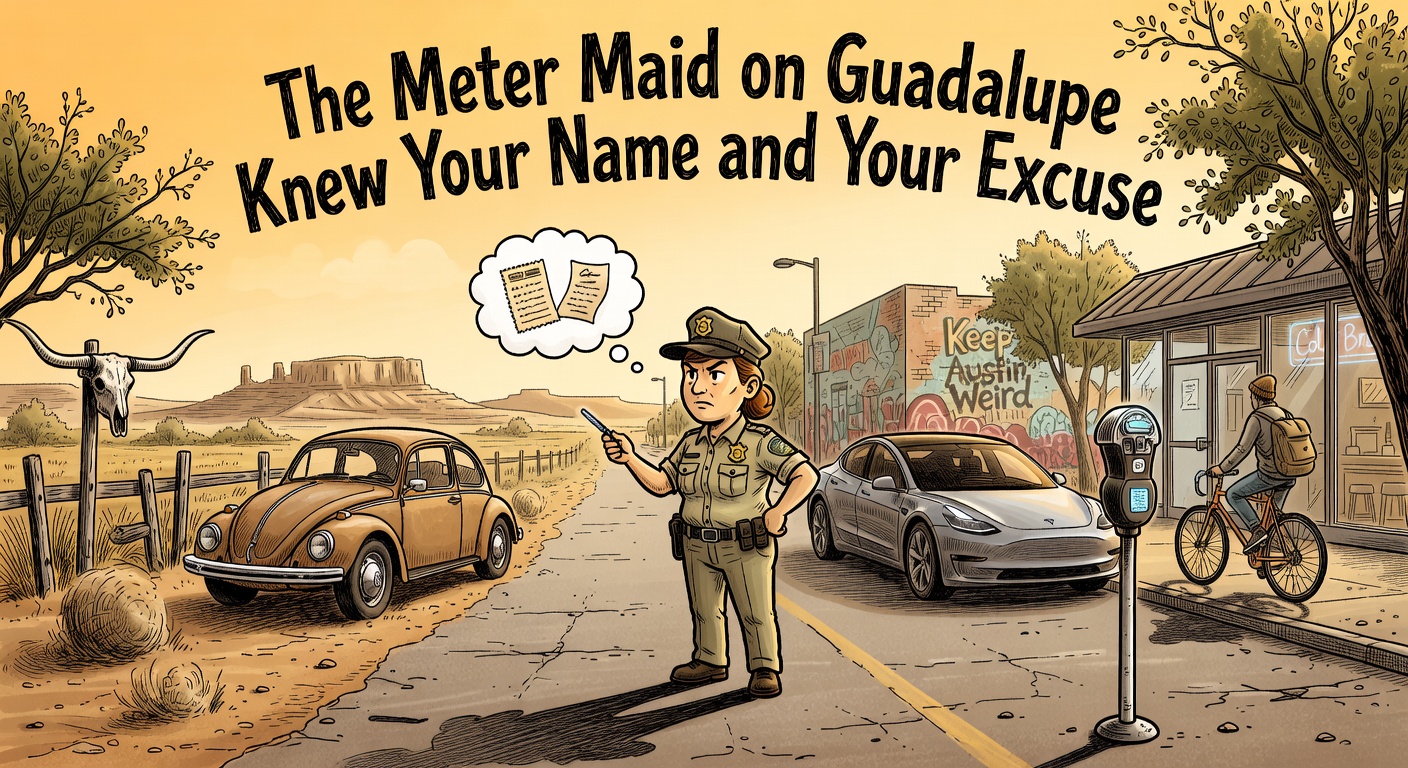
The Meter Maid on Guadalupe Knew Your Name and Your Excuse
Betty used to cruise the meters from 24th to 29th in a golf cart older than most freshmen, waving at regulars and only writing tickets when you truly deserved it; last week the new plate-reading cameras zinged me $34 for eleven minutes over on a spot outside the old University Co-op while I was buying one remaining real paperback, no conversation, no mercy, no Betty.
The orange envelope was waiting on the windshield like a parking ticket from a robot with no sense of humor. No handwriting. No little note about how the Rangers blew it again last night. Just a QR code, a case number, and a demand for $34 that hit my phone before I even crossed Guadalupe with my bag of overpriced trail mix.
I stood there a minute, truck still ticking from the drive in, remembering the woman who used to own this stretch of curb. Betty. Short, sun-leathered, voice like gravel soaked in Shiner. She drove that same faded city cart every morning for twenty-something years, radio playing KOKE-FM low enough you could hear it from half a block away. Knew every regular by sight, car, and sob story.
You could watch her make decisions in real time. Student with expired plates and a backseat full of laundry? She'd knock on the window, tell you to get your act together, and roll on. Local musician loading a bass cab into the back of a van outside the Hole? She'd pretend the meter was broken for an extra ten minutes. Only the shiny new BMWs from Westlake got the full treatment, and even then she'd usually walk over and give the driver a lecture about "this ain't Dallas, buddy" before writing anything.
The Drag in those days ran on a system of small understandings. The meters took actual quarters—remember those?—and if you were a buck short Betty might accept a slightly stale kolache from the Polish place that used to be where the poke bowl spot is now. She knew whose grandma was sick, whose band just got a record deal, whose truck had been parked there since Tuesday because the alternator crapped out again. The city got its money, mostly. The people got to stay human.
Last Tuesday the system didn't care that I'd only stepped into the Co-op to replace a copy of Lonesome Dove that finally fell apart after twenty reads. The cameras don't read context. They read pixels. My 2009 Tacoma with the dent from that 2017 hailstorm and the bumper sticker that still says "Keep Austin Weird" even though the people who printed those stickers moved to Denver years ago triggered an automatic violation. Thirty-four dollars. Instant. Impersonal. Efficient.
I paid it on the app while standing under the same live oak that used to drop acorns on Betty's cart every fall. The transaction made a little digital whoosh sound that felt obscene. Somewhere in a server farm a line item now reads "revenue optimization event" instead of "Betty let the grouch slide again."
The new parking regime loves data. Every spot on Guadalupe between MLK and 38th is tracked, logged, priced according to some algorithm that probably went to Stanford. Peak hours around class change spike to six bucks an hour. During SXSW it hits twelve. They send you helpful push notifications like "Your session is 47% utilized—would you like to extend for optimal convenience?" I have never wanted to throw my phone into Waller Creek more than when that particular robot voice starts talking to me.
Used to be you'd feed the meter, run into the Texas Union for a $1.75 cup of coffee and a breakfast taco that came wrapped in actual foil, not some compostable fiber coffin. If you were running late, you might see Betty on the way back and give her the universal "one minute" finger. She'd roll her eyes but give it to you. The exchange felt like part of the city’s operating system. The new system has no eyes to roll.
My friend Chuy, who drove a delivery van for the old Bookstop until it became that overpriced gym, swears he once talked Betty out of ticketing him by producing two tamales and a credible story about his cousin's wedding. The tamales were from the lady who parked her cooler on the corner of 26th where the smoothie franchise now sells $9.50 wheatgrass shots. Everything was connected. The meters, the food, the people, the excuses.
Now the only connection is your credit card and their database. The city council presentation probably called it "frictionless urban mobility." I call it the death of small negotiations that made living here feel like living somewhere instead of inside a branded experience.
Walk the same block today and you'll see the new enforcement vehicles—white SUVs with enough cameras to film a Marvel movie. No faces. No radios playing country music. Just silent collection machines. The kid working the pop-up coffee trailer near 25th told me even he gets dinged if his truck sits too long while he's refilling the cold brew tanks. He used to joke with Betty about her terrible taste in football teams. Now he just hopes the algorithm doesn't notice him.
I sat in the truck for a while after paying the ticket, watching students hurry past with their AirPods and their $1,800 MacBooks. None of them will ever know the small theater that used to play out on this curb three times a week. The polite haggling. The grudging respect. The way Betty would sometimes just lean against your hood and ask how your mom was doing after that surgery in '03. She remembered the surgery. The new system doesn't even know you have a mom.
The worst part is how quickly we accepted it. First the meters went digital. Then they added the pay-by-phone signs with those impossible-to-read QR codes that never scan right in direct sunlight. Then the cameras. Then the app that knows where you live and works and probably what you had for breakfast. Each step felt small. Each step made the city a little less ours.
At least the old tickets came with a story.
I still have one from 2004 in my glove box. Handwritten. Twenty dollars. Betty's unmistakable scrawl across the bottom: "This is your last warning, hotshot. —B." I kept it because it felt like a note from the city itself. A city that knew your name, your car, your bullshit, and was willing to work with you anyway.
The new ticket doesn't even have Betty's initials. Just a string of numbers and a link to pay.
I started the truck, checked the rearview, and pulled out before the algorithm could decide I'd overstayed my grief. Somewhere up the block a new condo building was advertising "live-work-play units" starting at $2,450 for 480 square feet. The sign featured models laughing on a balcony that overlooked the exact stretch of curb where Betty used to let the world be messy for just a little while longer.
Progress, they call it. I call it expensive loneliness wearing the skin of convenience. The meters keep turning. The city keeps collecting. But the small kindnesses that once balanced the books are gone, and no app is ever going to bring them back.