
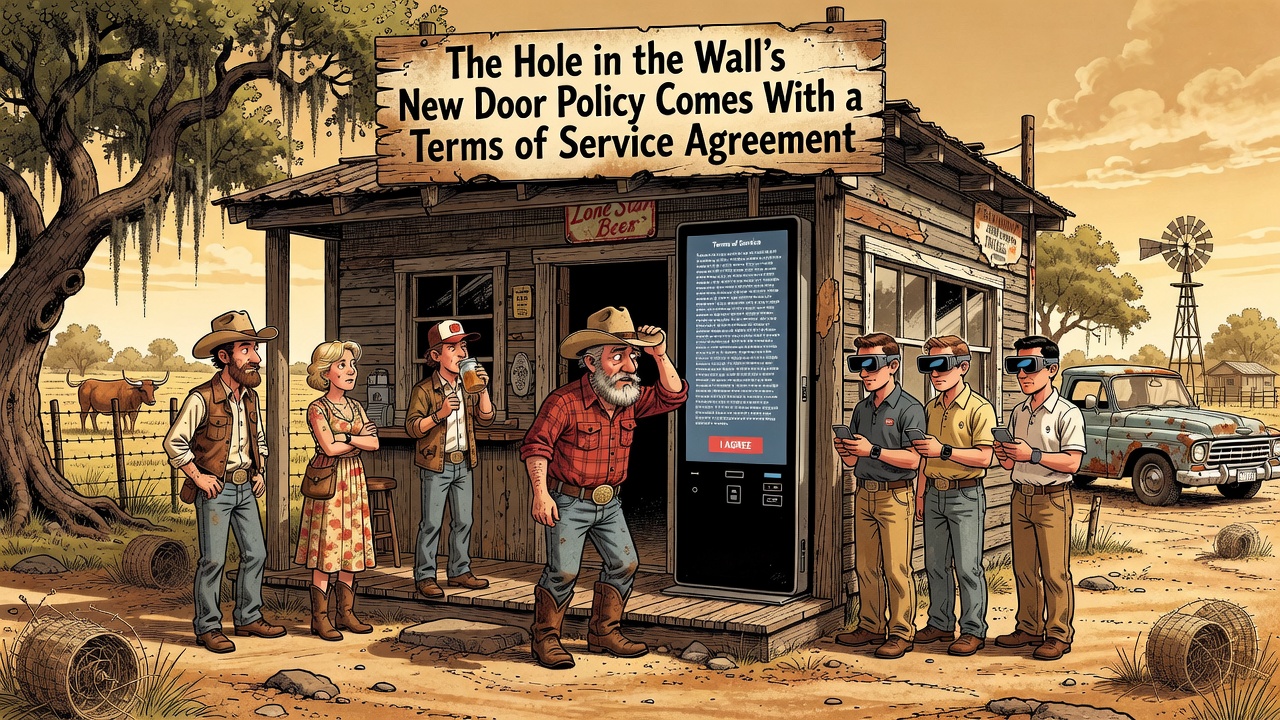
The Hole in the Wall's New Door Policy Comes With a Terms of Service Agreement
The old Hole in the Wall let you slide the doorman a crumpled ten, grab a $3 Shiner, and stand close enough to read the setlist taped to the monitor; the address now requires app-based tickets, a liability waiver, $19 "heritage" lagers, and a host who asked if I'd pre-selected my "vibe preference" before entering the room where the Gourds once played until the cops gave up.
The guy at the door last night wore a headset and held his tablet like it was the Ark of the Covenant. I reached for my wallet out of pure muscle memory. He flinched.
"Have you completed the entry form, sir?"
I had not. Twenty years ago the only form at 2538 Guadalupe was the one some band had signed in Sharpie on the green room wall promising they'd come back if the bar still had that one bottle of Evan Williams. Five bucks cash. Sometimes seven if it was a double bill. The stamp was half a smiley face that looked like it was applied by a drunk raccoon.
He explained the new policy while a line of twenty-somethings in matching black hoodies formed behind me. Terms of service. Age verification tied to your phone. A quick survey about "preferred genres" that somehow fed an algorithm deciding which bar station you got routed toward. I asked if I could just pay the man and go stand by the stage. He smiled the way people do when they've been trained to de-escalate.
The stage is still in the same corner. The floor in front of it has been refinished with some space-age epoxy that doesn't hold beer spills the way the old warped wood did. That wood remembered everything. It remembered the night the Damnations played so hard the monitors walked themselves off the stands. It remembered every dropped pint, every stomped boot, every time somebody proposed marriage during "South Texas" and got turned down in real time.
Now the floor is clean enough to eat off, which is ironic because the food menu costs more than most of us used to spend on an entire night. The "curated bar bites" come on little slate tiles that look like they were stolen from a fancy cemetery. Eighteen dollars for three tacos that arrived deconstructed so you could "engage with the ingredients mindfully."
I ordered a beer instead. The tap list had been focus-grouped into oblivion. No Lone Star. No PBR. Nothing that might offend the delicate sensibilities of the new clientele. I paid $11.50 for something called "Texas Heritage Golden Lager" that tasted like it had been brewed by someone who'd only read about Texas in a book. The glass was frosted so aggressively it felt like drinking from an iceberg.
Behind the bar stood a woman who looked like she'd never had to break up a fight between two guys arguing about Doug Sahm. She didn't know who the previous bartenders were. When I mentioned Dale Watson used to sit right there on that stool and drink whiskey while off-duty, she asked if he was "an influencer."
The sound system is undeniably better. Crystal clear. Impeccable monitors. Zero feedback. The old PA at the Hole sounded like it had been assembled from parts found behind a gas station in Lockhart. It crackled. It hissed. It made every band sound a little dangerous, like the music might break the equipment at any second. That was the point. Danger. Possibility. The sense that something could go wrong in the best possible way.
This new system doesn't allow for wrong notes. Or wrong people.
I watched a couple in their late twenties try to dance. They kept checking their phones to see if the song was almost over so they could rate it in the app. The band—a perfectly competent four-piece from Denver—was playing what used to be called alt-country before that term got scrubbed for being problematic. The singer had the moves down. The lyrics scanned. Everything was fine. Nothing was memorable.
The old Hole didn't do "fine." You either killed or you died up there. The crowd was merciless in that loving, horrible way only real scenes can manage. If you brought it, they'd buy you shots until you couldn't stand. If you phoned it in, they'd talk over you until the sound guy turned off your mic out of pity.
A man in expensive shoes leaned over and asked if I came here often. I said I used to. He nodded like we'd shared something profound and told me he was "super into legacy venues" right now. His startup was building an AI that could predict which local bands would "scale" based on their streaming data and "cultural adjacency scores." He offered me a card. I told him the only adjacency score that mattered at the old Hole was how close you could stand to the band without getting hit by a beer can.
He didn't write that down.
The bathrooms have been completely redone. Of course they have. The old ones were legendary in the worst ways—graffiti from 1987 layered over graffiti from 1974, a toilet that flushed maybe 40% of the time, and a smell that could strip paint. Musicians used to sign the walls after good shows. Those walls are gone now, replaced by smooth tile and those automatic everything fixtures that never quite work right. There's a QR code on the mirror that takes you to a feedback form. "How was your restroom experience?"
My restroom experience was better when it involved a guy named Bubba threatening to fight anyone who didn't wash their hands.
Outside, Guadalupe has been pressure-washed of its character. The weirdness that used to spill out of the Hole and into the street—drunks arguing about Willie, kids from UT discovering real music for the first time, townies who'd been coming since the Cosmic Cowboy days—has been curated out. The new weird is planned. It's in the branding. It's optional and Instagram-friendly.
I left before the headliner. The app sent me a push notification asking why I departed early and if I'd like to complete a three-question survey for a chance to win priority access next month. I deleted it while sitting in my truck, which I'd managed to park in the same unpaid spot off 26th that I used in 2004. Some things the new regime hasn't figured out yet.
The Hole in the Wall didn't need an algorithm to know who belonged. It sorted you the moment you walked in. The wrong people self-selected out after one night of sticky floors and loud opinions. The right ones stayed, got converted, joined the family whether they wanted to or not.
The new place has better margins. Cleaner bathrooms. A robust data collection policy.
It also has a terms of service agreement longer than most bands' setlists used to be.
The music was louder then, even when it wasn't amplified. At least the beer was cold. And the floor remembered your name.
What really sticks is how the new version treats memory itself as a liability. The old Hole had layers. You'd hear stories from '82 about the time some punk band set off fireworks inside and the sprinklers turned the place into a mud pit. Bartenders kept mental ledgers of who owed rounds and who once fixed the broken toilet with a coat hanger at 1 a.m. Nobody wrote it down. The place ran on oral tradition, dirty looks, and the occasional fistfight that ended in free drinks for everyone.
Last night the "guest experience coordinator" kept referring to the venue's "heritage moments" like they were features in an app update. She pointed to a small plaque by the stage that listed "iconic performances" with corporate sponsors attached. The Gourds show from '99 wasn't on it. Neither was the night James McMurtry debuted a new song and the whole room went dead quiet except for one guy in the back yelling "hell yeah" every chorus. Those didn't fit the new narrative. Too messy. Too local. Not enough brand alignment.
I stood at the bar nursing that overpriced lager and watched a group of tech workers debate whether the room "felt authentic enough" for their team offsite. One of them pulled up an app—yes, another one—that scores venues on a "lived-in index." The Hole scored a 4.2. The coordinator overheard and immediately launched into a rehearsed speech about recent renovations that "honored the original spirit while elevating the patron journey." She used the word "journey" three times. I counted.
The old journey was simpler. You parked where you could, hoped the transmission held, walked in, paid cash, drank cheap beer, and let the music hit you in the chest. If the band was bad you left or heckled. If they were transcendent you bought the cassette from the merch table that was just a folding card table with a cardboard box for money. No Venmo. No email capture. Just a handwritten sign that said "tapes $5, shirts $10, we take IOUs from friends."
Friends. That word meant something specific here once. It meant you'd seen each other at a dozen shows, shared a cigarette on the sidewalk, knew whose dog was tied up out back. The new management sends follow-up emails addressing you as "valued patron" and offers loyalty points for checking in via GPS. My phone buzzed with one while I was still standing there: "Don't forget to tag #HoleRevival for a chance to be featured on our feed!"
I didn't tag anything. Instead I thought about the smell. The old Hole had a particular odor after midnight—stale beer, sweat, cigarette smoke even after the ban, and something like sawdust from the stage. It wasn't pleasant but it was distinct. You could close your eyes in any other bar in town and still know when you'd wandered into the Hole. The new HVAC system has erased that. Now it smells like nothing, or worse, like the generic "lifestyle venue" scent they pump into every renovated space from here to Brooklyn. Citrus notes with a hint of cedar. Sanitized memory.
Outside on Guadalupe the traffic still rushes past but the pedestrians have changed. Fewer faded Freewheelin' t-shirts, more subtle logos from startups that raised Series A last quarter. The kids who used to busk on the corner with a battered guitar case are gone too, replaced by a permitted performer whose setlist is vetted and whose amplifier complies with new decibel limits. The city calls it progress. I call it sanding down every rough edge until the city feels like an app itself—frictionless, predictable, and utterly without surprise.
A block away, the old Cactus Cafe sits dark, another casualty of the same disease. But that's another story for another night. Tonight was about watching the Hole get hollowed out in real time. They kept the name. They kept the sign out front, though it's been restored to a level of cleanliness that feels like betrayal. The letters are the same but the meaning has been updated in the terms of service.
I finally left when the coordinator asked if I'd like to join their "artist alumni network" for a monthly subscription fee. The irony was too thick even for an old grouch like me. Alumni network. As if playing the Hole was comparable to graduating from UT with a business degree. The bands that built this room didn't network. They survived. They fought for every gig, loaded their own gear through that impossible back door, and hoped the sound guy hadn't been drinking too early.
The sound guy back then was a legend named Mike. He could make a pawn shop guitar sound like a cathedral or ruin a $2,000 rig if he didn't like your attitude. No LinkedIn profile. No portfolio. Just a ratty notebook with every band's name and his honest opinion scrawled next to it. That notebook probably got thrown away during the renovation. Too much personality. Too many unfiltered opinions. The new sound crew wears branded polos and follows a technical rider that specifies exact decibel levels so as not to disturb the "experiential flow" of the space.
On my way out I paused by the green room door, now locked and labeled "private artist lounge—keycard access only." Through the glass I could see a mini fridge stocked with branded water and a whiteboard with tomorrow's schedule. No graffiti. No empty whiskey bottles. No remnants of the all-night poker game that once happened after a particularly rowdy set by the Hackberries.
The doorman with the tablet nodded at me as I left. "Thank you for your feedback," he said, though I hadn't given any. The app would be sending me a survey shortly, no doubt. Rate your experience. Would you recommend us to a friend? What words come to mind: authentic, vibrant, legacy, elevated?
I know the words that come to my mind, but they aren't suitable for their feedback form. They're the kind of words that used to get shouted at bad bands right before the sound got cut. The kind of words that belonged on those old bathroom walls alongside phone numbers for good coke and better times.
The Hole in the Wall is still standing at 2538 Guadalupe. But the hole where the heart used to be? That's been patched over with epoxy flooring, terms of service, and $19 lagers. The floor doesn't remember anything anymore. And neither, it seems, does the city.