
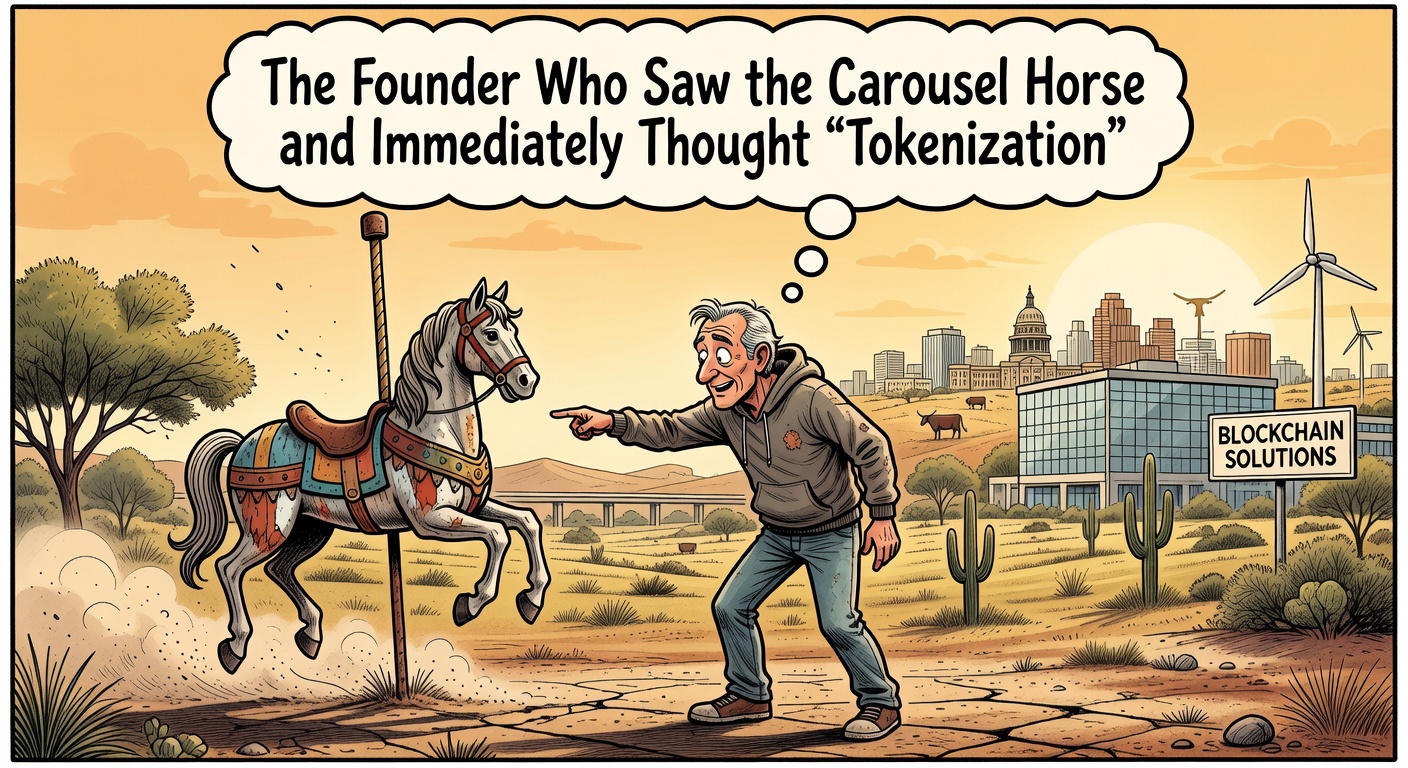
The Founder Who Saw the Carousel Horse and Immediately Thought 'Tokenization'
The tech founder who bought the Carousel Lounge in 2024 kept the fiberglass horse and the rodeo posters but added NFT bar tabs, a $9 minimum on domestic cans, and a 'heritage DAO' that lets token holders vote on playlist themes; last Friday he explained his vision for 'productizing weird' while I watched a 68-year-old townie get gently escorted out for not having the membership QR code.
The email invite came with a QR code and a dress code: "neo-western casual." I went anyway, because some things you have to see for yourself.
Inside the Carousel Lounge on East 52nd, the air smelled like cedarwood diffuser and venture capital. The famous fiberglass horse still stood in the corner, but someone had installed a discreet ring light above it and a small plaque explaining its "cultural IP value." The sticky concrete floor I remembered from nights when the band quit at 1 a.m. and the real weirdos kept drinking was now a polished epoxy that reflected your phone screen back at you.
Jordan — our tech-bro of the week — held court by the horse like a zookeeper introducing a new exhibit. Patagonia vest over a $400 Western shirt, beard shaped like he had a barber on retainer, shoes that had never touched actual dirt. He was explaining to three twenty-somethings how he'd "discovered" the Carousel in late 2023.
"I was driving back from a board meeting in Dripping Springs and just felt the Austin energy, you know? This place was raw. Untapped."
Raw. The word people use when they mean "people who worked for a living used to drink here."
Back in 2007 the Carousel was the place you went when Sixth Street felt too performed. You could nurse a $2.75 Lone Star for an hour while the bartender — a woman named Rhonda who called everyone "baby" without a trace of irony — kept the pool table lights on until the last straggler stumbled out. The jukebox had actual physical buttons. Merle Haggard sat next to the Ramones and nobody thought it was quirky branding. The parking lot was gravel and half the cars had bumper stickers from the '94 election. On hot nights the smell of mesquite from the grill next door mixed with cigarette smoke and cheap cologne in a way no diffuser will ever replicate.
Jordan raised $4.8 million to "reopen" it. The press release called the previous owners "beloved but limited in their ability to scale the experience." Limited. That's what they call it when people run a bar instead of a lifestyle platform.
Now the beer menu starts at nine dollars. There's a section called "Heritage Cocktails" that includes something called the Bucking Bronco — bourbon, ginger, smoked rosemary, and a $3 add-on for "activated charcoal" that I'm pretty sure is just food coloring and attitude. The old rodeo photos are still on the wall but each one has a little NFC chip. Tap your phone and it tells you the "story" behind the image, written by someone who definitely wasn't there.
I ordered the cheapest thing available and watched Jordan work the room. He kept using the phrase "analog authenticity" like it was a seasoning. At one point he gestured at the horse and said, completely serious, "We're exploring tokenization models that let early community members own fractional equity in the mascot itself."
I nearly choked on nine-dollar beer.
The new crowd looked like every other tech import I've watched colonize East Side bars over the last decade. They stood in clusters talking about burn rates and cap tables while wearing T-shirts that said things like "Keep Austin Weird Since 2022." One guy in limited-edition hiking boots was explaining how the Carousel fit into his thesis on "third places as decentralized social graphs." The woman next to him nodded vigorously while filming the horse for content.
The old regulars haven't completely vanished. A few still show up on weeknights before the velvet rope goes up at eight. I watched one — a retired mechanic who'd been coming here since the Ford plant days — get asked if he had the membership app. When he said he just wanted a beer like always, the new bouncer suggested he check out the "legacy pricing tier" launching next quarter.
Jordan caught me observing and made a beeline.
"Man, the stories these walls could tell," he said, clapping me on the shoulder like we'd served together. "We're capturing oral histories next month. Got a grant from a Web3 philanthropy fund."
I asked if any of the original bartenders or regulars were part of this oral history project. He blinked twice.
"We're focusing on narrative architects who can really capture the essence."
Of course they are.
The saddest part isn't even the prices or the apps or the guy who replaced the jukebox with a Sonos system programmed to play "indie Western" playlists. It's the way the place now feels like it's wearing a costume of itself. The weirdness that used to happen naturally — the 2 a.m. singalongs, the arguments about Willie versus Waylon that somehow turned into free guitar lessons in the parking lot, the quiet understanding that everybody was there to escape something for a few hours — has been replaced by people performing what they think old Austin looked like.
They kept the horse but lost the ride.
Jordan wants to franchise the concept. He told me this while tapping at his phone to adjust the "mood lighting" from "nostalgic amber" to "community teal." The next Carousel Lounge is apparently going into an old warehouse in Denver. "The Austin brand travels really well," he explained. I didn't have the heart to tell him the Austin brand left town about six years ago and has been living under an assumed name in a cheaper city.
I finished my beer and stepped outside. The gravel parking lot is now crushed granite with reserved spots for "founders and early believers." Someone had parked a Cybertruck diagonally across two spaces like it was making a statement. The neon sign still buzzes the same electric blue it always did, but now it competes with a digital display cycling through upcoming "activations" and "token drops."
On the drive home I passed the usual gauntlet: another self-storage facility where a mechanic shop used to be, a row of townhomes where the old barbecue joint had its smoker, a juice bar in what was once a laundromat that smelled like fabric softener and cigarette ghosts. Each one with its own carefully crafted story about honoring the past while charging $11 for cold brew.
The Carousel will survive. Places like that usually do, even if they become something else. But the version that existed without a pitch deck, without equity incentives, without anyone trying to "leverage its cultural IP" — that one is gone. Jordan and his investors made sure of it.
He emailed me yesterday asking if I'd like to join the beta for their "loyalty experience" app. Said my "institutional knowledge of old Austin" would be valuable. I deleted it, then drove back out to East 52nd at 2 a.m. just to sit in the empty lot across the street and look at the sign.
The horse was still visible through the window, lit up like a museum piece. For a second I could almost hear Rhonda calling someone "baby" and the clack of pool balls and the particular sound of a room full of people who belonged exactly where they were.
Then the digital display flipped to the next activation and the moment passed. Some things can't be brought back, no matter how many millions you raise trying to own their ghost.