
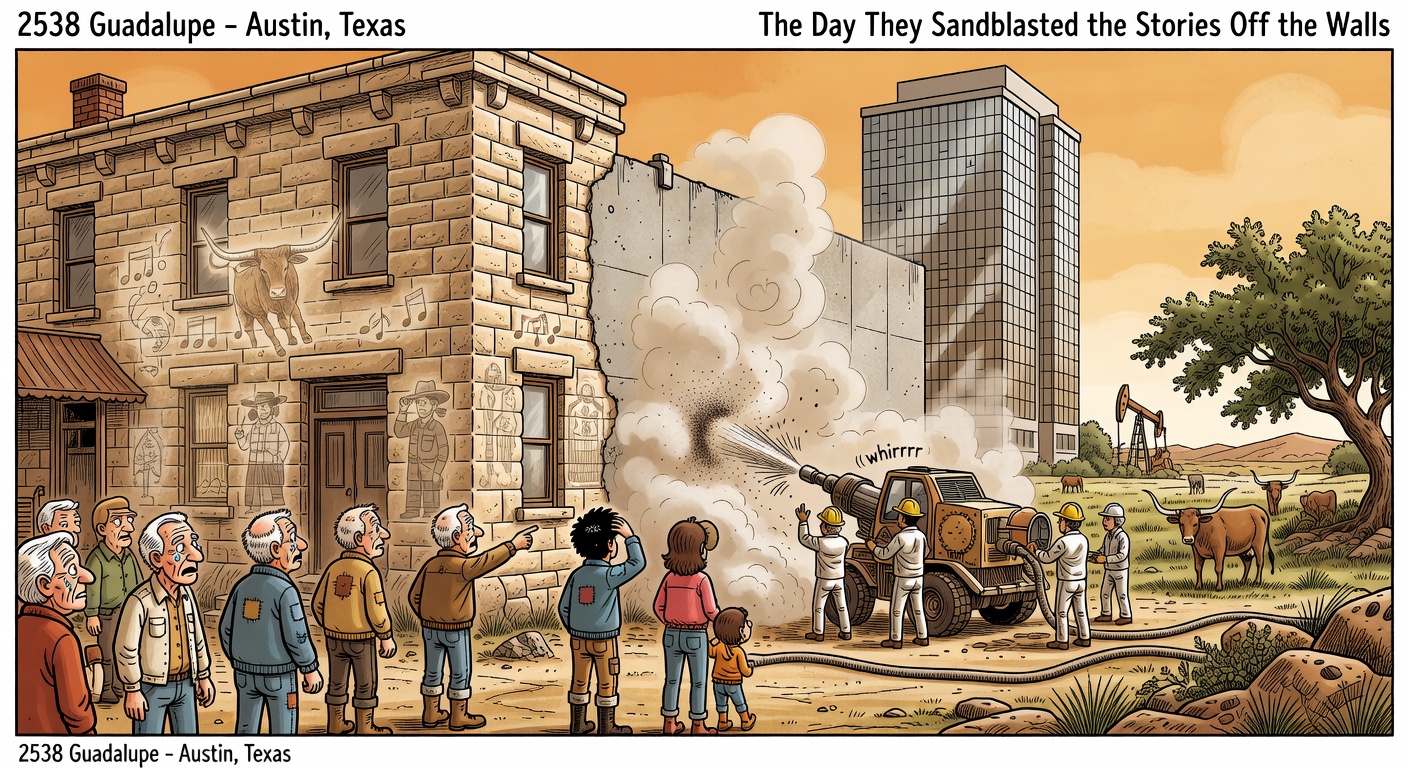
The Day They Sandblasted the Stories Off the Walls at 2538 Guadalupe
My palm hit the new brushed-nickel door handle at the Hole in the Wall and immediately knew the building had been lobotomized; what was once a sticky-floored pressure cooker where Alejandro Escovedo played surprise sets for beer money now requires a $18 ticket minimum, sells oat-milk old fashioneds, and has painted over every Sharpie confession and phone number that once catalogued thirty years of Austin mistakes.
My palm hit the new brushed-nickel door handle at the Hole in the Wall and immediately knew the building had been lobotomized. The old brass one clung to your skin like it had opinions. This thing felt like it was installed by someone who’d never waited in the rain for the bouncer to decide you looked local enough.
Inside, the smell hit first. Or rather, the absence of smell. No stale beer soaked into carpet padding. No cloud of cigarette ghosts arguing with the fryer grease from the kitchen that used to operate until 2 a.m. Instead I got whatever “urban oud” reed diffuser the new management thinks signals authenticity. The walls—once layered with band stickers, phone numbers, and cryptic threats—were the color of a therapist’s waiting room. They’d even sandblasted the low ceiling. Thirty years of nicotine and exhaled confessions, gone in one afternoon so some influencer could shoot clean video.
I ordered a beer. The bartender, pleasant in that terrifying way, asked if I wanted it in a can or a “vintage-style” glass with the new logo. Eight dollars. I paid because turning around and walking out would have felt like admitting the building won.
The worst part? The stage is exactly the same size.
Same scuffed black paint. Same four feet of depth that somehow fit half the Texas punk scene in the late ’90s. But now it has a sleek black monitor wedge sponsored by a headphones company and a little plaque listing the “legacy artists” who once played here. The plaque doesn’t mention the night the power failed during a thunderstorm and the crowd kept the beat by stomping on the floor while the band finished acoustically. That story didn’t fit the font.
I sat at the bar where the old wooden surface used to carry the scars of a thousand forgotten drink tickets. The new one is sealed so thoroughly you could perform surgery on it. Behind me, two guys in expensive sneakers argued about whether the upcoming South by Southwest panel on “authenticating grit in Web3” was tone-deaf. One of them kept saying “the old Austin” the way people say “my therapist.” I wanted to tell him the old Austin didn’t need authenticating. It just needed the rent paid and the cops to look the other way on a Tuesday.
The bathroom is unrecognizable. They installed those automatic everything fixtures that never quite work. The old bathrooms were a collaborative art project. You could trace the romantic history of East Campus just by reading the stall doors. Sharpie sonnets next to crude drawings next to “Free Bird 4eva.” Last week the only ink I found was a discreet URL for a pop-up whiskey tasting. Even the vandalism got focus-grouped.
I remember bringing my then-girlfriend here in ’98. We were twenty-three, broke, and convinced we were witnessing something important every time a local band tore through a Tuesday night set. The cover was three dollars. The bartender—big guy named Mike with a mustache that arrived five minutes before he did—would sometimes just wave people in if the band was good and the room was thin. Nobody ran a spreadsheet on it. The math was simpler: if the band sells beer, everybody wins.
Last Friday the same room had a $12 “suggested donation” even though the act was some guy from Portland doing spoken word over laptop beats. The suggested donation was mandatory. They scan your wristband at the door now. The bouncer didn’t recognize me, which makes sense. I haven’t been carded in this town since Clinton was president, but suddenly my gray hair and bad knees need digital validation.
The neighborhood around it changed in the exact same incremental way. First the record store across the street became a boba shop. Then the boba shop became a “third-wave coffee roaster” with its own NFT drop. The laundromat where I used to wash clothes between classes got turned into eight micro-units marketed as “pied-à-terres for the creative class.” Every time I drive north on Guadalupe the buildings look nervous, like they’re waiting for their next appraisal.
They kept the neon sign, of course. Can’t have a heritage venue without the flickering arrow pointing at nothing. But they rewired it so it no longer buzzes. The imperfection was the point. Now it glows with the cold confidence of a venture-funded future.
Progress smells like oat milk and fear.
I stayed for one drink. Couldn’t do two. On the way out I paused by the framed black-and-white photos they’d hung near the entrance—carefully curated shots of the “important” nights. Not a single picture of the regulars who kept the place alive between the legendary sets. No shot of the guy who fixed motorcycles out of his truck bed and tipped in quarters. No evidence of the bartender who let a broke musician sleep in the storage room for three weeks in 2004. Those stories didn’t photograph well.
The new owners sent out a press release last month talking about “honoring the spirit while elevating the experience.” I’ve lived here long enough to know what elevate means. It means add three zeros. It means replace the people who made the spirit with people who can afford to cosplay it on weekends.
Walking back to my truck I caught the reflection in the polished window: an old grouch staring at a building that no longer stares back. The Hole was never fancy. That was the entire business model. You went there because it felt like the city itself—messy, loud, slightly dangerous, and completely uninterested in your personal brand.
They can sandblast the walls. They can install the QR codes and the sponsor banners and the reclaimed-wood tables that cost more than my first car. But the stories don’t disappear just because you paint over them. They just move down the street to the next unpolished room, until that room gets noticed too.
At least the neon still works. For now.
I’ll give it another six months before some “experiential marketing” firm buys the name and starts selling Hole in the Wall branded cold brew. When that day comes, I’ll drive past one last time, roll the window down, and let the ghost of Mike’s mustache judge me for not fighting harder.
Some buildings you outgrow. This one we outgrew the people who loved it. There’s a difference.