
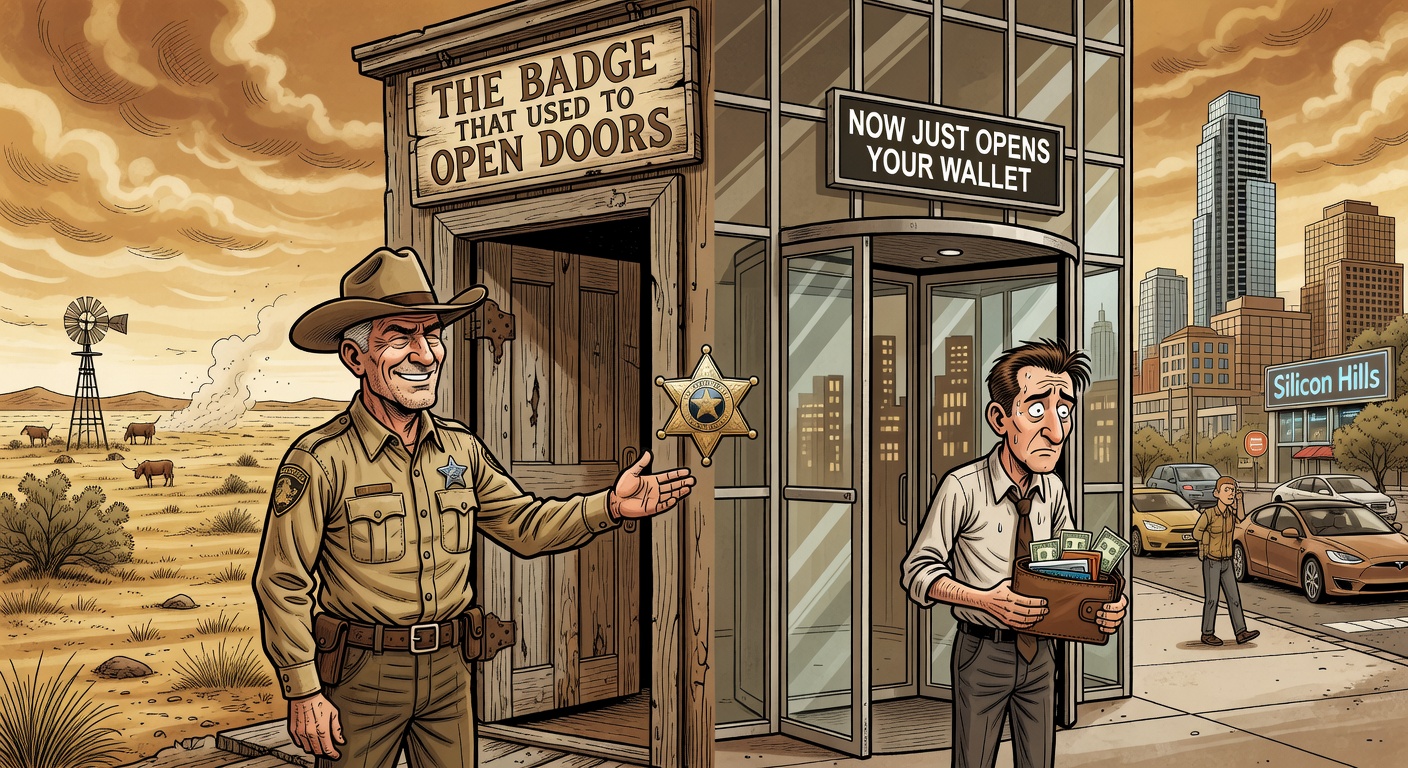
The Badge That Used to Open Doors Now Just Opens Your Wallet
The volunteer at the entrance to what remains of the Red River corridor asked me to 'pair' my 2009 laminate with the new festival app before he'd let me see a band; that same corner once let you slide in for a $5 suggested donation, a warm Lone Star, and the chance to stand three feet from a future legend while the PA rattled the walls.
The volunteer at the entrance to what remains of the Red River corridor asked me to "pair" my 2009 laminate with the new festival app before he'd let me see a band. His lanyard was thicker than most bicycle chains. The thing blinked.
I told him the laminate still had a working hole punch from the year the White Stripes played a surprise set at the old Cedar Door. He smiled the way people do when they're calculating how fast they can escalate to a supervisor. Behind him, the street that used to thump with overlapping guitar solos now featured three separate pop-up "activation zones" complete with charging stations, oat milk bars, and young men in matching quarter-zips discussing churn rates.
That's what SXSW has become: a week-long middleware layer between Austin and whatever remains of its personality.
In 2003 you could park a dented pickup on 6th Street at 2 a.m., walk into the Hole in the Wall with a case of beer under your arm as tribute, and end up watching a then-unknown band from Denton blow the doors off the place while the bartender kept a running tab on a napkin. The only data being collected was how many free Shiner tickets the guitar player could drink before his set. Nobody asked for your email. Nobody needed to "onboard" you to the vibe.
Now the official app demands location permissions, camera access, and a blood sample before it will show you which panel on "Web3 and the Future of Venue Booking" still has seats. The map is a sponsored hallucination. Every third building has been rebranded into a "presented by" experience where the real entertainment is watching mid-level marketing managers try to look like they belong in Texas.
I walked up to the Continental Club last month during the daytime setup. The loading dock where Dale Watson used to hold court still smells like stale cigarettes and ambition, but the new signage requires you to scan before entering what used to be open to anyone with ears. Inside, a woman in performance fleece was explaining to a local sound guy that his mixing board needed to integrate with their "fan engagement API." The sound guy, who has mixed every important act to come through here since the Clinton administration, just stared at her like she'd suggested he replace his console with a Ouija board.
The math is brutal and specific. A basic wristband this year cleared $1,650 before taxes. The "Platinum" tier that gets you into the actual good stuff starts at $4,200. In 2008 that same money bought you a year's worth of Tuesday night residency shows, a new alternator for your Civic, and enough leftover cash to tip the bartender who remembered you liked your margaritas without salt.
The worst part isn't even the money. It's the transformation of discovery into product.
Used to be you'd follow the crowd down to the Mohawk or spill into the backyard of some house on 9th Street where a PA system was illegally loud and perfectly perfect. You'd discover three bands that would change what you listened to for the next decade. The only algorithm was "that place looks like it might be fun."
Now every set has a sponsored hashtag. Every artist has a QR code on their pedalboard directing you to their newsletter. The crowd spends as much time staring at phones, trying to decide which of the twelve overlapping "must-see" events to attend, as they do actually watching the stage. The FOMO is the product. The music is the delivery mechanism.
I ran into an old promoter friend near the former Liberty. He'd booked half the best nights of my life in venues that no longer exist. We stood there watching tech bros argue about whether the AI-generated art installation counted as "interactive." He shook his head and said, "Remember when 'interactive' meant the guitar player would hand you the joint during the solo?"
The city still pretends this is economic development. The badges come with lanyards that cost more to produce than most of those early bands made in a year on the road. The official sponsors include companies that wouldn't know a good song if it bit them on their valuation. Meanwhile the actual clubs that built the festival's reputation fight triple-net leases and complaints about "festival spillover" from the new condo residents who moved in specifically because the listing mentioned "proximity to SXSW."
One perfect paragraph of truth: they kept the name but sold the soul for venture capital and better SEO.
The smell is what gets me. Walk that stretch of Red River in late March and instead of sweat, cheap whiskey, and green chile from the food trucks, you get notes of hand sanitizer, new carpet, and the particular metallic tang of lanyard clips fresh from the conference center. It's the smell of optimization.
Yet every year I still go. Not for the official stuff. I go for the one night when some kid from Lubbock plays a guerrilla set in a parking lot and suddenly it's 2004 again for forty perfect minutes. The apps don't know about those shows. The algorithm can't predict them. You have to be there, physically, untracked, unbadged, and slightly lost. The way we all used to be.
The grouch in me wants to burn the whole thing down. The Austin in me knows that somewhere in that mess, a great band is still playing their heart out to a room that hasn't been completely colonized yet. You just have to know which wristband to ignore.
And if you see me out there this year, don't ask me to pair anything. The only credentials I need are the ones written in beer stains and memories that still scan just fine.