
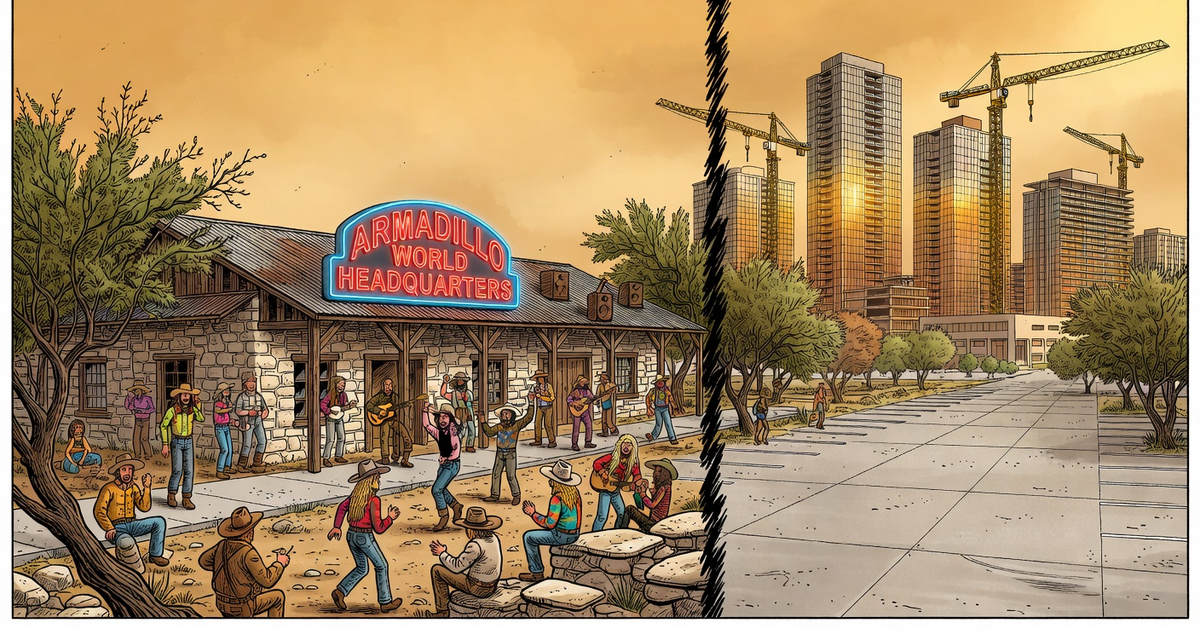
The Armadillo World Headquarters: Where Austin Became Austin
Before it was a parking lot and then a high-rise, it was the room where rednecks and hippies decided to get along.
"The Armadillo wasn't a venue. It was the moment Austin decided what it wanted to be. We've been forgetting ever since."
Every city has an origin story it tells itself. For Austin, that story starts in a converted National Guard armory at 525 1/2 Barton Springs Road, where in 1970 a man named Eddie Wilson opened a venue that would accidentally invent the cultural identity of an entire city. Then the city tore it down. Because that's what Austin does.
The Armadillo World Headquarters operated from 1970 to 1980. Ten years. That's all it got. In those ten years, it hosted Willie Nelson, Frank Zappa, Bruce Springsteen, Freddie King, Commander Cody, the Pointer Sisters, Count Basie, Ravi Shankar, and roughly a thousand other acts that ranged from cosmic cowboys to punk upstarts to jazz legends who had no business playing a room that smelled like Shiner Bock and armadillo grease — except they did, because the Armadillo was the kind of place where "no business" was the whole business.
The Armadillo wasn't a venue. It was the moment Austin decided what it wanted to be. We've been forgetting ever since.
What made the Armadillo matter wasn't just the music. It was the audience. This was the place where the cosmic cowboy movement was born — where rednecks and hippies, who had spent the better part of the 1960s not speaking to each other, showed up to the same room, drank the same beer, and realized they had more in common than the culture wars suggested. Willie Nelson's Fourth of July Picnics, the progressive country scene, the entire mythology of Austin as a place where weirdness was a civic virtue — all of it traces back, in one way or another, to the Armadillo.
Here's what you need to know:
- The venue held about 1,500 people. The stage was wide and low. The seating was, generously, "flexible" — meaning there were some chairs, some tables, and a lot of floor. You could sit, stand, dance, or lie down, and nobody cared as long as you weren't blocking someone's view of the band. This was radical democracy applied to concert seating.
- Jim Franklin's armadillo art — those iconic, surreal, sometimes psychedelic posters — became the visual language of Austin music. They're in the Smithsonian now. They were designed for a venue that no longer exists, advertising shows in a room that is now a parking structure. If irony were fatal, we'd all be dead.
- Beer was cheap. Food was cheap. Eddie Wilson ran a kitchen that served what was essentially hippie health food — a radical concept in 1970s Texas — and the whole operation functioned less like a business and more like a community center that happened to have a world-class booking calendar.
The Armadillo closed on New Year's Eve 1980. The building was demolished to make way for a high-rise. The high-rise was built. Progress, they called it.
Eddie Wilson went on to open Threadgill's, carrying the spirit forward in a different room. But the Armadillo was the Armadillo. You can carry a spirit, but you can't rebuild the armory where it was born.
There's a historical marker at the site now. It's nice. It's informative. It is the least a city can do after destroying the most important cultural space in its history, which is probably why they did exactly that much and no more.
Every venue Austin has lost since —
If you're new here — and statistically,
It was the room where Austin decided to be itself. And the rent came due, same as it always does.