
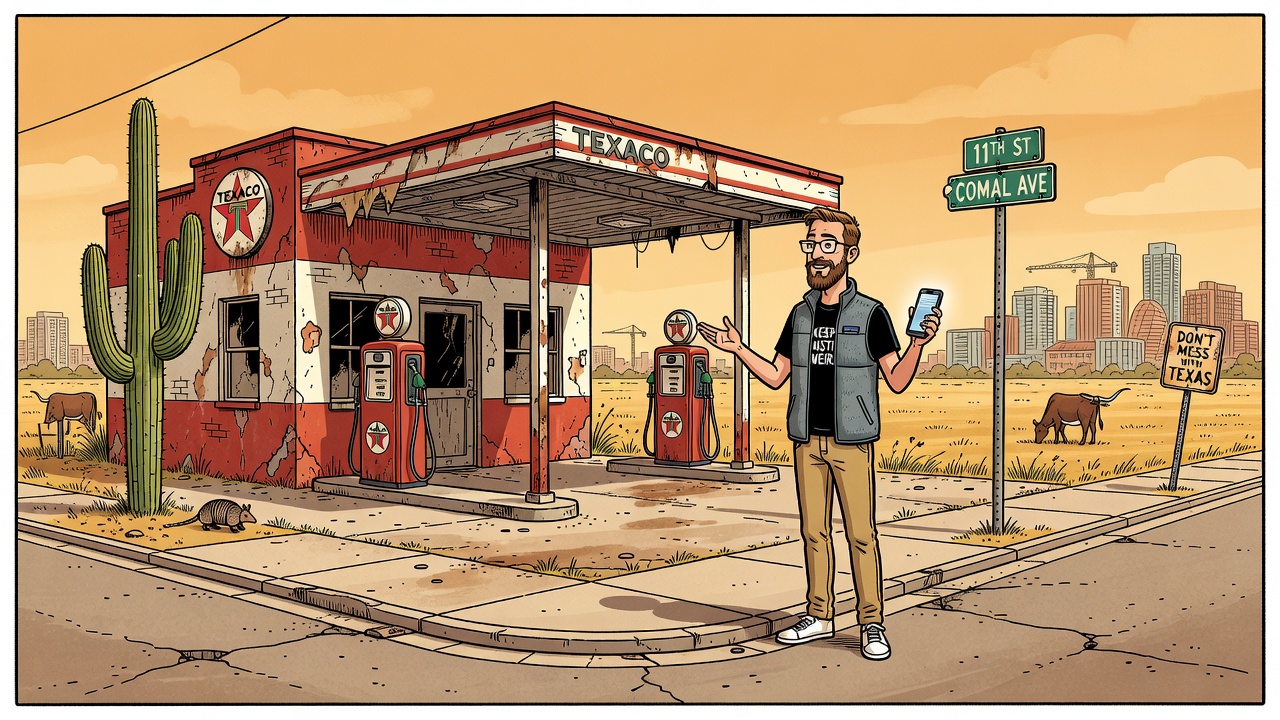
Tech-Bro of the Week Sees 'Strong IP' in the Old Texaco on 11th and Comal
Braden Hollister slid into my inbox pitching 'Aether Commons,' his $4.2 million conversion of the East 11th Street Texaco where Manny once fixed your transmission for beer money and the neighborhood kept a communal Igloo full of Shiner on Fridays; the new iris-scanned pods now run $3,300 a month with mandatory 'legacy sync' meetings and a resident smart contract that docks your vibe score if you don't attend the Wednesday NFT minting workshop.
The email arrived at 2:14 a.m., which apparently is when Braden Hollister does his "deep work." Subject line: "Capturing the IP of Old Austin Before It's Gone."
I almost deleted it. Then I saw the attachment titled "Aether_Commons_Deck_v23.keynote" and morbid curiosity won. Twenty-seven slides of beige-on-beige Helvetica. The third one had an aerial photo of the old Texaco at 11th and Comal, circa 2009, with the hand-painted sign that read "Manny's Quick Lube & Beer" in that wobbly script only East Side uncles could pull off. Overlay text in that new corporate font everyone uses now: "Underutilized Cultural Real Estate."
The old lot never asked for a deck. It just existed. You'd pull up with a rattling Civic and Manny would be under the hood before you killed the engine, cigarette hanging from his lip like it was welded there. Forty bucks cash, maybe a sixer of Lone Star if the job took longer than an hour. On summer Friday nights the place turned into unofficial headquarters for half the neighborhood. Somebody dragged out a Weber grill, another guy brought his guitar, and the domino game at the folding table went until the streetlights buzzed on. The air smelled like mesquite smoke, 87 octane, and the faint metallic tang of transmission fluid. Nobody ran a credit check. Nobody needed an app to know if you belonged.
Braden belongs to a different species.
He moved here in late 2021, right after the big wave but before the really big wave. Claims he "discovered" Austin during a bachelor party that ended with someone throwing up on the Congress Bridge bats. Read Please Kill Me and a Willie Nelson biography back-to-back on the flight from SF and decided he was meant to "steward the cosmic cowboy energy into the web3 era." His LinkedIn says he's "Chief Nostalgia Architect" at something called LegacyDAO. The headshot features him in a $400 reproduction of a 1970s pearl-snap shirt, staring pensively at what I assume is a taco.
The deck gets worse.
Slide 9 shows a rendering of the shipping containers they dropped where the lift bays used to be. Each one sleeps four in built-in bunks that look like Japanese pod hotels designed by someone who only read about Austin on a Substack. "Phygital legacy units," Braden calls them. Rent starts at $3,300 for the top bunk facing the dumpster. The bottom bunk—closer to the original grease trap—goes for $2,800 because it has "more authentic patina."
I visited last Tuesday. The iris scanner at the new gate recognized Braden immediately and greeted him with "Welcome home, vibe sovereign." He actually said "gm" back to it. Out loud.
The old concrete island where the pumps stood now holds a communal table made from reclaimed cedar that definitely did not come from this neighborhood. Three guys in their late twenties sat there drinking $9 cold brew, arguing about whether the new Spoon album had "lost the thread of early Austin weirdness." One of them wore a distressed cap that read "Keep Austin Weird Since 2023."
Braden walked me through the features like a real estate agent on amphetamines. The old office where Manny kept his Lowrider magazines and a coffee can full of quarters is now a "narrative capture studio." Residents are encouraged to record oral histories about "their Austin" for the project's blockchain archive. The fact that none of them were here before 2020 does not appear to be a problem.
"We want to tokenize the feeling," he told me, gesturing at the spot where the domino table used to live. "Not the buildings. The feeling. The smoke in the air. The low hum of Freddie King from somebody's truck. We're calling it the East Side Harmonic."
I asked if the neighbors—the ones who actually grew up here—got any say in this. He gave me the look people give when you ask if NFTs have real value.
"The community is invited to the activation events," he said. "We're doing a token-gated barbecue next month. Real brisket from that place on 12th that Guy Fieri liked."
The only thing they kept from the original setup is the concrete pad out back. Even that got pressure-washed within an inch of its life. No more oil stains that told you exactly where Manny dropped his wrenches for thirty years. Just clean gray with a fresh mural of a longhorn wearing VR goggles.
The punchline is that Braden thinks he's the good guy.
He keeps telling anyone who'll listen that he's "protecting" the neighborhood from worse developers. At least his containers have solar panels. At least he's "in dialogue with the legacy." The fact that the legacy didn't ask to be dialogued with doesn't register. The mariachi who used to set up outside the taqueria across the street now competes with whatever ambient playlist the Aether Commons speakers pump out at 7 p.m. sharp—something Braden describes as "a fusion of Texas blues and future bass."
Last week one of the residents filed a noise complaint against the paletero cart that's been circling these blocks since before Braden knew Austin existed. The complaint cited "disruption of the intentional soundscape." The paletero has been selling coconut bars to kids at this intersection for twenty-three years. His name is Mr. Lopez. Everyone just calls him "the ice cream man" even though half his cart is actual fruit cups with chamoy.
I keep thinking about the Friday nights that pad used to see. Real arguments over dominoes. Real music from trucks with actual dents. Real laughter that didn't need to be logged for a community sentiment dashboard. The new version has an app where residents rate each other's "vibe contributions" on a scale of one to ten. If you fall below 7.4 for two weeks straight you get an automated email about "alignment opportunities."
Manny died in 2017. Last I heard his daughter sold the lot to some LLC that probably flipped it to Braden's group for seven times what it was worth in 2014. She moved to San Antonio. I don't blame her. The email she sent the old customers was three sentences long and ended with "Thank you for the years." No deck. No renderings. Just the truth in plain Spanish and English.
Braden wants me to come to the launch party. Says I "embody the analog authenticity we're trying to scale." I told him the only thing I plan to scale at that address is my middle finger, but I said it nicer.
The old Texaco sign is in storage somewhere. Braden swears they'll reinstall it "with tasteful lighting" once the permitting clears. In the meantime residents get a small brass plaque by the gate that reads "Est. 2026." They think that's funny.
I think about the smell of those Friday night smokes drifting toward Comal Street, the clack of dominoes, the way Manny could diagnose a bad alternator just by listening to your engine idle for ten seconds. That whole ecosystem ran on handshake deals, cash, and the understanding that not everything needs optimizing.
Braden and his cohort are optimizing it anyway. They're calling it preservation.
The containers are already full. The waiting list has seventy-three names. Last I checked, the app showed an average vibe score of 8.9.
Manny would have taken one look at the whole operation, spit in the dirt where the new mural meets the old concrete, and charged them double for the air.