
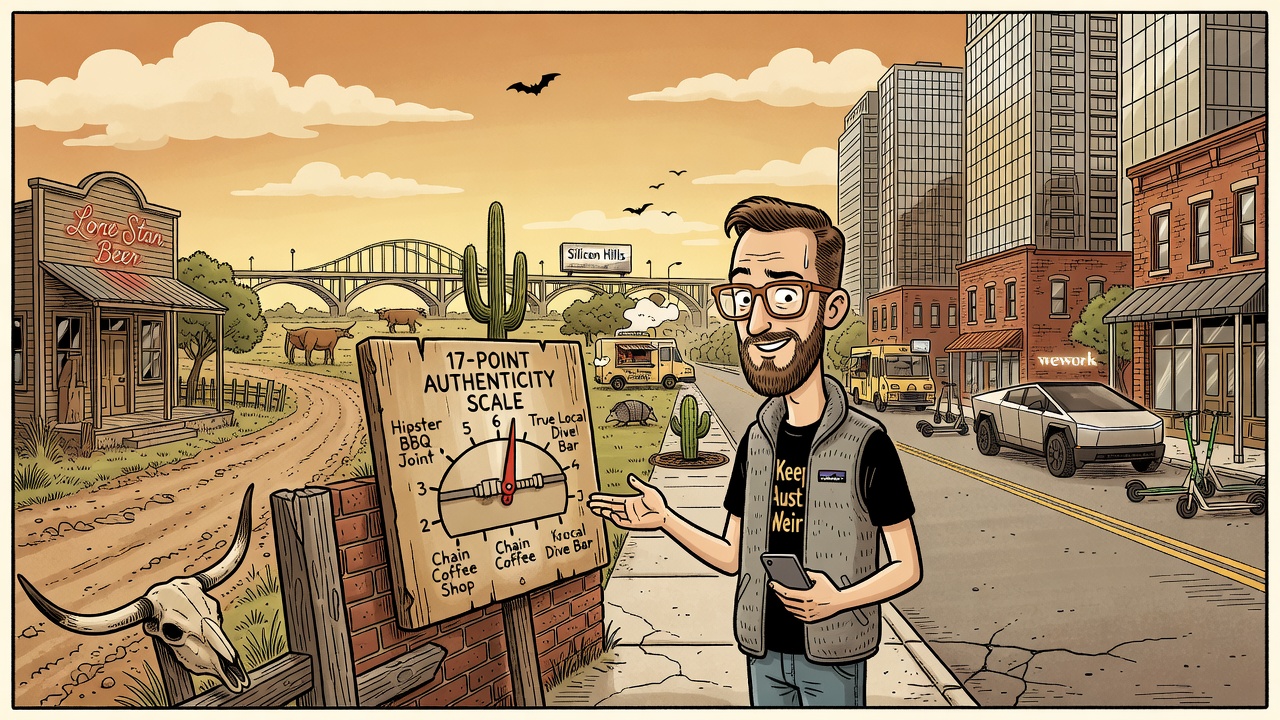
Tech Bro of the Week Is Scoring Sixth Street on a 17-Point Authenticity Scale
Overheard a tech bro at the old MLK gas station pitching WeirdScore, his AI app that rates buskers and vibes on a 17-point authenticity scale while wearing a scalable "Keep Austin Weird" shirt; the recent Bay Area arrival who tore down a Travis Heights cottage now blames actual weirdos for hurting his pitch deck.
The barista at the new market hall on MLK had the posture of a woman calculating her exact escape velocity when the guy in the limited-drop Patagonia vest started waving his phone like it was the Declaration of Independence. "It's not a rating system," he insisted, "it's a preservation layer." Behind him, where the old Full-Service Chevron used to let you run a tab if your truck was parked in the shade, the exposed ductwork hummed over a $9 cold brew station.
I was three tables over pretending to read the Chronicle—the one that still pretends it's not half real-estate ads. The guy couldn't have been more than thirty-one. Hair perfectly messy in that "I have a barber who charges by the follicle" way. Allbirds already scuffed from one too many "thought walks" around the Rainey Street graveyard shift. His companion, same uniform but in gray, kept nodding while tapping notes into a Notion doc labeled Authenticity Thesis v0.8.
"Look," the first one said, "you point the camera at the dude playing Wonderwall outside the Hilton and the model spits out a 2.4. Too much Ed Sheeran DNA, not enough steel guitar, visible corporate tattoo sponsorship. We surface the 8.7s. The ones doing the actual weird shit. Think of it as Strava for soul."
The couple trying to eat their grain bowls next to him suddenly found their phones fascinating. I recognized the defensive hunch. Same one the mechanics at the old South Congress Exxon used to give tourists asking if the place took Apple Pay in 2014.
He moved here in late 2022, right after his last startup got acqui-hired for low eight figures. Told the barista this like it was a personality. "Oakland was cooked. Everyone there was already optimizing their sleep scores. Austin still had edge. The bats. The breakfast tacos. The guys in the parking lots selling speakers out of vans. I wanted that."
What he apparently didn't want was any of the parts that made the edge sharp. The house he bought in Travis Heights—1938 cottage, original pine floors, one bathroom the size of a confessional—got the full teardown. Now it's 3,400 square feet of smart glass, a Sub-Zero that texts you when the cold brew runs low, and a "meditation nook" where the washer-dryer used to be. Property taxes jumped from $6,200 to $41,000. He calls this "voting with my capital for the vibe."
The app is called WeirdScore. Patent pending on the smell-analysis module. Their deck claims the total addressable market for "quantified authenticity" is $2.1 billion once you factor in every tech transplant who wants to prove they didn't just raise the rents and kill the culture. Slide 7 actually has a heat map of Sixth Street with red zones labeled "authenticity decay." I saw it when he tilted the laptop too far.
The saddest part is how proud he is of knowing the references. He name-dropped the Hole in the Wall, the old Liberty Lunch, even the original Les Amis location like he'd discovered fire. Then immediately suggested a pop-up "heritage activation" where influencers could pay $175 to stand behind velvet ropes while a "curated local" played exactly three songs from 1994. The barista refilled his water without being asked. That's how you know she's seen this species before.
I watched him demonstrate the beta. He pointed the phone at the mariachi trio playing near the old H-E-B on 7th. The screen lit up: 9.1. "Strong accordion fundamentals. Visible wear on the instrument cases. Zero venture capital in the facial hair. This is the good stuff." The trumpet player, who I've seen at that same corner since Clinton was president, just kept playing "Volver" like the phone wasn't deciding his cultural relevance.
The market hall itself used to be three businesses: the gas station, a tire shop that would patch your bike tube for two bucks, and a little lunch counter run by a woman named Gloria who remembered your order if you came in twice. Now it's one giant room that smells like cedar planks and venture debt. The "local vendors" are all ghost kitchens that deliver through an app. The tamale lady with the Igloo cooler who used to set up under the live oak? Her spot is now a QR code that directs you to a $13 "heritage masa" version with short rib.
He doesn't see the contradiction. That's the part that gets me every time with this week's model. They move here because the weirdness metric was high, then install guardrails so the weirdness stays within acceptable parameters for their pitch decks. The rooster that used to wake up the block on 3rd Street got code enforced into silence six months after he closed on his house. Now he complains on Nextdoor that the neighborhood is losing its character.
His cofounder leaned in: "We're thinking about a social layer. You can tip the high-scoring performers in crypto. They get 70 percent. We take a small vig for the algorithm." The mariachi trumpet hit a high note like it was answering.
I left before they could ask me to join their Slack. Outside, the heat was doing that thing it does in late June where it makes the asphalt remember every spilled beer from 1987 onward. My truck—paid off since 2018, windows that roll down with an actual crank—felt like a time machine. I drove past the old gas station one more time. The new signage uses that fake-handwritten font that costs $40,000 to commission. It says "GATHER" in all caps like the building is yelling at you.
The tech bro and his partner were still inside, probably modeling engagement curves for when users rate the food trucks. They'll raise the round. Some larger fund that also doesn't live here will write the check. Another building that used to do something useful will become "creative office space" with ping-pong tables where the loading dock was.
Meanwhile the guys who actually kept the weird score high without measuring it—the mechanics, the cooks, the bar bands that played for beer and tips, the lady who sold corn on the cob out of a shopping cart—are priced into the suburbs or back to the Valley or just gone. The algorithm will miss them. It has no category for "showed up every day for thirty years and never once needed validation from a smartphone."
He'll call the newsletter update "doubling down on weird." The T-shirt will come in new colors. And the city will keep doing what it does now: smiling politely while the latest arrival explains how he's going to save what he just finished paving over. The bats under Congress Bridge don't have an account. Yet. But give the next funding round six months and there'll be a bat cam NFT drop complete with provenance tracking for every guano deposit. The app will ding anyone feeding the pigeons near the bridge a -3.2 for "disrupting the branded ecosystem."
By the time I hit the light at Congress, the whole exchange had calcified into another data point in the ledger of how we measure loss around here. Not with some fancy computer vision model, but with the simple recognition that the kid who used to sling newspapers at the corner of MLK and South First never needed an algorithm to tell him what was real. He just knew the price of a sixer, the sound of a screen door slamming at the old rental duplexes, and the exact shade of neglect that let a city stay interesting instead of optimized. That knowledge doesn't scale. It just evaporates, one seed round at a time, while the new arrivals keep score.