
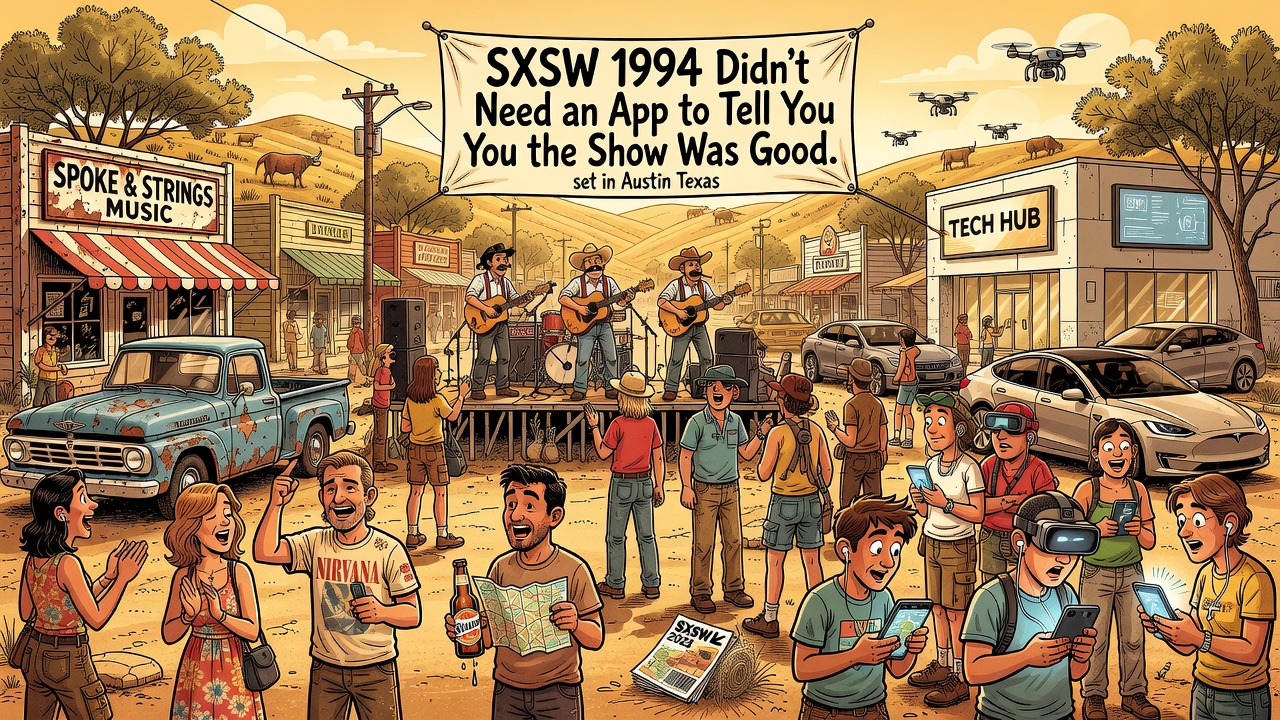
SXSW 1994 Didn't Need an App to Tell You the Show Was Good
In 1994 you paid cash at a folding table outside a paint-peeling room on 5th and Brazos, watched a band from Athens or Lubbock blow the roof off, and left with a napkin setlist; now the corner demands an $1100 wristband scan, sponsored gates, and an engagement coordinator hawking tote bags while venture capital chatter drowns the guitars.
The kid at the pop-up coffee stand on 5th and Brazos asked for my festival code before he'd even ring up the seven-dollar cold brew. I stared until he repeated it, slower, the way people talk to uncles who still use flip phones. Behind him a speaker pumped the same lo-fi beat that has stalked me every March since the first branded pop-up appeared. I paid cash anyway, just to watch his face do that little corporate twitch.
Back in 1994 none of us needed a code. You walked up to a card table outside a room with paint peeling like old sunburn, handed over crumpled twenties, and got a stamp that looked like it was carved from a potato. Inside, a band from Athens or Lubbock or some garage off Springdale Road would plug in and proceed to melt faces. No one checked your wristband tier. No one offered a branded tote bag for uploading a selfie. The only engagement coordinator was the bartender who remembered your drink after the second round and slid it across without comment.
I still smell that night on 5th and Brazos when Alejandro Escovedo played so hard the sidewalk crowd went dead quiet except for the occasional beer bottle clink against the curb. No phones went up. No one live-tweeted the solo. We just stood there in the humid dark letting the notes hit us like hail. The next morning the newspaper ran a grainy photo and a couple paragraphs that basically said yeah, that was good. No algorithms. No dynamic pricing for the afterparty.
The wristband changed everything.
First it was harmless, a laminated card on a rubber band. Then the tech money smelled blood in the water and turned it into a tiered caste system complete with its own economy. Last year I watched a woman in full Patagonia argue with a nineteen-year-old volunteer because her creator-tier pass wouldn't get her into the secret showcase at the old Scoot Inn site. The volunteer kept saying the algorithm decides capacity like it was the damn Nicene Creed.
That same algorithm decided which bars on East Sixth became official. It decided which taco trucks earned the glowing SXSW Preferred sticker that magically justified nine bucks for two street tacos with a side of influencer small talk. It decided my favorite used-to-be record store on North Loop was better reincarnated as a pop-up for noise-canceling headphones. The faded mural of the owner's dog still watches the sidewalk, but inside it's all white walls and people nodding along to playlists labeled Chill Discoveries.
Walk the corridor from Cesar Chavez up to 6th any night during peak week and the air feels wrong. Vape clouds fight for airspace with overpriced brisket steam. The taquería that used to feed every broke musician and stagehand at three in the morning is long gone, replaced by a two-story experiential venue where every cocktail has a corporate sponsor. I tried the Google Pixel Punch once purely as self-flagellation. It tasted like disappointment and oat milk with a lime wedge that cost extra.
The parking situation alone could fill its own ledger. In the old days you could slide a five to the guy in the lawn chair behind the Continental and he'd hold your spot with an orange cone that had seen better decades. Now the same pavement texts you dynamic pricing alerts based on how many badges are currently inside the venue. Leave for twenty minutes to grab food and the rate jumps. Pay with actual folded money at the new kiosk and it hits you with a convenience fee for the crime of not downloading their app.
I keep running into the same overheard quote everywhere. Some guy in expensive sneakers telling his buddy that the band on stage has strong IP. Not strong songs. Not strong stage presence. Strong IP. As if the drummer is a startup waiting for seed funding. The first time I heard it I laughed out loud. The second time I wanted to throw a bottle. By the tenth time I just felt tired in my bones.
My friend Chuy still books shows in a warehouse off Springdale that hasn't been fully colonized yet. He refuses the official shuttle stop. Keeps the Wi-Fi password secret. Last March a pack of developers from Seattle wandered in anyway, drawn by some influencer's geotagged story. They asked if the band could turn it down so they could hear themselves discuss cap tables. Chuy gave them the same look an old ranch dog gives a city squirrel. The band kept playing at full volume. The developers left after one song. Small victories still exist but they feel like holdouts in a siege.
The city council releases its annual economic impact report like it's manna from heaven. Numbers in the hundreds of millions. Hotel occupancy rates. Badge sales. They never mention the practice spaces swallowed by condos on East 12th or the clubs that quietly stopped booking locals because the sponsors prefer touring acts with management teams. They don't track how many bartenders now need hospitality degrees or how the smell of old cigarettes and fresh regret at the Hole got replaced by cedar-scented diffusers and QR code menus.
I drove past the old Liberty Lunch site the other night just to torture myself. Nothing but another mixed-use tower with a coffee concept on the ground floor. The ghost of all those sweaty nights still lingers if you stand there long enough and ignore the leasing signs. Further down the street the original Emo's location is some kind of co-working space where the lift used to be. They call the grease pit legacy infrastructure in their marketing copy. I printed that phrase out and taped it above my desk so I never forget what we're dealing with.
Even the bats under the Congress bridge got pulled into the machine. Used to be you'd wander down after a late set, watch them rise in their black cloud, and feel like Austin still belonged to itself for a minute. Now there's a sponsor logo projected onto the water and guided tours that cost more than my first three SXSW badges combined. The bats probably hate it too but they don't have a LinkedIn to complain on.
I still go out during the festival. Not to the big stages with their metal detectors and bag checks. I seek the handful of rooms that remember how this was supposed to work. The crowds are thinner there. The sound is meaner. Someone usually brings a cooler with actual ice and a couple of real beers that didn't come with a biography. Nobody asks for your vibe score or whether you've optimized your personal brand.
But every year those rooms get harder to find. Another landlord sells out. Another club partners with a payment app. Another kid with a guitar learns the real money is in selling merch for a touring comedian instead of playing originals until the cops give up and go home.
The counter keeps ticking higher. The wristbands get thicker with more embedded chips. The sponsors add more letters to their names. And somewhere in the middle of it all the music fights to be heard over the sound of people talking about disruption.
I sent an old bandmate a photo I took in 1997 outside a venue that doesn't exist anymore. Just a blurry crowd spilling into the street, faces lit by one streetlight and the sheer volume coming from inside. No phones raised. No codes required.
He replied with a single fire emoji.
Some ghosts refuse to stay buried.