
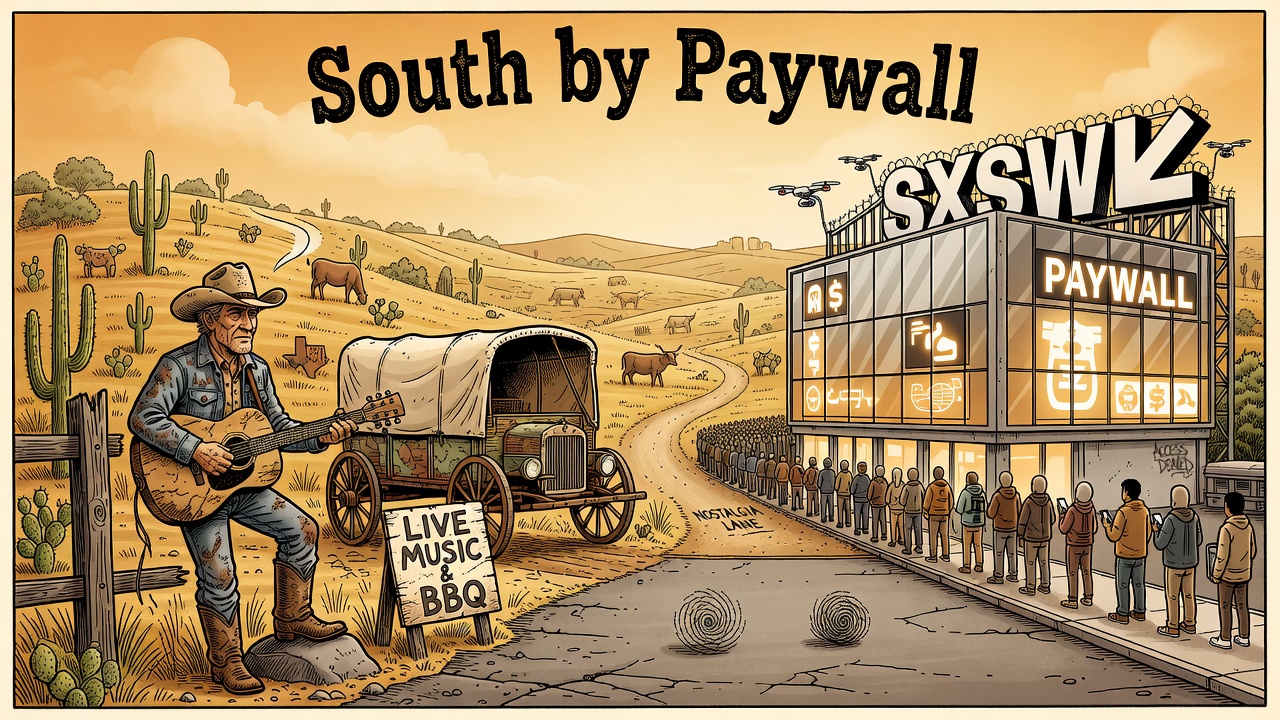
South by Paywall
Watched a product manager in limited-edition kicks argue with the Continental bouncer that his $1,850 platinum badge granted priority entry; the festival that once ran on $35 wristbands, photocopied schedules, and rooms smelling of beer and broken dreams now runs on geofenced tiers, $22 margaritas, and more marketing VPs than working drummers.
The bouncer at the Continental wasn't raising his voice. He didn't need to. The guy in the limited-drop sneakers simply refused to accept that his shiny new lanyard didn't grant him immediate passage to the back room where the actual band was already two songs deep.
"Bro, it says premium access right here."
The bouncer, same one who's been checking IDs since at least 2008, just pointed at the tiny print on the badge. The one that reads "suggested venues" in corporate euphemism. I slipped past both of them with the $10 cash cover I'd known about for three days because I still know people who know people. Old Austin credential: still works, for now.
Inside, the smell hit first. Not the old mix of stale Shiner and cigarette ghosts. This was something engineered: cedar vape, expensive candle, and the faint metallic tang of fresh iPhone boxes. The band—four locals who'd played this room since it had carpet on the tables—was killing it anyway. But half the crowd was staring at their phones, waiting for the sponsored Instagram moment. One woman in head-to-toe Patagonia kept asking the sound guy if the set was "going to be clipped for the recap video."
This is what victory looks like. The festival swallowed the town, then charged the town admission to watch itself get digested.
I first attended in '94 because a friend said there was free beer at the Convention Center if you looked like you belonged. We were nineteen. We belonged nowhere, which turned out to be the correct uniform. That year you could see Alejandro Escovedo at the Hole in the Wall for five bucks, then walk down Guadalupe and catch a half-dozen more bands without once showing identification or downloading an app. The biggest hassle was finding a parking spot that wouldn't get you towed by the church across the street.
Now the app is mandatory. Not the official one—the one that tracks your location so sponsors can "deliver personalized experiences." Last March it pinged me with a push notification that read "You're near an activation! Would you like to learn about sustainable blockchain?" while I was trying to buy cigarettes at the corner store on 5th and Neches. I turned the phone off. The phone kept working. That's the new Austin contract.
The price sheet is where the comedy writes itself. A basic wristband that once got you into most night shows ran about sixty bucks in the early 2000s. This year the lowest tier that actually lets you inside anything good starts at $1,450. The platinum experience—yes, they call it that without irony—is closer to three grand. For that you receive the privilege of standing in slightly shorter lines and the right to tell people at your Brooklyn coworking space that you "did South By."
The venues themselves have developed Stockholm syndrome. Signs that used to say "TONIGHT: $5 COVER, NO GUEST LIST" now feature sponsor logos the size of billboards. One bar on Red River has a QR code on every table. Scan it and you're entered into a raffle to win a branded Yeti tumbler and a thirty-minute mentorship session with a guy whose only qualification is having raised a Series A. The bar still serves the same well whiskey. It just costs fourteen dollars and comes with performance anxiety.
I walked the length of Rainey Street at 9 p.m. on a Wednesday. Every single patio featured the same scene: clusters of people in matching hoodies discussing churn rates while a DJ played the same four songs cleared for brand safety. The bouncers looked exhausted in that specific way that says I used to throw actual punk bands in here. One of them recognized me from the old days at the original Emo's location.
"They're calling this 'the neighborhood vibe,'" he said, gesturing at a pop-up serving $19 cocktails in plastic cups shaped like cacti. "Last week a girl asked me if the graffiti was 'curated.'"
The graffiti, for the record, was from 2017 and involved a very specific ex-girlfriend. It was not focus-grouped.
What gets me isn't the money. Austin has always had rich kids. What gets me is the performance of discovery. Every year they "find" another pocket of the city and immediately price its soul out of reach. In 2012 it was the East Side. By 2018 they'd colonized South Congress so thoroughly that the Continental's bartenders started keeping a running tab on how many visitors asked if this was "the real Weird Austin." This year they're deep in the North Loop, congratulating themselves for noticing the tire shops and dry cleaners that have been there since the '80s.
The musicians notice. Of course they do. The ones who used to play four showcases for gas money now compete with AI-generated "chill beats" playlists presented by some fintech company that wants you to know they're "disrupting" the live music experience. One band I like posted a set list from their official showcase that included the sponsor's name in the third slot: "3. Band Name presented by Unified Data Solutions." The guitar player told me later the check cleared in nine days. The dignity is still pending.
I ended the night the way I always do now—on a back porch in Crestview with four friends who know better than to go downtown in March. We drank actual beer from a cooler. Someone played records. No one scanned anything. The conversation turned, as it always does, to which venues we'd lost and which ones were next. The list grows longer every year. Liberty Lunch. The original Hole. The Electric Lounge. Now even the survivors feel like they're on borrowed time, performing "authenticity" for people who think grit is a marketing lever.
At one point my friend Mike, who booked shows at the Carousel before it became a parking lot for food trucks, raised his bottle and offered a toast: "To the only festival that manages to be both completely sold out and emotionally bankrupt at the same time."
We laughed because the alternative is crying, and crying over Austin is for amateurs.
The next morning my phone buzzed with a notification from the official SXSW account. "Thanks for being part of the magic!" it read. Attached was a photo of a crowded panel titled "Authenticity in the Age of Algorithmic Curation." The panelists were all under thirty. None of them had ever paid rent on a $475 duplex off Airport Boulevard. All of them looked extremely well hydrated.
I deleted the app. Then I remembered the city still uses it to ticket my truck if I leave it on the street too long. Even my rebellion comes with terms and conditions now.
That's the part they don't put in the recap video. The part where the thing that was supposed to celebrate the city became another way to extract from it. The bands keep playing. The bartenders keep pouring. The rest of us keep adjusting the math: how much of old Austin can we afford to remember before the memory itself gets monetized.
Somewhere out there a developer is already pitching "SXSW Heritage Lofts" on the site of a venue that closed last year. The renderings will feature exposed brick, a carefully distressed concert poster behind glass, and a monthly amenity fee that includes "curated playlists inspired by the original spirit of the festival."
The spirit, of course, left town years ago. It couldn't afford the badge.
The worst part is how normal it all feels now. I ran into a booker I used to see at every other show back when Sixth Street still had more guitar cases than venture capital lanyards. He was standing outside the new "experiential lounge" that used to be a parking lot behind the old Cedar Door. They had turned the lot into a branded photo op with hay bales and a mechanical armadillo. He shrugged when I asked how the week was treating him.
"Got three paid corporate gigs. Nobody's playing for the door anymore. It's all about the activation."
Activation. That's the word they use when they want to sound like they're creating culture instead of vacuuming the last loose change out of its pockets. I watched a twenty-something with a name tag that said "Head of Vibes" hand out free samples of something called "heritage energy water" to people waiting in line for a panel on "Disrupting Live Music." The water cost twelve bucks if you bought it inside. The line stretched past the spot where the old Liberty Lunch stage once stood, back when you could see a band like Spoon for eight dollars and a plastic cup of Pearl.
Further down the street, past the chain-link fences guarding construction sites that promise "festival-ready mixed-use developments," I counted four different pop-up bars all selling variations on the same margarita. Each one had a different tech sponsor. Each one required the app to claim the "complimentary" drink that wasn't complimentary if you read the fine print. One bartender, who I recognized from the old days slinging $2.50 Lone Stars at the Ritz, caught my eye and mouthed "help me" while pouring something neon into a souvenir cup shaped like a longhorn.
The absurdity compounds. Last year they added a "legacy artist track" to the schedule, which sounds nice until you realize it means putting actual legends like Willie Nelson's old sidemen on at 11 a.m. in a conference room so the real money can chase the next big thing at the branded stages. The legacy artists get a plaque. The sponsors get their logo on the plaque. The audience gets to say they saw history while checking their fantasy music league app.
I stopped by the old Emo's location—not the current one, the original on Sixth that got torn down for condos—and found a food truck parked on the spot where the stage used to be. It was selling $16 "South By Tacos" with a QR code that let you "tip the artist" directly to some DAO. The driver told me business was good because the badge holders loved anything that let them post about supporting local. I asked if he remembered the night Fugazi played there in '92. He looked at me like I'd spoken in ancient Greek.
That's the turnover rate now. Not just venues. Memory itself has a half-life of about eighteen months. Anything before the current boom might as well be folklore. The kids in limited-edition festival kicks don't want the real story. They want the version where Austin was always waiting for them to arrive and fix it with better data.
On my way home I drove past the Continental again. The argument at the door had resolved itself. The guy with the platinum badge was inside now, standing near the stage but facing away from the band, taking a video of himself nodding along. The caption probably read something like "Keeping Austin weird since 2026."
The band kept playing anyway. They always do. That's the quiet rebellion left: the ones who remember what it felt like when the music was the point, not the content. They play the same three chords that have echoed off these walls since before the apps and the badges and the activation managers. The notes don't care about your ARR or your series seed. They just hang in the air for anyone still willing to listen without recording it for later.
I rolled the window down and let the guitar drift into the truck for a block or two. It smelled like exhaust and distant barbecue smoke, the way spring nights used to before every corner got claimed by a pop-up serving nostalgia at a premium. For a second it felt like the old days. Then the phone in my pocket buzzed again with another geofenced offer.
I didn't even look. Some rebellions start small. Like not scanning the code. Like remembering the real prices. Like knowing that $1,850 doesn't buy you the right to rewrite the story while the rest of us are still living in it.
The festival will end. The badges will go back in drawers. The sponsors will fly home to wherever they pretend Austin is just another market. But the Continental will still be here, and the bouncer will still be checking IDs, and somewhere in the back a band that can't afford the wristband will be playing for the six people who showed up the old way.
That's the part worth keeping. The rest is just South by Paywall.