Slide Nine Is Just a Picture of a Croissant
Two studies say Austin-to-San Antonio rail means a huge bill or a fight with freight railroads. This week's fictional founder has a third option, and it involves a membership tier.
Slide one is a sunset over a train that does not exist, rendered so smoothly it looks buttered.
A buddy of mine forwarded me the deck around lunch with no message, just a single skull emoji, which is how I knew it was going to be good. It came from a founder I'll call Tanner, because he's not a real person. He's a composite, assembled from roughly forty guys I've stood behind in line at coffee places on East Cesar Chavez, each of them saying "we're pre-revenue but post-vision" into an earbud.
Here's the real part first, plainly, so nobody mistakes my jokes for transit reporting. KUT reported today that two studies came back on passenger rail between Austin and San Antonio, and the finding comes down to two doors. Behind one is a huge price tag, and the number in the headline is $13 billion. Behind the other are the freight railroads, which aren't eager to share. Those are the facts. Everything below this paragraph is me reading a fake PowerPoint out loud to my dog.
Tanner read the same story and saw a market.
Slide Two: "The Problem"
The slide says: "I-35 between Austin and San Antonio is a broken experience."
Tanner, buddy. Bud. You are not wrong. I have spent a measurable fraction of my one life parked near the Kyle exits watching a mattress strapped to a Silverado fight the wind like a sail. I've gone from a 75-minute drive to a three-hour drive over the years with no change in the distance. San Antonio didn't move. The road just got more people, more orange barrels, and more billboards for injury lawyers who look like they're about to sell you a boat.
So yes, problem identified. It's the only slide in the deck I'd sign.
Slide Three: "Why Now"
"Two public studies just validated demand AND exposed government's inability to execute."
This is how a pitch deck reads a sentence like "this is going to be extremely expensive." The studies come back saying it's a huge bill or a fight with the freight lines, and Tanner hears that the public sector has helpfully pre-scouted his obstacles and then wandered off. He's not discouraged by $13 billion. He's thrilled, because it's a big number, and big numbers make TAM slides look tall.
Slide Four: "Introducing GLYDE"
Five letters. No vowels where you'd expect them. The logo is a lowercase g that also looks a little like a train, if the train were a snail.
GLYDE is described as "a private rail experience for the Central Texas corridor." Not a train. An experience. You can tell something's going to cost money when it won't tell you what it is.
Slide Five: "How It Works"
This is where it gets beautiful. Tanner has also read the freight problem. His answer isn't to build new track, because that's the expensive door. It isn't to negotiate with the railroads either, because that's the other door. His answer is, and I'm quoting his fake slide exactly:
"Partner-first approach to existing rail assets (conversations TBD)."
Conversations TBD. The whole pitch rests on a phone call that hasn't been made to companies the actual studies say don't want the call. That's not a business plan. That's a guy at a party saying he's "basically friends" with a bartender he's never spoken to.
Underneath, in smaller font: "Phase 1 may utilize premium coach buses on I-35 while rail partnerships mature."
Read that twice.
The private rail experience is a bus.
Slide Six: "The Rider"
There's a persona. Her name is "Kensley, 31, Product Lead." She has a Pilates bag and a laptop open on a little fold-down table, and she's smiling at her screen the way nobody has ever smiled at a spreadsheet. Kensley "values time as her most precious asset" and "is willing to pay for frictionless intercity mobility."
Nowhere on this slide is the guy who drives down to San Antonio on Sundays to see his mom in the nursing home. Nowhere is the UTSA kid going home for laundry. Nowhere is the abuela with a cooler of tamales riding up for a baptism. They aren't the persona, because they're the people a train should actually be for, and they don't pencil out.
Slide Seven: "Pricing"
Three tiers, of course, because nobody in this town has ever been allowed to just buy a ticket.
| Tier | Price | What You Get |
|---|---|---|
| Coast | $89 one-way | A seat. Wi-Fi "in most segments." |
| Flow | $149 one-way | Seat, cold brew, "priority boarding" onto a bus |
| Founders Car | $2,400/month | Unlimited rides, a lounge at a location TBD, and "community" |
The Founders Car is the tell. Every one of these things eventually admits that the product isn't transportation, it's proximity. You aren't buying a ride to San Antonio. You're buying forty minutes in a sealed tube with eleven other people who might fund your Series A, while the regular folks sit on 35 outside the window like aquarium fish looking in.
For context, I once got to San Antonio for the price of half a tank in a Corolla with a cassette adapter, plus one gas-station breakfast taco, and I sang the whole way. Under Tanner's model, the singing would be in Flow.
Slide Eight: "Stations"
Austin station: "The Domain (exploring)."
San Antonio station: "Pearl District (exploring)."
So the line runs from a shopping center to a different, older, nicer shopping center, and both endpoints are being "explored," which in founder language means he looked at them on a map. There's no stop for East Austin, none for the south side of San Antonio, and nothing for San Marcos or New Braunfels, which are right there in the middle. Those get a dotted line labeled "Future Expansion," which is what you call a town you've driven past on your way to somewhere with valet parking.
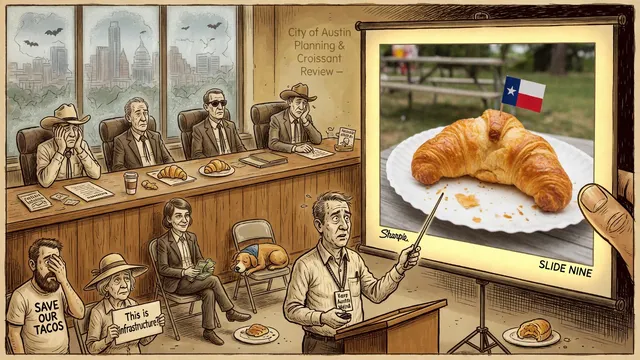
Slide Nine
It's a croissant.
Full bleed, no caption, golden and flaky in soft morning light. I assume it's meant to convey the onboard pastry program, or maybe the general mood of the company, which is mostly air with a crispy outside.
Slide Ten: "The Ask"
"Raising $4M pre-seed to unlock the corridor."
Four million against a thirteen-billion-dollar problem. If my math is right, and it's the kind of math I do on the back of an electric bill, that comes to about three hundredths of one percent of the studied cost. Tanner is raising enough money to build the croissant.
What gets me is that the deck never says the obvious part out loud. Public rail costs a fortune and the freight companies dig in because it's a hard public problem, the kind you solve with patience, political spine, and a lot of boring meetings where people argue over easements. GLYDE's whole pitch is that you can skip all that if the riders are rich enough. That isn't solving the corridor. It's charging admission to the traffic jam.
What I'd Actually Pay For
Here's my counter-deck, one slide, no croissant.
A train. Not an experience, a train, with a regular fare a regular person can afford. It stops in San Marcos and New Braunfels because people live there. It runs often enough that you don't plan your life around it. There's a snack cart with a guy who's been working it for nine years and knows exactly how much ice you want. Nobody's persona has a name.
I know the studies say that's the hard version. Thirteen billion hard, or freight-railroad hard. I read the story too. But I've driven that stretch of 35 for most of my adult life, past the same water towers and the same stubborn little Czech bakeries and the same field where somebody parks a fiberglass cow every spring. I'd like to someday ride past it at speed, looking out the window instead of at the brake lights, without having to pass a vibe check first.
Tanner closed his deck with the word "Let's GLYDE."
My buddy replied with a second skull.
I'm adopting it as the official position of this blog.
Keep reading Tech Bro of the Week
Turns Out It Was One Guy the Whole Time
I pinned every Tech Bro of the Week to my kitchen wall with yarn and thumbtacks, and the investigation came back with a sample size of one. The series retires, and so does the vest.
5 min read
His Chief of Staff Has No Hands
Tesla's steering-wheel-free Cybercabs started taking riders in Austin today, and this week's fictional founder has already promoted one to chief of staff. It does not own a lanyard.
5 min read
"The Creek Is Currently Paused"
This week's fictional founder set up a pop-up tent at a greenbelt trailhead to sell Barton Creek by the month. The creek is bone dry in August, which his app calls a pause.
5 min read
Follow the Grouch
Email subscriptions are unavailable. Follow new complaints in your RSS reader instead. We do not collect an email address here.
Open the RSS feedAdd this feed’s address to your reader. Opening the link does not subscribe you automatically.