
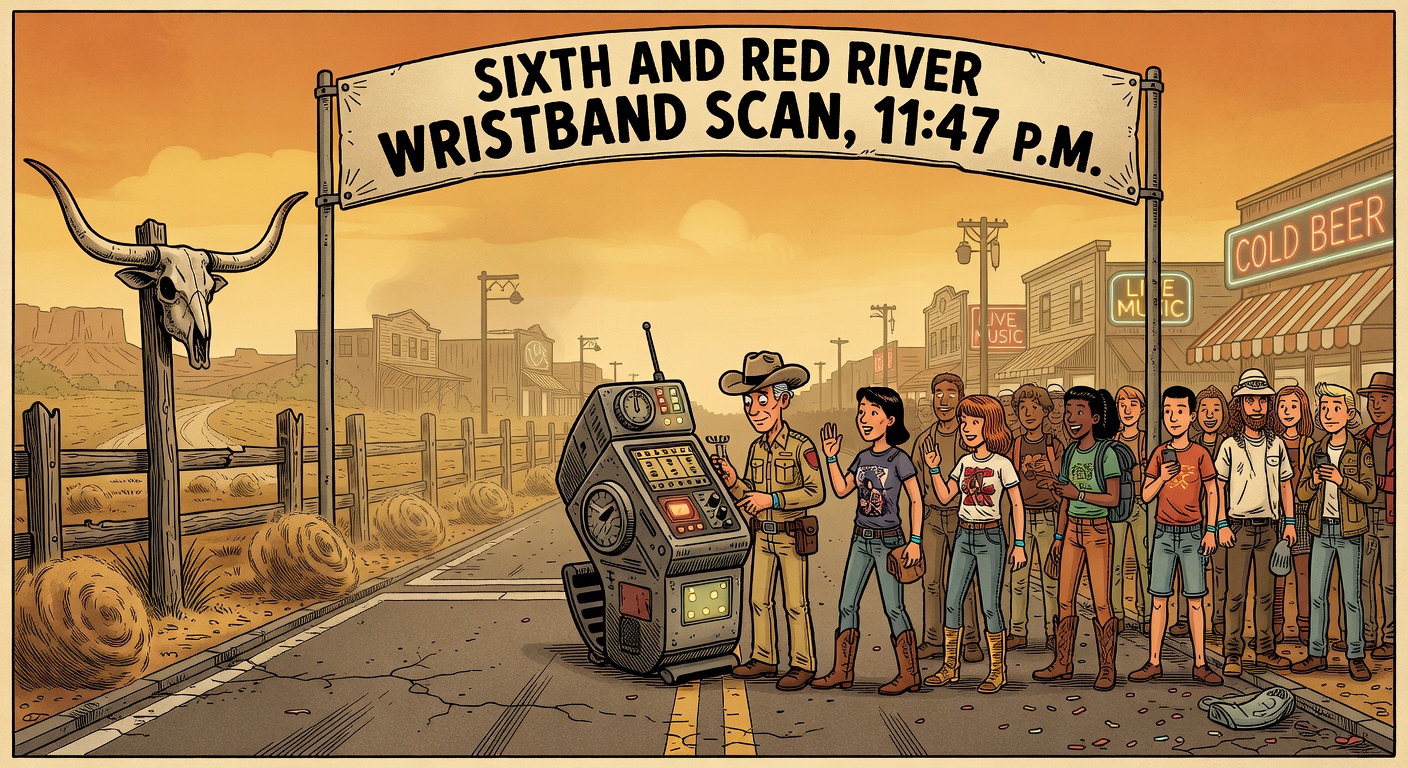
Sixth and Red River Wristband Scan, 11:47 p.m.
The bouncer needed three separate scans before he'd let me into the club where I once saw Alejandro Escovedo play for free on a Tuesday; this year the same corner charged $65 at the door, handed out sponsor-branded koozies, and piped in a playlist that sounded like it was generated by a committee in Cupertino.
The bouncer at Sixth and Red River needed my phone screen, the QR embedded in my wristband, and a government ID before the velvet rope dropped. Behind him a kid in a branded hoodie from some audio streaming service waved a tablet like it was a lightsaber. I was just trying to hear a band.
Fifteen years ago you followed the noise. That was the whole algorithm. You'd step out of the Continental Club, walk half a block, and the next decent guitar tone would pull you into the Twilight Room like a tractor beam. No apps. No tiers. Sometimes you'd end up watching a future legend in a room that smelled like stale beer and fresh regret, standing next to a drywaller from Pflugerville who knew every word to the chorus.
Last week the only genuine human sound I heard all night was a pedal steel player getting told his set was running long because the "brand experience" in the next room needed the stage for a mocktail demonstration.
The wristband itself is a marvel of late-stage Austin capitalism. Mine was lime green, which apparently signaled "basic access." The purple ones got you into the rooftop where the real networking happened. I watched a guy in perfect white sneakers argue that his orange band entitled him to the "creator lounge" anyway. The security guard, who looked like he'd rather be directing traffic at a funeral, just pointed at the giant foam-core sign listing the official sponsors. Adobe. Google. Some bank that used to be local before it got eaten. Each one had its own "activation," which is what we call advertising when the ad costs more than most people's rent.
I paid twenty-two dollars for a tallboy that used to be four bucks at the same bar during SXSW 2008. The can had a QR code on it. I scanned it because I'm an idiot. It took me to a page asking me to "join the conversation" with a hashtag I will not repeat. The beer tasted like it had already given up.
Back then the conversation was simpler. You talked about the last band. You argued about whether the sound guy at the Hole had gone deaf yet. You shared a cigarette with a stranger from Omaha who'd driven eighteen hours because he'd read a single paragraph in No Depression magazine. That stranger might sleep on your couch. He might also be the next big thing. Both outcomes felt equally likely and equally Austin.
Now the strangers all have pitch decks. I overheard one in the men's room line explaining how his startup was "disrupting discovery" by using AI to analyze Spotify skip rates. He said the words "frictionless onboarding" without a trace of shame. The guy washing his hands next to him was wearing the lanyard of a company that makes the software that makes the playlists that make the data that the first guy was disrupting. The circle was complete. Nobody had heard an actual song in hours.
The worst part is how thoroughly they've branded the memory of what this week once was. There's an official "Heritage Stage" now. It's inside a climate-controlled tent sponsored by a tequila company. They have historians. Actual historians, with lanyards, giving PowerPoints about "the Austin sound" while a band that sounds like every other band plays at safe volume. The slide deck included a photo of the old Liberty Lunch dirt floor. Someone had photoshopped the mud into an abstract pattern. I almost respected the audacity.
My phone buzzed with a push notification from the official SXSW app telling me a "must-see" panel on ethical AI was starting in nine minutes. The panel was moderated by a man whose last band broke up because he kept missing rehearsals for investor meetings. I deleted the app right there on the sidewalk. The deletion process took longer than it should have, like the phone itself was disappointed in me.
A kid in a Ramones shirt that still had the creases from the Urban Outfitters rack asked if I knew where the "real shows" were. I almost lied to him. Almost sent him toward some warehouse party I'd heard whispers about. Then I noticed his wristband was the top tier. Purple. The color of money. I pointed him toward the convention center instead. Let him network. The real shows left town somewhere around the time the first rooftop bar started charging for the view.
I ended the night the way the old Austin still knows how: drove east until the condos thinned out, parked on a side street in a neighborhood that hasn't been "discovered" yet, and sat on the hood of my truck listening to a local band practice through an open window. No cover. No QR code. Just three guys who still sounded hungry and a dog barking along off-key.
The wristband left a tan line I'll wear like a scar until it fades.
Some of us are still keeping score.