
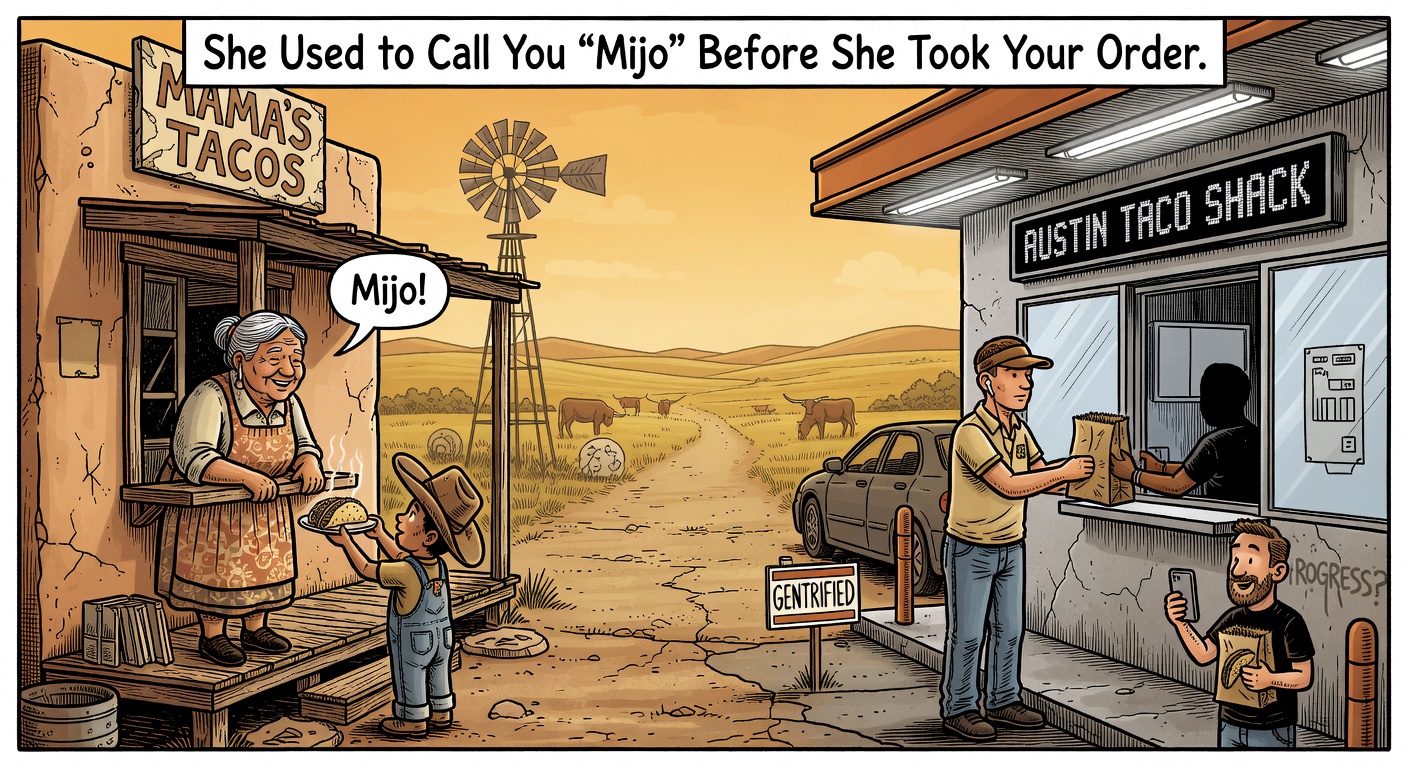
She Used to Call You 'Mijo' Before She Took Your Order
The cashier at Tamale House on Airport Boulevard used to greet half the room by name, slide your change across the counter with a wink, and already know you wanted extra green sauce; yesterday the new system asked for my phone number, suggested a 22% tip on a $17.25 plate, and the only person who made eye contact was the guy refilling the horchata dispenser.
The tablet beeped at me like a disappointed Roomba. I had barely cleared the door at the Tamale House on Airport Boulevard when it demanded my name, email, and zip code “for seamless ordering.” Behind the counter a kid who looked about nineteen offered the same blank professionalism you get at the DMV. No “¿Qué quieres, mijo?” No comment on the weather or my tired eyes. Just the faint smell of masa fighting a losing battle against hand sanitizer and the low hum of a digital order queue.
Fifteen years ago that same twenty-foot walk from the gravel lot felt like entering somebody’s loud, warm kitchen. Maria ran the register from 10 a.m. until the dinner rush tapered off around 8:30. She’d glance up, clock the expression on your face, and start punching buttons before your boots hit the mat. Construction workers in paint-spattered Carhartts, night-shift nurses still wearing scrubs from Seton, bike messengers with helmets dangling from their belts, disheveled guitar players who’d clearly slept in their vans outside the Continental Club, and the occasional state employee in a loosened tie all waited together without checking phones. The worst sin in that room was running out of napkins or letting the front door slam on the next person.
You could get three fat pork tamales, rice redolent with cumin, beans that had clearly been simmering since dawn, and a tall iced tea for $5.25. I still have the carbon-copy ticket from a rainy Thursday in 2011. She wrote “extra salsa verde, no onions, add jalapeño” in ballpoint and circled it twice. The total came to $6.87 after tax. Maria would slide the change across the Formica with two fingers, always two fingers, and drop the little foil-wrapped bundle into your hands like she was sending you off to school properly fed. Sometimes she tossed in an extra tortilla because “you look like you need it, mijo.” The word carried weight. It meant you belonged to the place whether you’d been coming since the Ford administration or just discovered it after last call at the Broken Spoke.
The tiles on the floor are the same scuffed orange. Same booths with the duct-taped vinyl. Same laminated menu boards that still advertise Mexican Coke in the old font. But the soul has been laundered out and replaced with efficiency metrics. The new owners installed a digital loyalty kiosk right where the old jukebox used to stand. That jukebox once held half a dozen Selena tracks, a stack of Freddy Fender, and at least one scratched-up Flaco Jimenez album that everybody fought over. Now it’s a Bluetooth speaker playing an algorithmically curated “chill Latin” playlist that sounds like it was focus-grouped in a Brooklyn loft. No more arguments in Spanglish about which conjunto was greater. Just the occasional wet cough of the ice machine and the wetter cough of venture capitalists clearing their throats while they discuss cap tables over chorizo.
I took the booth by the window where I once watched a tow-truck driver quietly wrap half his enchiladas in foil and set them outside for a one-eyed stray cat that patrolled the lot. That cat had more dignity than half the current clientele. Yesterday three separate people asked the kid behind the counter if the masa was gluten-free. One guy in pristine Ariat boots and a quarter-zip Patagonia vest wanted the carbon footprint of the rice. Another asked if the horchata contained “any proprietary allergens.” I stood there holding my numbered ticket like a prop from a museum exhibit titled How Austin Used To Feed Itself.
The neighborhood took the first hits. The budget motels along Airport that used to rent rooms by the week to line cooks and drywall guys are now “micro-apartments starting at $1,895 with tech-enabled entry.” The used-tire yard two blocks south is a construction fence promising The Hangar at Airport, even though we are nowhere near an actual hangar. Every new complex comes with the same rendering: thin white people laughing on balconies while holding bowls of something that definitely isn’t menudo. The Tamale House itself now casts a shorter shadow because the lot behind it was sold for “The Masa Lofts,” a name so tone-deaf it circles back around to offensive. The developers kept one faded mural of a giant ear of corn as a “heritage touch.”
Maria retired in early 2022. Her going-away party spilled into the parking lot and blocked Airport Boulevard for forty glorious minutes. Somebody brought a cooler of Shiner and the mariachis from the place on Rundberg showed up unannounced, playing “Volver, Volver” while Maria hugged every regular like we were her idiot sons finally home for Christmas. She told me that day she was moving out to Lockhart with her sister where the rent didn’t require a background check and a blood oath. The new management sent a company-wide email about “streamlining the guest experience” and “leveraging data to better serve community palates.” I printed that email. It lives in my glovebox next to the old carbon tickets. The contrast is its own kind of brutal poetry.
These days the line moves faster. That part is mathematically true. Nobody lingers at the tables swapping stories about last night’s set at the Hole in the Wall or the latest nonsense from the Capitol. The app tells you when your order is ready so you can stay sealed inside your climate-controlled crossover. The cook still bangs the bell when the plate hits the pass-through, but it feels like theater now, a nostalgic sound effect for people who think “authentic” is a filter on their food photos. Last week I watched a woman in Lululemon film her plate from four different angles, narrating the “texture journey” of a tamale to an audience that will never smell the actual steam rising off it.
The cooks who used to live five minutes away in rundown duplexes off Springdale now commute from Round Rock or Pflugerville because a one-bedroom anywhere near this stretch of Airport Boulevard clears eighteen hundred a month. They stand on the same cracked tile floors Maria once ruled, making the same recipes, but the joy has been squeezed out like the last drop from a lime wedge. The new point-of-sale system tracks their speed to the tenth of a second. Heaven forbid the tamale assembly time drifts above benchmark.
I paid the $17.25. The tablet suggested 18, 22, or 25 percent “to support the team.” I picked 22 because guilt is still cheaper than honesty in this town. The receipt was longer than my forearm, full of nutritional data I didn’t ask for, a QR code promising “more ways to connect with your neighborhood flavors,” and a prompt to download the app for a free chips upgrade on my next visit. There is no neighborhood left to connect with. Just real-estate inventory wearing nostalgia like a costume.
The kid handed me the bag without ceremony. “Have a great day.” It sounded like a sentence handed down by a weary parole board. I stepped back into the parking lot where the old shade tree that once protected a dozen cars is gone, removed last year for a “guest amenity station” that dispenses cold brew on demand. My truck smelled like cumin and disappointment the whole ride home down Airport, past the new self-storage facility that swallowed the old taqueria where the mariachis used to warm up.
I remember one specific Sunday morning in 2008 after a rough night that involved too much cheap whiskey at the Carousel Lounge. I walked in looking like something the cat dragged in. Maria took one look, didn’t say a word about my bloodshot eyes, and simply yelled toward the kitchen, “Huevos rancheros, extra spicy, and coffee strong enough to wake the dead.” Ten minutes later the plate arrived with a side of knowing silence that felt like absolution. That kind of transaction doesn’t fit in any app. It can’t be A/B tested or turned into a revenue stream.
The city didn’t just raise the prices. It raised the walls between people who used to share the same sticky booths without once mentioning their cap tables or content calendars.
Yet damn if those tamales don’t still hit the spot. The masa is still stone-ground, the filling still carries that perfect ratio of pork to red chile, and for exactly seven minutes while I sat in my truck in the new “paid parking zone” I could close my eyes and almost hear the old register ka-ching and Maria’s voice calling out the next order like it was the most important thing happening in Austin that day. Then the app on my phone buzzed with a push notification asking me to rate my “tamale journey” on a scale of one to five stars.
I gave it three. One for the food, one for the memory, and one for the sheer stubborn refusal of a few old recipes to let the last honest parts of this city disappear completely. The rest of the stars got paved over for luxury micro-apartments and subscription-based horchata.