Philosophy Was Behind the Radiator
I walked a vanished Drag used bookstore from memory, shelf by shelf, from the soggy free cart to the buy counter where a clerk once priced my soul at forty cents in store credit.
A paperback of Light in August fell off my top shelf last night and hit me on the collarbone. When I picked it up, the inside cover said $2 in soft pencil, with a little check mark beside it. That check mark meant somebody behind a counter on Guadalupe had looked at this book, looked at me, and decided we deserved each other.
The store that sold it is gone. The building is still there, roughly, the way a skull is still roughly a person. I don't need the building. I have the floor plan memorized better than the house I grew up in, so I'm going to walk it one more time, shelf by shelf, before somebody turns my memory into a co-working lounge.
The Free Cart, Sidewalk, Weather-Permitting
It sat outside the front door on a wheeled metal cart that had been liberated from some institution decades before I arrived. A cardboard sign said FREE, and under that, in different handwriting, PLEASE NO.
What was on the free cart: water-swollen Reader's Digest Condensed Books, a 1987 guide to programming in BASIC, three copies of the same Tom Clancy, and one book of Neruda that everybody passed over because they assumed it had to be a trap. It was not a trap. I still have it. The pages smell like a parking garage in August, which is to say like Austin.
The free cart taught you how the whole store worked. Rummage, and you would be rewarded. Nobody would help you, and nobody would stop you.
Fiction, A Through Somewhere Around M
The fiction section started near the door and lost its nerve around the M's, where the shelves ran into a load-bearing column. After that, fiction continued on the other side of the room, which meant half the regulars believed the store had no Nabokov and the other half had never seen a Faulkner. Two separate civilizations were browsing ten feet apart.
The alphabetizing was sincere but personal. Le Guin was under G for reasons nobody would explain. Vonnegut moved so fast he had essentially no fixed address. If you found a Pynchon, you bought it right then, because you would never find that Pynchon again.
Prices ran from $1.50 to $4, with a premium for books that still had a cover. A first edition went in a locked glass case behind the register. Was it really a first edition? The case was locked, so nobody could check.
Poetry, Stapled
Poetry was one shelf, low to the ground, so you had to kneel. I think that was a policy.
It held the canon, and then it held the chapbooks: photocopied, hand-stapled, sold on consignment by people who lived in Hyde Park group houses and owed the store nothing but hope. Each one cost a dollar. Each one had a title like Tuesday at the Laundromat on 29th and included at least one poem about a grackle. Some of those poems were good, and I mean that. A city where somebody can sell you a grackle poem for a dollar, two blocks from a university, is a city that's working.
Texana, Which Was Mostly Men in Hats
Two shelves of Texas history: cattle drives, oil booms, ranch memoirs, and a regional cookbook from a church in Lockhart with the recipes for six different congealed salads. Every cover showed a man in a hat squinting at a horizon. The section had the grim seriousness of a county courthouse. Graduate students went there to find primary sources, and retirees went there to argue with them.
There was also always one book, its spine broken and no author listed, called something like Austin: City of Tomorrow. The photos were from 1962, and every prediction inside was hilariously wrong in the optimistic direction.
Philosophy, Behind the Radiator
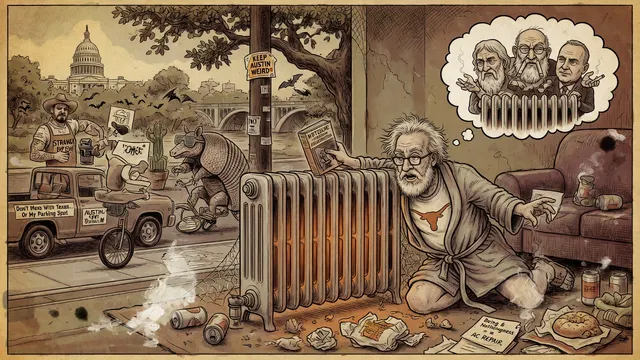
This is the one people remember. Somebody had wedged the philosophy section into the back corner, behind a cast-iron radiator that hadn't worked in any living person's lifetime. To reach Kierkegaard you had to lean across it at an angle that made your lower back file a formal complaint.
I've thought about this for twenty years and decided it was on purpose. If you wanted Spinoza that badly, the store made you prove it. Hegel was down at shin level. Nietzsche had been read so hard by so many sophomores that his pages fanned out like a deck of cards. Somebody had underlined every sentence in one copy of Being and Time, which is either devotion or a cry for help, and in a used bookstore the two are often the same thing.
A dog-eared Camus went for $1. Of everything in that building, it was the only thing priced exactly right.
The Buy Counter
At the back sat the buy counter, the place where you learned who you were.
You put down your grocery bag of books. The clerk usually wore a cardigan in July and gave off the energy of someone halfway through a dissertation they had no plans to finish. They went through your stack without a word. Book by book, they made two piles, and one of those piles went back in your bag.
"We'll do four dollars cash or six in credit."
You took the credit. Everybody took the credit. The credit was the store's whole business model: you never actually got money, you just moved your books around the room. I'd guess I sold the same copy of Infinite Jest back to that counter at least twice. It may still be circulating today on pure momentum, like a satellite.
A laminated sign above the counter read WE DO NOT BUY TEXTBOOKS. That was the only firm rule in the place. Every August, freshmen tested it anyway, holding up four-pound organic chemistry books like they were offering the clerk a kidney, and every August the clerk pointed at the sign without lifting their eyes from the cash drawer.
What's on the Shelf Now
Walk the Drag today and you can still buy books. You buy them at a coffee concept whose back wall holds about two hundred hardcovers arranged by color, so they look nice behind somebody's laptop. They're for sale, technically. A sticker on a sage-green memoir by a founder said $28. I asked the barista what section it belonged to. She looked at the wall, then at me, and said, "Green?"
She is not the problem. She is twenty, she works for tips, and she's answering a question nobody hired her to answer. The problem is the arithmetic. Commercial rent along Guadalupe now runs on the assumption that every square foot will earn like a phone-repair kiosk or a slot for a national chain. A business that sells a $2 Faulkner and pays you mostly in store credit can't make that arithmetic work on any planet, much less on a block where landlords price ground-floor space for whatever tenant the next pitch deck promises.
So the stores didn't really die. They got outbid by a spreadsheet. Plenty of people still wanted to read. What disappeared was the cheap room where you could kneel at the poetry shelf for forty minutes without buying anything and nobody minded.
Closing Inventory
I put Light in August back on my shelf. I left the pencil price alone. That two dollars is the last receipt I've got from a place that thought a back corner, a broken radiator, and a sophomore who wouldn't give up were enough reason to keep a whole section of philosophy in stock.
If a landlord ever wants to know what that corner was worth per square foot, I'll answer the way the clerk would have.
Four dollars cash, or six in credit.
Keep reading Things We Lost
Barton Springs Road, 58 Degrees, Wind Out of the North
The first real norther of the season blew down Barton Springs Road, and every patio on the strip found a way to bill for it. A scene report from the night cold weather got a cover charge.
5 min read
Coming Soon, Est. 2019
I opened a one-man investigation into a fenced lot on Manchaca that has promised mixed-use excitement since 2019. So far the only thing it has delivered is a porta-potty with seniority.
5 min read
Intro to Tightening, $65
The old Koenig Lane hardware store sold screws by the handful. The lifestyle concept that replaced it sells them six to a linen pouch and offers a workshop on which way to turn them.
5 min read
Follow the Grouch
Email subscriptions are unavailable. Follow new complaints in your RSS reader instead. We do not collect an email address here.
Open the RSS feedAdd this feed’s address to your reader. Opening the link does not subscribe you automatically.