
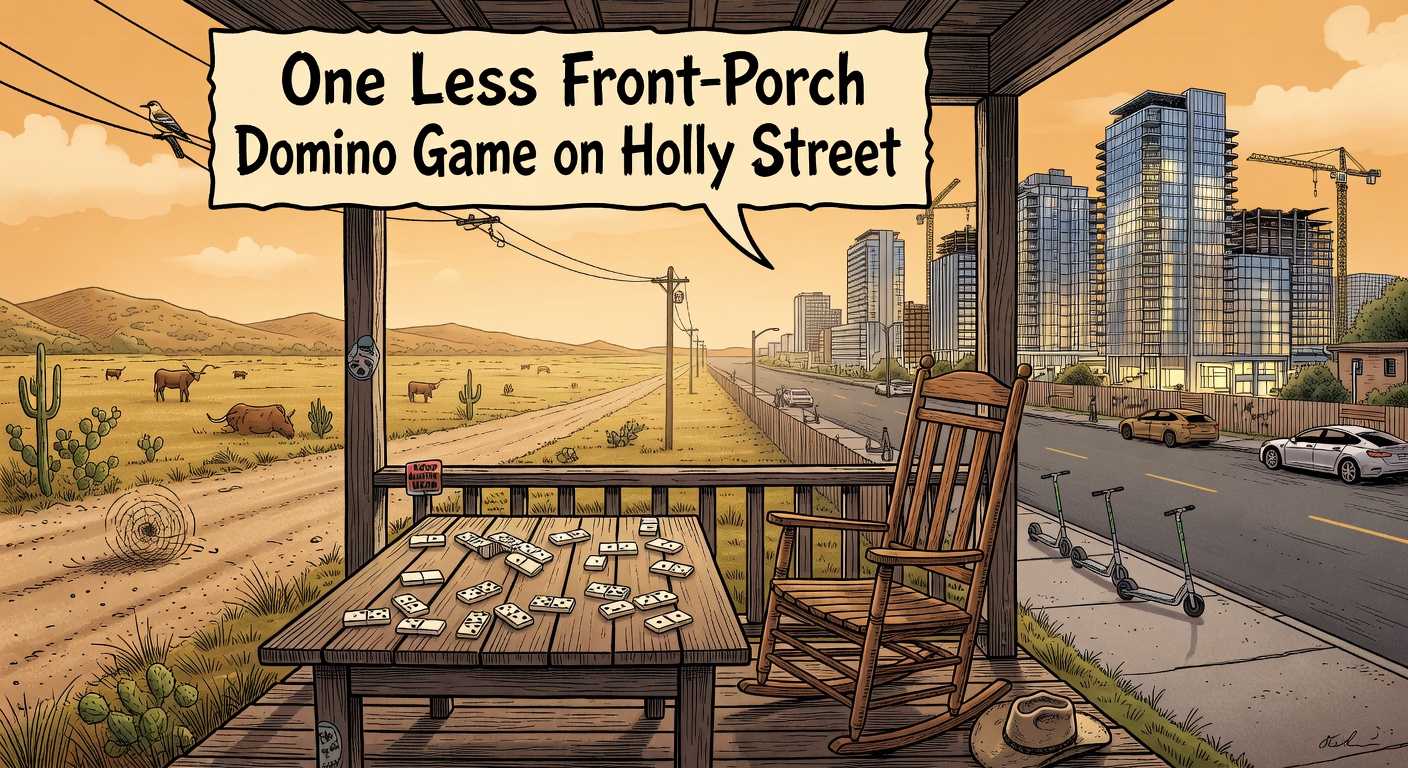
One Less Front-Porch Domino Game on Holly Street
The yellow bungalow at 912 Holly kept its screen door squeak, its porch swing chains, and its every-Sunday domino table for decades; last month the lot got scraped to bare dirt for four "heritage-modern" townhomes starting at $1.15M with rooftop decks, app-controlled lighting, and a marketing video that somehow forgot to mention the man who actually lived there.
The swing was already in the yard when I drove past, propped against a sawhorse with a piece of cardboard that read "Free. Take it." The hooks remained in the porch beam overhead, empty and ridiculous, like earrings on a statue.
I parked the truck half on the curb because this is still the kind of street where you can do that without an immediate ticket. The house at 912 Holly hadn't changed much since the late '70s. Same faded yellow paint. Same bottle tree in the front bed, blue glass glinting like it had been doing since I was a kid riding my bike to the old corner store on Cesar Chavez.
Chuy Garcia bought it outright in 1974 for what a decent used truck costs now. He worked at the Post Office on Springdale Road, raised three kids here, buried his wife Rosa out of it in 2018. Every Sunday after noon mass the dominoes came out. Four or five old heads from the neighborhood would settle in with a cooler of whatever was cheapest at the H-E-B on 7th—usually Lone Star or Pearl if they had it on special. The clack of tiles carried halfway to the railroad tracks. Nobody kept score too seriously. The point was the arguing, the laughter, the occasional accusation of cheating delivered in two languages.
The yard always smelled like a mix of cut St. Augustine, charcoal, and whatever Rosa had going in the kitchen. Cilantro and onion mostly. Sometimes menudo on special occasions. Kids from three blocks over knew they could get a Big Red and a fix on their bicycle chain if they showed up polite. Chuy never charged. Said he'd rather teach them to fix it than watch them ride around on a busted setup.
Property taxes didn't care about any of that.
The first serious offer came in 2022 from a guy in a Tesla wearing what looked like expensive pajamas. Chuy laughed him off the porch. The second offer doubled. By the fourth one the number had so many zeros it stopped looking like money and started looking like an exit strategy. Medical bills from Rosa's last years had stacked up. The roof was twenty years past due for replacement. When the cash offer from the Delaware LLC landed—quick close, no inspection—Chuy was eighty-one and exhausted in a way no amount of porch time could fix. He signed. Moved to his daughter's place outside San Antonio two weeks later.
The bulldozer showed up on a Tuesday.
Three days and the house was gone. Not a trace except that pecan tree in the back they swear they're keeping. The concrete crew has already poured a pad that comes within four feet of its trunk. Good luck with the roots, boys.
Now the sign is up. Professional. Backlit. It calls the project "Holly Grove Cottages" even though there are no cottages and the only grove that ever existed got paved for the highway in the '60s. The renderings show smiling people who look like they summer in Aspen. One of them is sitting on what might be a domino table, but it's made of reclaimed teak and probably costs more than Chuy's original house. The video narration talks about "honoring East Austin's rich cultural tapestry." They even used an old photo of Chuy's bottle tree in the collage. Photoshopped, of course. The real one got hauled off last Thursday.
I walked the block at dusk. Four other houses show the same symptoms. One has a bright orange development sign already. Another has a trailer with Washington plates parked in the driveway while the owners wait for the inevitable. The guy two doors down sold his '69 Chevelle last month just to cover the jump in his insurance. Said the classic car guys in Round Rock gave him a fair price. He didn't sound like he believed it.
This is how it happens now. Not with bulldozers first. With the paperwork. With the taxes that triple every time the county decides our "area is appreciating." With the realization that your paid-off house is worth more dead than alive if you're the one living in it.
The new units will have two-car garages for cars that have never seen a dirt road. They'll have "smart" everything—thermostats that know when you're sad, lights that dim themselves when your algorithm thinks it's bedtime. The marketing materials brag about "walkability scores" and proximity to "vibrant street life." The vibrant street life, last time I checked, was mostly day laborers waiting for work at the intersection and the breakfast taco truck that still somehow survives on the corner. Give it six months.
I took the swing. It's in my garage now, taking up space I don't have. The wood is weathered to the color of old bone. One chain has a kink where Chuy welded it back together in 1987 after his oldest grandkid swung too high. I sat on it for a while yesterday evening with a can of Big Red I'd bought for the occasion. Tasted exactly the same. The sugar hit the same way. The carbonation didn't care that the neighborhood it came from had been redesignated "transitional."
At least they kept the address. Continuity is important to these people.
The thing nobody says out loud is that the new residents will pay extra every month for the feeling that they live somewhere with a story. They'll tell their friends from Denver about the "authentic" neighborhood, how it used to be "sketchy," how they rescued it. They'll put up tasteful black-and-white photos of 1950s East Austin in their minimalist living rooms. None of the photos will show the actual people who kept the place alive through the '80s and '90s when the rest of Austin treated this side of the river like it was another country.
Chuy called me last week. Sounded smaller on the phone. Asked if the tree was still standing. I lied and said it looked healthy. He told me the dominoes are in a box in his new closet. His daughter doesn't have a porch. The HOA in her subdivision doesn't allow unsanctioned gatherings of more than four people anyway.
I didn't have the heart to tell him about the sign. About the video. About the part where the narrator says "once a hidden gem, now ready for its close-up." Some losses don't need extra narration.
Driving back toward Airport the other night I passed the lot again. The construction lights were on, bleaching everything that ugly daytime color even at 10 p.m. A crew in matching shirts was staking out the property lines with laser precision. One of them had the radio playing norteño at a respectful volume. For a second it almost sounded like the old days.
Then the backup beepers started and the moment snapped. Progress doesn't idle quietly. It has to announce itself every three seconds so you never forget who's in charge now.
The swing is still in my garage. I keep meaning to hang it somewhere. But the truth is there isn't a porch left on this side of town that deserves it. Not one that hasn't already been pressure-washed, staged, and priced out of reach for the people who would actually use it.
Some things just don't transplant. They break off at the roots. You can put the pieces in the renderings all you want. The clack of the dominoes doesn't come through in 4K.