One Avocado-Green Crock-Pot, Lid Included, $64
A price autopsy of a used slow cooker at a Hyde Park estate sale with timed entry, a wristband and a calligrapher. The pot is the same color it was in 1994. Everything else got curated.
The woman with the iPad scanned my wristband at 8:59 and told me my window was 9:00 to 9:20, "but nobody's going to rush you." Then she looked at her watch, which is a form of rushing.
The wristband was teal, Tyvek, and cost twelve dollars. The fine print said the fee was "applied toward purchases over $150." It was printed under a logo of a wheat sheaf crossed with a skeleton key, for a company called Hearth & Provenance Estate Experiences. I had seen their signs zip-tied to stop signs all over Hyde Park all week, the good kind of sign with a serif font and no misspellings. A garage sale sign without a misspelling should have told me everything.
I went in for the house. I came out having studied a Crock-Pot for eleven minutes.
The Pot
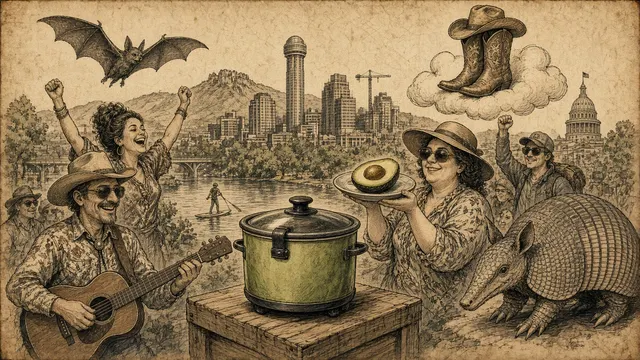
It sat on a kitchen counter between a fondue set and a framed needlepoint that said BLESS THIS MESS, which was also for sale, for $38. The Crock-Pot was avocado green, the precise green of a 1970s kitchen and of nothing else in nature. It had the brown stoneware insert, the glass lid with the little knob, and a cord with the cloth-wrapped strain relief that tells you an appliance has outlived at least one marriage.
The tag was a cream cardstock rectangle tied on with butcher's twine. Someone had written, in actual calligraphy, with flourishes:
Vintage slow cooker, c. 1976. Warm patina. Lid included.$64
"Lid included" is my favorite part. That's like a used-car listing saying "wheels attached." As if somewhere in a back room there's a second, cheaper tier of Crock-Pot sold topless to the unworthy.
What a Crock-Pot Cost on Ramsey Avenue in 1994
I know what this pot should cost because I bought its twin. Saturday, early November, a garage on Ramsey or thereabouts in Rosedale, a man in a folding lawn chair with a cigar box on his lap and a transistor radio doing pregame on the Longhorns. There were no wristbands. There was a driveway and a blue tarp and a hand-lettered sign on the light pole that said GARAGE SALE with the last A crammed in sideways because he'd run out of posterboard.
The Crock-Pot was in a box with a waffle iron, a bag of mismatched coasters and a single ice skate. The whole box said $3. I asked if I could just get the Crock-Pot. He said, "Son, I'm trying to get rid of the skate."
I took the box. I made chili in that pot for nine years. The skate I left on a curb, and I'd like to believe it found someone with one foot.
So, $3, skate included. Thirty-two years later, $64, lid included. I'm not an economist, but I can hold a calculator, and that's a lot of lid.
Where the Other Sixty-One Dollars Went
I spent the rest of my 20-minute window doing forensics, because a man should know what he's being asked to pay for. As best I can reconstruct it, the markup breaks down like this.
The calligraphy. Somebody was paid to hand-letter every tag in a three-bedroom bungalow, including a tag for a box of rubber bands ("Assorted, utilitarian, $6"). You do not hire a calligrapher and then price rubber bands at a quarter. The penmanship has to make its money back somewhere, and that somewhere is your dinner.
The word "vintage." In 1994 the same object was called "old." Old was free. Vintage costs roughly twenty dollars, and it compounds. Nobody can tell me exactly when the pot crossed over, but I suspect it was the day it showed up on a mood board.
The word "patina." Patina is what they call it when they've already decided not to clean it. I lifted the lid. The patina was chili. Not my chili, but someone's, from the Ford administration, and I'm sure it was very good.
The staging. The kitchen had been arranged. Not cleaned out, arranged: a single lemon in a wooden bowl, a cookbook propped open to a page about aspic, a linen towel folded over the oven handle at a tasteful slant. The lemon was not for sale. I asked. The young man in the HEARTH & PROVENANCE apron said, "That's styling," the way a museum guard says "That's load-bearing."
The line. People had started lining up at 6:15 a.m. on folding camp chairs. Not neighbors; pros. Guys with tape measures on their belts and a phone propped on one knee, already looking up sold prices. This is the part that gets me. The old garage sale line was three retirees and a guy who wanted the power tools. Now the line itself is a market signal. If forty people will sit on a Hyde Park sidewalk at dawn, the company knows exactly what the green pot is worth, and the answer is "whatever the fortieth person will pay."
The wristband. I've covered this. Twelve dollars to be allowed near a fondue set.
The Dead Man's Chair
The worst part is that everything in the house was clearly loved by somebody, and then a company came in and turned that into a brand voice. The recliner in the den had a tag that said Mid-century lounge chair, well-loved, $295. Well-loved. Somebody sat in that chair and watched the evening news for forty years and yelled at the weatherman, and now his posture is a selling point.
I'm not knocking the family. Selling a parent's house in this town is its own special humiliation: the property tax bill, the appraisal, the investor postcards that start arriving before the casseroles do. If somebody offers to empty the place, take a cut and do it in a nice font, I understand saying yes. My quarrel is with whoever decided that an estate sale needed a velvet rope, a "window" and an apron with a logo. The garage sale used to be the one retail event in America where the seller was trying to lose.
At my old man-in-the-lawn-chair sales, the whole point was to make the stuff go away. You'd haggle downward out of politeness. The seller would throw in a lamp just to stop seeing it. By 11 a.m. everything was FREE and by noon he'd be dragging the rest to the curb himself. There was a joy in it: a cul-de-sac's worth of junk reshuffled among strangers for the price of a breakfast taco.
Now it's an auction with better lighting.
What I Did
At 9:19 the iPad woman found me still holding the lid, like a man in a portrait holding a skull.
"Did you want to take that to the front?"
I thought about it. I really did. My old green pot cracked in 2003, and I've been making chili in a stainless steel thing with a digital display that beeps when it's done, like it wants a tip.
But I put the lid back down, gently, onto its sixty-four dollars of patina. On the way out I passed a dining room table with a tag that said Gathering table, farmhouse, $1,400. Back in my day that was a table. You put food on it. Nobody had to gather.
Out on the sidewalk, a guy in the reseller line had already bought the BLESS THIS MESS needlepoint and was photographing it against a brick wall for his listing.
I hope he gets a hundred for it. Somebody in this town ought to be getting blessed.
Keep reading Things That Used to Cost $3
Men's Cut, Standard, Nine Dollars, Discontinued
I went to get a haircut where a barbershop used to be on Airport Boulevard and was asked to describe my relationship with my hair. The answer, it turns out, costs $78 before the scalp ritual.
5 min read
A Letter to the Bats Under Congress Avenue, Who Are Leaving Without Paying for Anything
Before the free-tailed bats head south for the winter, I wrote to thank them for staying free in a city that now sells tickets to the sky. Please do not tell the rooftop bars where you're going.
5 min read
You Are Number 47. Reply 1 to Confirm You Are Still Hungry.
A Sunday scene report from a South First brunch waitlist, where migas cost $23, coffee refills have been discontinued, and the app texts you more often than your family does.
5 min read
Follow the Grouch
Email subscriptions are unavailable. Follow new complaints in your RSS reader instead. We do not collect an email address here.
Open the RSS feedAdd this feed’s address to your reader. Opening the link does not subscribe you automatically.