
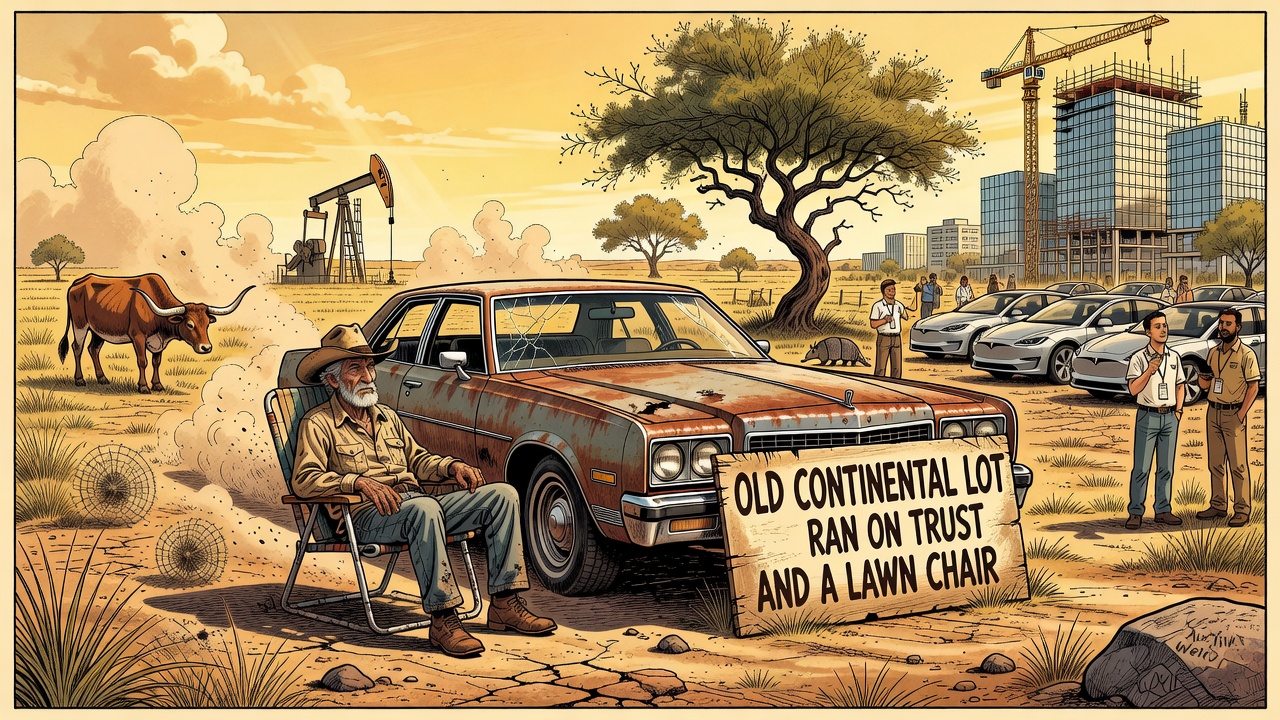
Old Continental Lot Ran on Trust and a Lawn Chair
The dirt lot behind the Continental Club on South Congress charged five bucks cash, let you park your beater all night if the band was good, and the attendant in the lawn chair would hold your spot with an orange cone that had seen better days; these days the pavement's the same but the system texts you dynamic pricing alerts, knows when you left the bar, and charges a convenience fee for using actual money at the new kiosk.
Saw the new brushed-steel kiosk where Big Mike's lawn chair used to sit and the stomach drop hit before I even killed the engine. The thing glowed soft blue, like it was too important to just be a parking meter. No folding chair. No Mike. No handwritten sign that once read "Back by 2am or I move you—$10 more."
Fifteen years ago that lot operated on physics I still don't fully understand. You pulled in, Mike gave you the once-over, and five dollars changed hands. Sometimes it was three if the show was light. Sometimes he just waved you through if he recognized the truck from the previous three nights. The transaction took eleven seconds and involved zero apps, zero license plate scans, and exactly one piece of advice: "Don't block the blue Civic, kid. Owner's got a temper."
The ground was always the same mix of crushed limestone and leaked motor oil. After rain it smelled like every backyard party from 1998 to 2008—mesquite smoke drifting over from the Continental's back door, stale Shiner, and that particular South Congress dust that got into your floorboards and never left. You'd kill the headlights, hear the muffled kick drum leaking from the club, and know you were exactly where you were supposed to be.
I once left a '92 Civic there for nine hours during SXSW 2007. Came back at 4 a.m. to find a note under the wiper that just said "Nice parking job. —M". The car hadn't moved. Mike had apparently repositioned three other vehicles around it like a Tetris master working under moonlight and pure intuition. That level of spatial awareness and human decency doesn't fit in venture capital decks.
Now the lot's managed by a company called VeloPark whose headquarters, I shit you not, is in a WeWork in Denver. The app requires location services, camera access, and a linked credit card before it'll even quote you a price. Last Tuesday at 9:47 p.m. it wanted $9 for the first hour. By 11:15 it had bumped to $14 because "high demand detected near live music venue." The surge pricing knows when the Continental's at capacity. It knows when you're at the bar next door. It probably knows what you ordered.
I watched a woman in her late thirties try to pay with actual cash last month. She approached the kiosk like it was a hostile alien artifact. The machine instructed her to download the app. She asked the empty air where the attendant was. A speaker crackled to life with a recorded voice that sounded like every airport announcement ever: "VeloPark prioritizes frictionless experiences. Please utilize the mobile application."
The old system had friction. Beautiful, human friction. Mike would tell you if your left rear tire looked low. He'd let you know the headliner's running late. Once he held my five bucks for twenty minutes while I ran to the ATM because I'd shown up with two singles and a handful of quarters. The new system charged me a $2.99 "convenience fee" for using the credit card reader that doesn't give receipts unless you create an account.
The pricing autopsy is almost too predictable at this point. Five dollars got you the night in 2009. Twelve dollars gets you forty-five minutes in 2026 if there's a touring act. Twenty-eight if it's a sold-out hometown return show. The app sends you a push notification at minute forty that reads "Your parking session is expiring. Extend for seamless experience?" The seamless experience costs another nine bucks.
Last weekend I parked three blocks away just to avoid the whole production. Walked past the lot and saw two guys in their twenties staring at their phones, arguing with the kiosk like it was customer service at an airline. One of them actually said, out loud, "Bro, it won't sync with my digital wallet." The kiosk just blinked its cold blue light, indifferent to their vibes, their crypto, their entire generational trauma around paying for things.
The Continental itself still has some of the old soul on the inside, but even that's starting to feel like a museum exhibit. The lot out back was never glamorous. That was the point. It was where the sound guy kept his van, where the bartender went to scream between doubles, where you could smoke a joint without some influencer filming it for content. Now the sensors probably detect elevated CO2 levels and send data packets to somebody.
Mike disappeared around 2019. Rumor was the property sold to a group out of California who immediately saw "underutilized footprint" instead of a working system that had run smoothly for decades on handshakes and lawn furniture. They kept the potholes, though. Can't monetize those yet, but give them time. Some enterprising grad student is probably pitching "pothole NFTs" to the same people who turned the old Texaco into iris-scanned pods.
I still drive past there some nights when the club's dark. The kiosk keeps glowing, collecting its data, calculating its yields. The orange cones are gone. The handwritten signs are gone. The guy who knew your name, your car, and whether you'd had a good night is gone.
The limestone dust remains, but they're probably working on a way to charge for that too.