
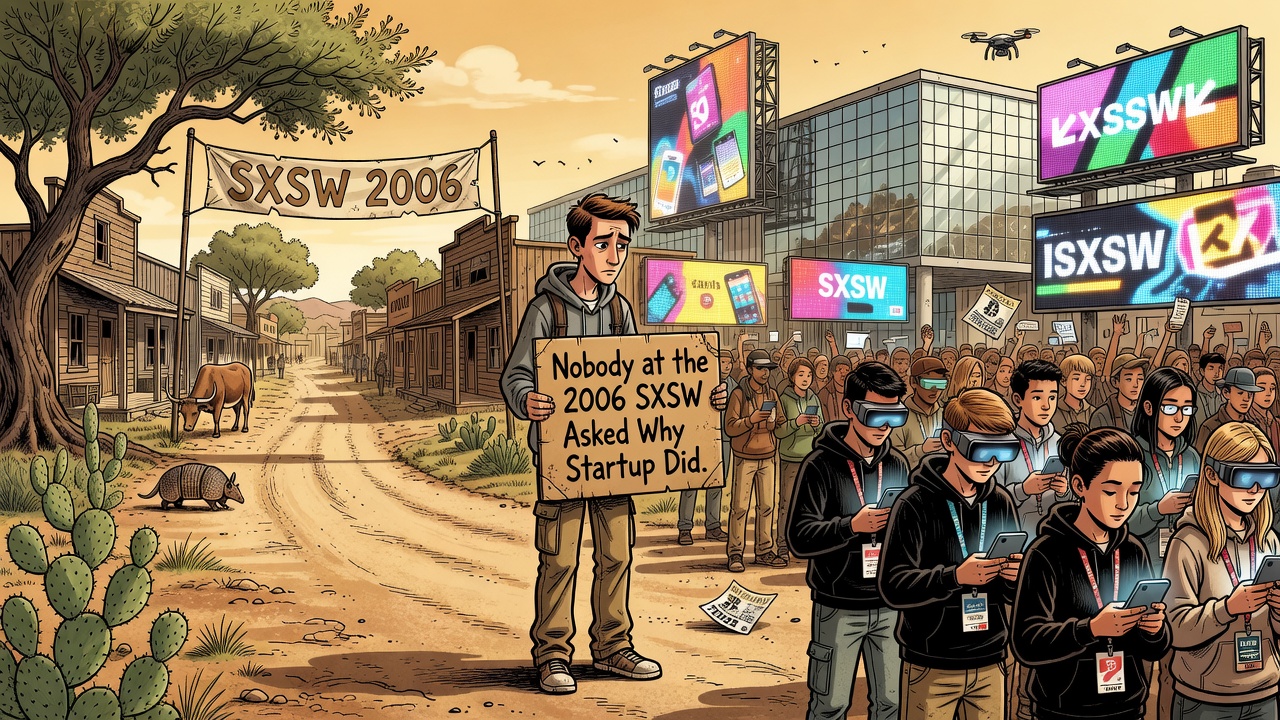
Nobody at the 2006 SXSW Asked What My Startup Did
A 2006 wristband got you into the Cedar Street Courtyard for $2.50 Lone Stars and whatever Denton band was murdering it that night with zero questions about your burn rate; the 2026 version demands $2,800 for the 'Founder Tier,' an app that maps your 'synergy opportunities,' and at least four people who'll pitch you before the first chorus.
The lanyard in my junk drawer still carries a faint whiff of stale Shiner and somebody else's American Spirits. Plastic, green, 2006 issue. The volunteer who printed it had spelled my name wrong and I never bothered to fix it because nobody cared.
That year I watched a then-unknown band from Ohio play the back room at the old Flamingo Cantina on a Tuesday afternoon. Twenty-five people in the crowd, maybe. The guitar player kept stepping on his cord and the sound guy just shrugged like that's how it goes. After the set the whole group walked next door for $1.75 tacos off a truck that didn't have a QR code or a mission statement. We stood on the sidewalk sweating and arguing about whether the drummer was better than the one from Spoon. No one asked what I did for money. No one handed me a pitch deck.
Fast-forward twenty years and the same corner looks like a trade show that wandered into a city by mistake. Metal barriers. Branded archways. A woman in a Patagonia vest asking if I've "optimized my schedule yet" while a speaker the size of a Volkswagen pumps something that sounds like a dial tone having an anxiety attack.
The wristband itself is now a plastic brick with an embedded chip that pings your location to the mothership every ninety seconds. Miss too many "activation opportunities" and it downgrades your access like a credit card that knows you've been bad. Last March I saw a guy in line at the convention center actually argue with the thing because it wouldn't let him into a panel called "Disrupting Discovery: How AI Can Find Your Next Favorite Band." The irony was lost on him. It was not lost on the two Austin lifers behind me who just turned around and walked toward actual music instead.
Back in '06 the festival still felt like it belonged to the clubs first and the sponsors second. You could ditch the official map entirely, wander down to 6th and Red River, and follow your ears. Sounded good? In you went. Ten bucks at the door if the guy recognized you, nothing at all if he didn't. The air inside was thick with cigarette smoke, sweat, and the particular perfume of spilled beer on a floor that hadn't been mopped since Clinton was president. Good smell. Honest smell.
Nobody was "building community." They were just drinking and listening and occasionally making out in the alley because the band was excellent and the night felt infinite. I once stood next to a guy in a torn Ween T-shirt who turned out to be in the band I was there to see. We talked about barbecue. He recommended a place on South Congress that closed two years later. I still miss both of them.
These days the conversations all sound like job interviews with worse lighting. "What's your ARR?" "Are you pre or post seed?" "Have you considered adding a social layer to your playlist curation tool?" I heard a kid—no older than twenty-three—explain his "music NFT loyalty program" to an exhausted bartender at the Mohawk annex while she tried to pour drinks for actual humans. She gave him the same look she used to give the guy who asked for a cosmopolitan in 2009. Some things never change.
The worst part is how thoroughly the city has been trained to perform for the visitors. Every other storefront on East Cesar Chavez now has a temporary banner that says things like "SXSW WELCOME: COLD BREW AND CAPITAL." The old taquerias that used to feed local cooks and drywall guys at 7 a.m. now sell $9 breakfast tacos with edible flowers and a suggested tip screen that starts at 25%. The guys in the kitchen still make them the same way. The prices and the signage do not.
Even the weather feels different. Or maybe it's just that the rain used to send everyone scrambling into the nearest dive where they'd end up seeing the best set of the week by accident. Now it sends everyone scrolling the app for "covered networking zones" with QR codes on every table. Progress.
I ran into an old sound guy last year during the festival. He'd worked the board at the original Emo's back when it was still on Red River and you could stand close enough to watch the bass player sweat. He was directing foot traffic for a sponsor activation involving smart water bottles that light up when you're "hydrated enough to network." The look on his face was the same one my grandfather wore when he talked about watching the family farm get sold for a Walmart.
We didn't say much. Just nodded at each other like two guys who remember when the weird wasn't a marketing vertical.
The thing that actually stings isn't the money or the branding or even the tech bros in limited-edition sneakers. It's how thoroughly the spontaneous part got murdered. Used to be you'd hear a banjo from half a block away and just go see what the hell it was. Now that banjo has a booking agent, a brand partnership with a hard seltzer company, and a time slot that conflicts with three other things your app insists you can't miss.
At least the hangovers were earned honestly back then.
Every March I still get the itch. I pull out that faded lanyard, think about walking down to the Continental or the Saxon or whatever's left that hasn't been optimized into oblivion. Sometimes I even buy a day pass just to see how bad it got. Then I remember the guy from 2006 who didn't care what my startup did—mostly because I didn't have one—and I put the lanyard back in the drawer.
The bands are still out there. The weirdos too, if you know where to look after the corporate tide rolls back out. But the particular alchemy that happened when cheap beer, broken PA systems, and zero expectations collided on a warm Austin night? That version of South by Southwest is just another thing we lost to people who wanted to scale it.
Turns out some stuff doesn't scale. It just gets replaced by something that rhymes with the original if you say it fast enough in a pitch meeting.