Most of Them Are in Mexico Right Now
I paid for a rooftop sunset bat experience near the Congress Avenue Bridge in mid-November and was handed a lanyard, a mezcal cocktail and the news that the bats had already left for the winter.
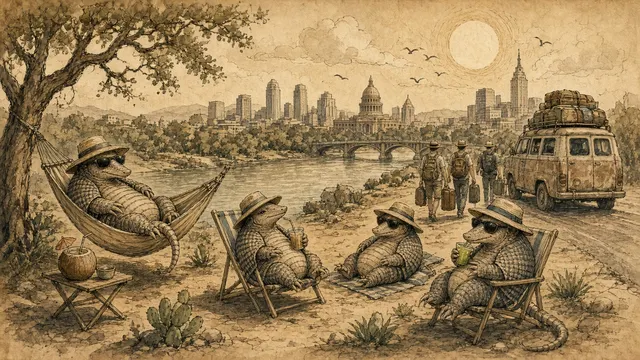
"Most of them are in Mexico right now," said the young man with the tablet, in the gentle voice a vet uses to tell you about the dog. "But we do sometimes get stragglers."
He said this after he had scanned my wristband, which was after I had paid eighty-five dollars plus a "conservation-adjacent service fee," which was after I had ridden an elevator nine floors up a hotel two blocks from the Congress Avenue Bridge, so the information arrived at the exact moment it was no longer useful to me. That is the defining feature of modern Austin hospitality. You find out what you bought once you're standing in it.
The venture is called Roost, lowercase, with a period after it, as though the word itself had made a decision. Its website promises "an elevated encounter with Austin's most iconic residents." I'll give them this much: they got the iconic part right. They just didn't check the residents' travel plans.
A Brief Note on Whose Bats These Are
Every October and November, Austin's colony of Mexican free-tailed bats does what every sane creature in Central Texas would do if it could. It heads south. The bats have been roosting in the crevices under the bridge since the city rebuilt it around 1980 and accidentally made the perfect bat apartment complex: dark, narrow, warm, and with a view of the water. Over a million of them, mostly mothers and pups, come back every spring and pour out at dusk all summer, a long brown ribbon unspooling down the river toward the bugs over the farmland east of town.
For years the city's first instinct was to get rid of them. Then people realized the bats eat tons of insects a night and don't charge for it, and Austin did a rare and lovely thing. It changed its mind. It kept the bats. It put up a sign.
That's what I want everyone to remember. The single greatest tourist attraction in this city is free, it's run by rodent-adjacent mammals, and it closes for the season without a press release.
What the Package Includes
Roost's Sunset Colony Experience comes with one welcome beverage, a "curated small-bites moment," access to a heated lounge, and a laminated card explaining echolocation in a font I'd describe as Wellness Serif. The welcome beverage is a smoked mezcal number called the Night Shift, garnished with a dehydrated blood orange wheel that looks like a tiny stained-glass window of a sunset you're not going to see because it's November and the sun goes down at 5:30, behind a crane.
The small-bites moment was three dates wrapped in bacon on a slate tile. The slate tile had more presence than the dates.
There was also, I'm not kidding, a "colony guide," a cheerful woman in a black quarter-zip whose job was to stand at the railing and narrate. She was good at it. She knew things. She told us the bats can fly up to around 10,000 feet and catch tailwinds, and I believed her, and I felt bad that her talent had been deployed to an audience of eleven people in puffer vests looking at a bridge where nothing was happening.
"Keep your eyes on the east side," she said, the way you'd tell a kid to keep an eye out for Santa.
We kept our eyes on the east side. A grackle landed on a light pole and screamed at us. Somebody took a picture of it.
Where I Used to Sit
I used to watch the bats from the grass on the south bank, near the old newspaper building, sitting on a towel that had been in my trunk since the Clinton administration. Admission was zero dollars. Refreshments were whatever you brought: a Big Red sweating through a paper sack, a breakfast taco you'd been ignoring since noon, a bag of pork rinds from the gas station on Riverside.
You'd show up around 7:45 in August, when the heat was still coming up out of the ground like it had a grudge. Families spread out on blankets. Some guy always had a guitar he didn't play. Kayakers bobbed underneath the bridge, which looked romantic until the bats came out and you remembered what bats do after dinner. The whole bank would go quiet at once, a hundred strangers who would never agree on a property tax rate all looking at the same spot.
Then the first ones would flick out, then a hundred, then a river of them, and somebody's kid would say "whoa" in a voice so pure you'd forgive the parents for the scooter.
Nobody gave you a lanyard. You didn't need proof you'd been there. You'd been there.
The Refund Policy, Which I Read Twice
At the bottom of the confirmation email, under a paragraph about "honoring the rhythms of the natural world," Roost includes the following: Bat activity is a natural phenomenon and cannot be guaranteed. Experiences are non-refundable but may be transferred to a future date subject to availability and seasonal pricing.
Seasonal pricing. For bats.
So in July, when the bats are actually here, the same package costs more, because now the product exists. In November, when the product is somewhere around Zacatecas, you pay a mere eighty-five dollars for the privilege of standing near where the product usually is. This is the business model of half the restaurants on Rainey Street, honestly, so I'm not sure why I expected the bats to be treated better.
The colony guide, sensing a mood, offered us the app. Roost has an app. You hold your phone up to the bridge and it shows you augmented-reality bats swirling out of the railing, little cartoon bats with big eyes, while a soundtrack plays that I can only describe as Enya visiting a spa. A man next to me tried it and said, quietly, "That's kind of worse."
He was right. It was kind of worse. It was the sound of a city that has started to think anything real is just a rough draft for a better-monetized version.
Fourteen Bats
Around 5:50, as the sky went the color of a bruised peach, something happened.
A bat came out. Then another. The colony guide actually gasped, a real gasp, the gasp of a person who has watched an empty bridge for eleven nights straight. Eight, ten, fourteen little dark shapes, flicking and banking over the water, a scrappy handful who apparently didn't get the memo or were just too stubborn to leave yet.
I'll be honest with you. It was wonderful. Fourteen bats against a crane-cluttered sunset, over a river lined with glass towers that didn't exist when I first sat on that grass, and they flew exactly the way their great-great-grandmothers did, without a single thought about our rooftop or our cocktails or our wristbands.
Nobody in the lounge said "whoa." A woman said, "Oh, they're so small," and someone else said, "Should we have done the summer package," and the moment folded up and went back into the brochure.
I went down to the bank afterward, the old spot, just to look. Fenced off. There's a development plan for that whole stretch thick enough to stun a bat. A sign on the fence promises "vibrant public space," which is what they always promise, right before they charge you to stand in it.
Here's what gets me. Every fall, a million of this city's oldest residents pack up and leave, and every spring they come back, and their spot under the bridge is right where they left it. Same crevice. Same rent, which is nothing.
They are the last Austinites who get to leave for a few months and come home to a place they can still afford.
Keep reading Things We Lost
Keep It Moving, Sir
The night before Thanksgiving, I circled the Austin airport five times waiting on a brother-in-law from Lubbock and remembered when the airport was a place you could stand still.
5 min read
Twelve Blocks of South Congress With a Full Bladder
A block-by-block dispatch from South Congress on a Sunday morning, where every bathroom door wants a purchase, a code, a membership or a feeling, and the only honest toilet on the street belongs to a condo that doesn't exist yet.
5 min read
Chips Are Eleven, Salsa Is a Separate Conversation
A mock investigation into the disappearance of free chips and salsa from a South First Tex-Mex joint, where the basket now has a sourcing story, a price tag and a separate charge for the red stuff.
5 min read
Follow the Grouch
Email subscriptions are unavailable. Follow new complaints in your RSS reader instead. We do not collect an email address here.
Open the RSS feedAdd this feed’s address to your reader. Opening the link does not subscribe you automatically.