
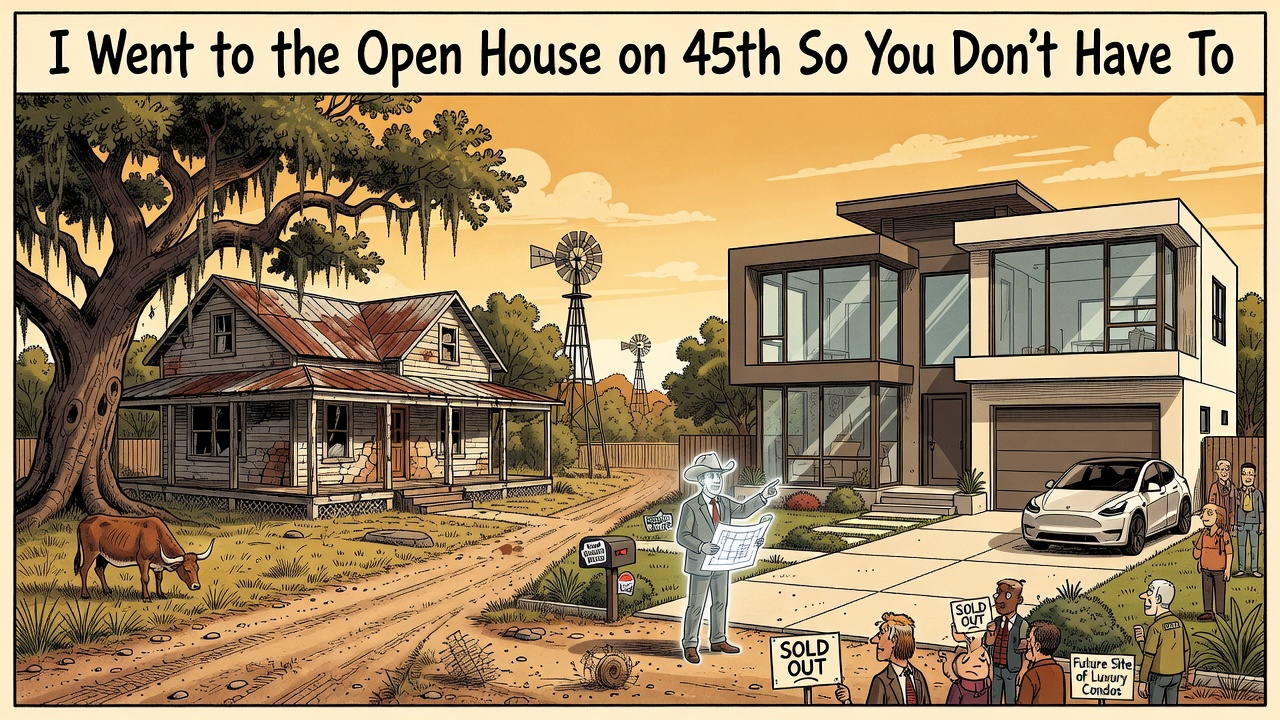
I Went to the Open House on 45th So You Don't Have To
Stood in the former carport of 4508 Duval while the agent bragged about "adaptive reuse" of the 1947 duplex footprint; the place that once housed a mailman, two UT dropouts, a revolving cast of cooks, and one very loud parrot for under $400 a side is now four "bespoke residences" starting at $4,295 with a $275 monthly amenity fee and a rooftop deck no one will use.
The saleswoman kept calling the poured-concrete counter "a nod to the neighborhood's industrial past." I was busy trying to figure out where the old avocado-green refrigerator had stood—the one with the broken handle held on by a bungee cord and three magnets from Kerrville. She didn't know any of that. Her name tag said Avery, Senior Community Curator. I asked what exactly she curated and she pivoted smoothly to the smart-home panel that lets you control the shades from your phone. The shades, she explained, are "inspired by the cedar shutters that used to be here."
Those cedar shutters were literally in the dumpster out back, cracked and full of termites, next to the warped screen door that had slammed a million times between 1979 and 2024. The dumpster itself sat where the shared driveway used to be, the one where Mr. Ramirez parked his beige Ford pickup every night at 5:45 after his shift at the post office. I timed it for years. You'd hear the engine rattle up 45th, the door creak open, then the jingle of keys as he walked past the pomegranate tree he planted in '68.
I walked the unit twice. What used to be two separate living spaces with a carport in between is now four identical boxes totaling eleven hundred square feet each if you count the "private outdoor space" the size of a generous bathroom rug. That carport once held Mrs. Ramirez's washer, a chest freezer full of tamales, and the El Camino that never quite ran right but provided endless Saturday afternoon entertainment for every kid on the block. Rent in '96 was $385 per side. Cash or check. The landlord lived three blocks away on Avenue G and would fix your water heater the same day if you caught him before he started drinking Shiner Bock on his porch.
The new floor plan carves that history into marketing bullet points. Each unit gets a "heritage wall" with a filtered photo of the original 1953 duplex blown up to mural size. Next to it hangs a rusted metal sign that read RAMIREZ in the old man's careful hand-painted letters. I asked where they got it. Avery said the crew found it in the shed and "incorporated it into the story." The story. Like it was a branding exercise instead of the name of the man who fixed every kid's bicycle for free and grew chiles in coffee cans along the driveway. Those coffee cans are gone. The chiles are gone. The parrot that lived in the back unit and cussed fluently in Spanish is now in a rescue up in Round Rock, still screaming at doorbells.
Avery kept gesturing at features like they were revelations. The kitchen island? Salvaged-look quartz chosen to echo the old concrete porches. The lighting fixtures? Midcentury modern nods to the neighborhood's 1940s roots. The fact that those roots involved actual families who stayed for decades, traded tools, watched each other's kids, and never once needed a QR code for the trash chute didn't come up. Instead she mentioned the monthly amenity fee of $275 that buys you access to the rooftop deck, the package concierge, and "curated neighborhood experiences" that probably means a food truck once a month selling twelve-dollar tacos to people who think Hyde Park has always looked like this.
I stepped outside to the spot where the parrot used to terrorize the neighborhood cats. The live oak still drips sap on the sidewalk every July. That hasn't changed. But the block has. The little yellow house across the street where the mechanic kept his tools under a blue tarp is gone. In its place another fourplex with the same gray palette, same black window frames, same tiny electric-car charging stations nobody on this street could afford in 2012. The For Lease signs already outnumber the actual humans. Down the block you can still see the ridge of Shipe Park if you know where to look. Used to be you'd hear kids screaming on the metal slide until the streetlights came on. Now the new residents will pay extra for reserved parking so they don't have to walk the six blocks from the light rail.
The parking situation alone could fill its own ledger. The old duplex had room for four cars if you angled them right and didn't mind your bumper kissing the pomegranate tree. The new build offers three reserved spots per unit in a gated lot that used to be the mechanic's yard. That yard once let you leave your truck overnight if it broke down. No questions. The mechanic knew everyone. He kept a coffee can full of quarters for kids who needed bus fare and another can for the guys who needed a cold one after a long day roofing in the August heat. Those cans are landfill now. The new cans are sleek metal receptacles with sensors that text you when they're full.
Inside again, Avery showed me the bathroom. Rainfall showerhead, of course. Heated floors. A medicine cabinet that doubles as a smart mirror. I asked if it could tell me where the old clawfoot tub went. She laughed like that was a charming question from a quirky local. The tub went to the salvage place off Airport, she guessed. Someone probably paid top dollar for that authentic Austin relic to put in their own condo downtown. Meanwhile these units start at $4,295 a month with a pet fee if your animal weighs more than twenty pounds. The parrot would have been evicted on day one.
I stood on the new porch—composite decking, of course—and tried to remember the smell of the old place. It was a specific combination: cut St. Augustine grass, motor oil from the El Camino, and whatever Mrs. Ramirez was frying for dinner. The new building smells like fresh drywall and the vanilla diffuser they plugged in by the front door. Avery offered me a branded reusable water bottle. I declined. She looked personally wounded, as if rejecting the water bottle meant rejecting the entire adaptive-reuse concept.
The open house had a few other lookers. A couple in matching Patagonia vests kept murmuring about how "authentic" the exposed brick felt. That brick came from a 1948 duplex two streets over that got demolished last spring. They tore it down for a similar project, then sold the bricks back to this developer at a markup. The couple asked about walkability scores and whether the neighborhood had any "vibe." Avery assured them it did. She didn't mention the vibe used to include the Ramirez family arguing in Spanish at 7 a.m., the pinball repair guy blasting Willie Nelson from his stereo, or the substitute teacher practicing trombone on the back steps. That vibe didn't test well with focus groups.
That's the part that sticks. Not just the money—though $4,295 plus fees for what used to be two modest rentals is criminal. It's the speed of the rewrite. One day you've got a neighborhood full of people who know which house gives out full-size candy bars on Halloween and which widow still leaves tomatoes on your porch in August. Next day it's all "curated" and "bespoke" and every third person is a senior community curator explaining heritage while standing on the grave of it.
I left before they brought out the charcuterie. The last thing I needed was some 27-year-old from Denver explaining the difference between "old Austin" and "new Austin" while eating prosciutto off a reclaimed-wood board that used to be somebody's actual front door. On the drive home I passed the spot on 43rd where the old ice house used to sit. It's a yoga studio now. The sign still says ICE in faded paint if you know to look behind the succulents. Nobody looks.
The punchline is that they named the development "Duval Grove" like they didn't just pave over the only grove that mattered. The pomegranate tree is still out there, boxed in by a privacy fence so the new tenants don't have to look at actual neighborhood fruit. Some things refuse the rebrand. The rest of us just get the new paint color. They call it Heritage Gray. It looks exactly like the color of every other building that ate an old Austin street and smiled about it on Instagram.