
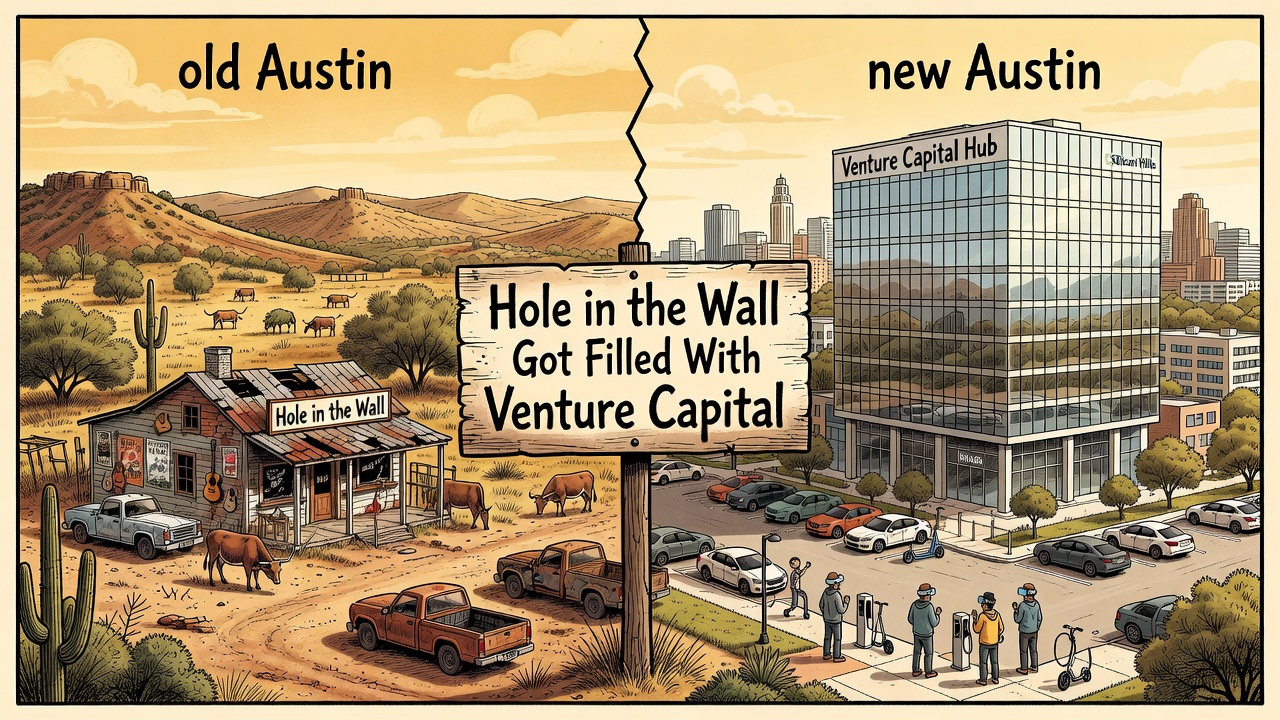
Hole in the Wall Got Filled With Venture Capital
Walked into the Hole and my boots didn't stick; the sticky floors, $2 wells, and $4 covers that fueled legendary nights are now $16 heritage flights, QR menus, and merch walls selling $38 hats.
I stepped onto the floor of the Hole in the Wall and my boots didn't make that familiar peeling sound. Twenty years of spilled Shiner, peanut shells, and whatever leaked out of the men's room used to create an adhesive layer that announced your every move. Last night it was smooth reclaimed concrete, sealed with something that probably cost more per gallon than my first month's rent on 45th Street.
The guy behind the bar wore a black apron that looked like it had been ironed. He didn't recognize me, which was fair. I hadn't been back since the sale. Instead of asking if I wanted "the usual" he slid over an iPad menu with tasting notes. The old Lone Star special—$2.75 for a can and a smile from whoever was working the register in 2004—had been replaced by something called "Texas Unfiltered Pilsner" for $9. It came with a little card explaining the brewery's commitment to regenerative farming. I ordered it anyway. Tasted like regret and barley.
Back in '99 this place was the last reliable mile marker on the stretch of Guadalupe between the university and the freeway. You could catch a young Okkervil River for five bucks at the door, stand shoulder-to-shoulder with off-duty chefs from Uchi before Uchi existed, and maybe share a joint with a guy who claimed he once roadied for Doug Sahm. The stage smelled like sweat and feedback. The green room was literally a closet with a milk crate. Nobody was live-tweeting their feelings about the set.
Now there's track lighting. The kind that makes everyone look like they're in a documentary about themselves.
I took my fancy pilsner to the back corner where the pinball machine used to be. It's gone. In its place sits a high-top table occupied by three people wearing identical black sneakers, all staring at the same laptop. One of them gestured at the stage and said, "We could do a really cool dinner-and-show series here. Like, ticket bundles with wine pairings." His friend nodded solemnly, as if they'd just diagnosed the room with potential.
The new owners sent out a press release last month about "honoring the legacy while elevating the experience." Elevating. That's the word that keeps showing up in these stories, like the building was lying on the ground begging to be lifted toward the price point of people who summer in Wimberley.
I still have my old stamp card from 2003. Ten punches and you got a free domestic. I kept it in my wallet next to the expired Blockbuster card because both felt like artifacts from a civilization that at least pretended to serve regular humans. The last time I got it stamped, the bartender was a woman named Diane who kept a baseball bat behind the cooler and once broke up a fight between two guitarists by threatening to cancel both their tabs permanently. She didn't give a speech about it. She just acted like a person who lived here.
Last night the staff all had name tags with pronouns. The one who brought me a second beer asked if I'd like to follow the venue on Instagram for "early access to our new supper club programming." I told her the only programming I was interested in was the kind that happened between 10 p.m. and last call when the band was too drunk to play in key but somehow still better than anything on a Spotify playlist. She gave me the smile people reserve for uncles who won't stop talking about the before times.
The bathroom is what really did it. Used to be a single-stall horror show with graffiti that qualified as oral history. Half the bands that played the Hole had at least one song inspired by something they read on those walls. Now it's gender-neutral, well-lit, and features a framed print of an old concert flyer. The original flyer is probably in a museum. The toilet still flushes, but the romance is gone.
Outside, the condos across Guadalupe glow with that particular shade of Austin teal that means nobody who works there can afford to live there. A kid with a $400 bicycle locked to the new bike rack asked me if the place was any good. I told him it depends on whether he enjoys paying for the memory of other people's good times. He looked confused. His shirt had a tiny embroidered logo for a tech company that makes software to help other software talk to itself.
I sat on the new bench out front—the one that doesn't have bottle caps pressed into the concrete—and watched two more groups of badge-wearing festival types walk in. They all did that thing where they take a picture of the exterior sign first, like the building is a prop. Nobody seemed to notice that the sign itself had been cleaned. The old one had decades of nicotine and exhaust baked into the plastic. This one looked like it had been power-washed by someone with something to prove.
The worst part isn't even the prices, though $16 for what used to be three beers and a tip is its own kind of punchline. The worst part is the sincerity. These people believe they're preserving something. They use words like "curation" and "activation" without a trace of shame. The old Hole didn't need activation. It needed someone to occasionally mop up the blood and make sure the PA didn't electrocute the bass player.
They turned a joint that ran on spite, cheap beer, and questionable electrical wiring into content.
I finished the fancy pilsner, left the glass on the high-top like an asshole, and walked north toward the freeway. The new lights on the condos made the whole block look like an Apple Store had gotten drunk and reproduced. Somewhere in the distance a real band was probably loading gear into a van that costs more than my first three cars combined. I hope they found a room that still has a sticky floor. I hope the beer is still cold and the sound guy is still mean. I hope they never have to hear the phrase "heritage lager" as long as they live.
The city keeps telling itself it's evolving. Maybe it is. But evolution usually doesn't require an app to claim your table or a $25 minimum to stand near the stage where so many people once stood for free, or close enough.
I still have that stamp card. Ten punches left, good forever at a place that doesn't exist anymore. Some relics aren't meant to be redeemed. They're just there to remind you what the floor used to feel like when it clung to your shoes like it didn't want you to leave.
What gets me is how the new regime keeps the name but sandblasts the soul. The Hole in the Wall wasn't a brand. It was a consequence of cheap rent, lax enforcement, and a steady supply of kids who wanted to play loud in front of other kids who wanted to drink cheap. On any given Tuesday you might see a four-band bill that started with a solo guy who built his own synth out of trash, moved to a country act that only played minor keys, then a noise rock trio that ended their set by kicking over the drum kit, and finished with some outfit that sounded like the Replacements if they'd grown up in Pflugerville. The sound guy would shrug and adjust levels with a roll of gaff tape and pure spite.
Nobody was optimizing for Instagram moments. The lighting was whatever bulbs hadn't burned out. The posters on the wall were layered so thick they had geological strata—Missing Persons flyers from the '80s under Xeroxed handbills for 2005 metal nights under faded printouts for last week's benefit show. You could peel back the layers and read the history of every weird kid who ever dragged an amp down Guadalupe.
Now the walls are painted a tasteful gray. The posters are framed. There's a QR code on every table that leads to the "story of the venue" page, written by somebody who clearly wasn't there for any of it. The page mentions "countercultural roots" and "authentic Austin energy" but forgets to note that the counterculture mostly consisted of people avoiding their shift at Tower Records or sneaking in through the back when they couldn't afford the five-dollar cover.
I remember one night in 2007 when a power outage hit right as the headliner was tearing into their loudest song. The whole room went black except for a few exit signs and the red glow of cigarette cherries. Instead of panic or refunds, the crowd started clapping in unison. The band kept playing acoustically somehow. A bartender passed around candles from the emergency kit. For twenty minutes it was the best show I'd seen all year. No one filmed it. No one posted about the "magical unplugged moment." We just lived it, then went back to our beers when the lights came on.
Try doing that now. The insurance forms alone would kill the vibe. The new management would probably issue a statement about "temporary experiential downtime" and offer everyone a $5 credit toward their next heritage flight.
The parking lot out back tells its own story. Used to be a chaotic mess of rusted pickups, band vans with mismatched tires, and the occasional broken-down Volvo belonging to some English major who swore this was the night he'd finally talk to the bass player. People would stand around drinking from brown bags, trading cigarettes and setlist opinions. Last night it was freshly striped, with EV charging stations and a sign warning that loitering was prohibited. The only person out there was a guy in a branded polo taking a work call about "synergizing the brand narrative with local music heritage."
He said the phrase "monetizable authenticity" without laughing. I wanted to hand him my old stamp card and tell him to go punch it ten times at the place that used to be here, see if it transported him back to when authenticity didn't need a business plan.
But that's the thing about these changes. They don't happen in one dramatic bulldozer moment. They happen one ironic koozie at a time, one tasting note at a time, one "we're keeping the spirit alive" press release at a time. The sticky floor gets pressure-washed. The $2 well gets a markup. The fistfight in the parking lot gets replaced by a networking event. Pretty soon the only people who remember the old way are the ones who can't afford the new cover charge.
The Hole wasn't perfect. It was drafty, the bathrooms were biological warfare, and half the acts were unlistenable. But it was ours in the way only truly uncurated spaces can be. No mission statement. No chief experience officer. Just a room, a stage, cold beer, and the understanding that if you showed up and paid your five bucks, the night belonged to you and whoever was brave enough to plug in.
I walked past the place again this morning. The sign looks pristine in daylight, the new windows reflecting the condo towers across the street like some funhouse mirror of progress. A couple of UT students were taking a selfie in front of it, doing that thing where they pretend to look ironic while clearly loving the aesthetic. One of them wore a vintage Hole in the Wall T-shirt that I guarantee came from the new merch wall inside. The ink was too sharp. The fabric too soft. Just like everything else here.
They turned a joint that ran on spite, cheap beer, and questionable electrical wiring into content.
Maybe that's the final punchline. The old Austin didn't market its weirdness. It just was weird, often uncomfortably so, and if you didn't like the smell of stale beer and broken dreams you could go somewhere else. The new version sells you the smell in a $16 candle labeled "Guadalupe Nights" with notes of "feedback and possibility."
I kept walking. Somewhere north of there, in a garage that hasn't been redeveloped yet, a band is probably setting up right now. Their amps are older than they are. Their setlist is written on a napkin. The beer in the cooler is whatever was on sale at the H-E-B. If they're lucky, nobody will ever turn their sticky floor into a selling point. If we're all lucky, a few more places like that will survive the heritage upgrade long enough for the next round of kids to make their own mess.
The stamp card stays in my wallet. Some things aren't for redemption. They're for remembering what it felt like when the floor grabbed you on the way out, like it wasn't quite done with you yet. Like the night wasn't over until the lights came up and even then it followed you home in the soles of your shoes.