
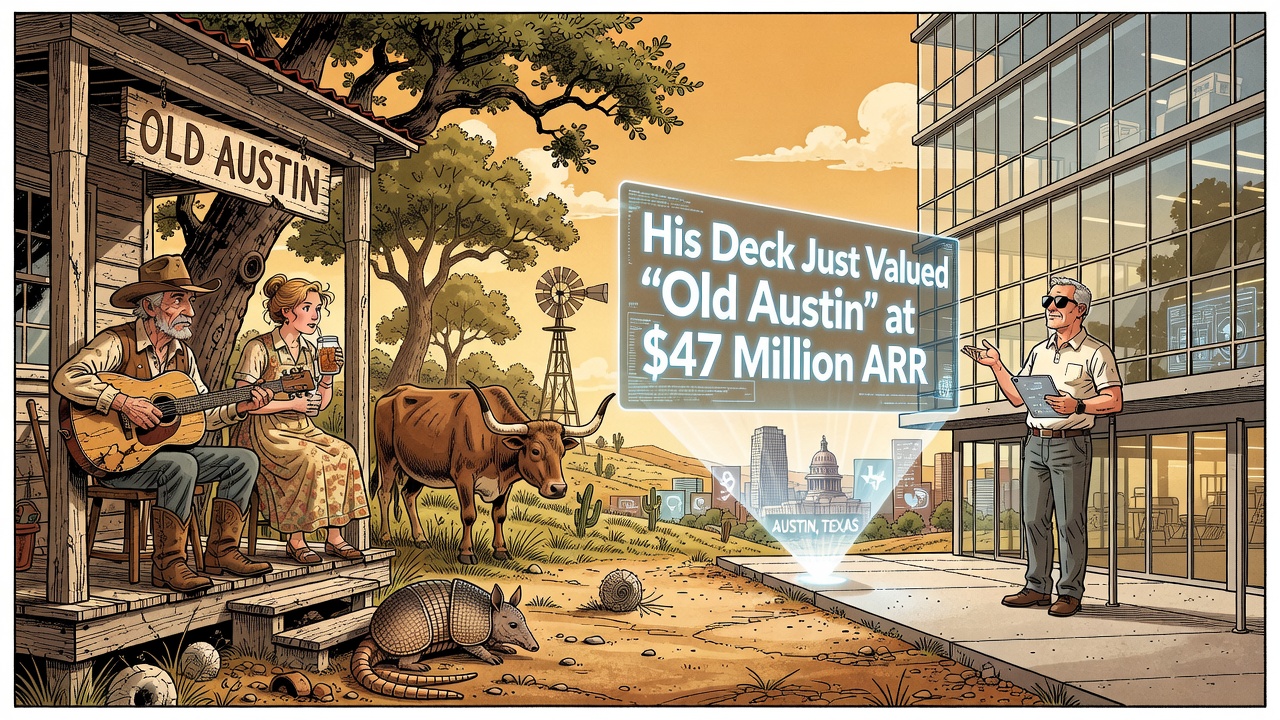
His Deck Just Valued "Old Austin" at $47 Million ARR
Sat through a tech bro's 22-slide deck at the new East 6th innovation hub projecting millions by charging for "legacy experiences" at Tamale House and Scoot Inn; the same block that once thrived on $2.50 Negra Modelos and handwritten setlists is now a gated subscription for nostalgia.
The projector clicked to the next slide at precisely 2:13 p.m. and the phrase "Monetized Serendipity" appeared in that soulless SaaS font nobody outside a Series A round has ever loved. Braden—rhymes with "raidin'"—tapped his Apple Pencil against the conference table like a conductor who'd never once stood in front of a stage at the Electric Lounge with actual nerves in his stomach.
I was only there because the barista at Radio Coffee had warned me the free cold brew came with a mandatory product demo. Should've known.
Braden is 29, moved from Oakland in 2023 "right before it got played out," and now heads something called HeritageLayer. The company slogan, printed on the back of his business card in raised ink, reads Preserving what makes Austin weird by productizing it. The card itself cost more to print than I used to pay for two rounds at the Hole in the Wall in 1998.
He gestured at a heatmap of East Austin. Red meant "under-monetized." The reddest block sat right where the old Liberty Lunch footprint still ghosts the pavement if you know how to look. His plan: an app that lets visitors "claim" a memory. Pay $11.99 and the app plays a three-minute oral history of the venue while you stand on the sidewalk where it used to be. Pay $29.99 and it unlocks a QR code for a "curated playlist" assembled by actual former regulars—now paid in equity options instead of beer tabs.
A woman in expensive yoga pants actually clapped.
I stared at the slide that listed current "legacy partners." The Tavern. The original Maria's Taco Xpress location before they moved the trailer. Even the busted payphone outside the old Waterloo Records that still had faded stickers for bands that broke up before Braden learned to read. Each one carried a small superscript footnote: IP under negotiation.
The room smelled like oat milk and fear of missing out.
What gets me isn't that some kid from Menlo Park wants to slap a revenue model on top of a city that mostly ran on shrugs and happy accidents. It's the confidence. The absolute granite certainty that nothing here had value until it could be A/B tested. Back when I first started drinking at the Ritz on 6th and Red River, nobody was calculating lifetime value of the guy in the corner nursing a $1.75 Schlitz while playing dominoes. We just knew he was part of the scenery, same as the water stains on the ceiling and the smell of bleach trying to lose a fight with last night's mistakes.
Braden clicked to the traction slide. Fourteen thousand "heritage wallets" downloaded in beta. Average session time: eleven minutes. Retention rate: 43% after the free trial ends. He said the words "sticky user behavior" with the same reverence old-timers used for "that one set when Stevie sat in."
I raised my hand. Couldn't help it.
"So if I want to just walk into the Continental Club on a Tuesday, drink a beer, and hear somebody who's good but not famous yet, how much does that cost me in your world?"
He smiled the smile of someone who'd practiced it in investor meetings. "That's the beauty. The base experience stays free. We're simply layering value on top for those who want the full immersive context. Think of it as the difference between listening to vinyl and using our AI to tell you why this particular pressing matters."
I thought about the night in '99 when I saw a then-unknown Alejandro Escovedo play three hours for thirty people and a bucket of tips. Nobody needed context. The floor was sticky, the PA was older than most of the audience, and the song about forgiveness still hurts when I hear it on the radio twenty-seven years later. No algorithm required.
Braden kept talking. His team had "onboarded" three former bouncers as "cultural authenticity officers." They get a small monthly stipend and a free subscription. One of them used to work the door at the Black Cat. Now he's supposed to file weekly reports on whether the new clientele "feels correct." The pay is less than he used to make in a single good Saturday night, but it comes with health insurance and something called "equity participation."
The punchline arrived on slide 19: Exit Strategy. The slide showed two columns. Left: "Acquisition by Spotify, Live Nation, or Peloton." Right: "IPO at $240M valuation." Both pathways assumed the city would keep producing weirdness faster than they could productize it. Like the springs stay full no matter how many straws you stick in them.
After the presentation a couple of UT kids in matching branded hoodies surrounded him. One asked how soon they could get the API. The other wanted to know if there was an affiliate program for "micro-influencers with authentic followings under 8k."
I walked out onto East 6th. The heat coming off the pavement felt familiar. The buildings, less so. Half the signs still pretend to be ironic while charging club rates for bottle service. The other half have already surrendered to the glass-and-steel future Braden's deck so lovingly rendered in three dimensions.
A guy I used to see at every other show back in the day was leaning against a new bike rack, smoking. He nodded at the innovation hub behind me. "Heard they're doing a soft launch next month. First hundred users get a digital badge that says 'I Was Here Before The Algorithm.'"
We both laughed the short, bitter laugh of people who remember when the only badge you needed was showing up.
Here's the part that actually stings. Braden isn't evil. He's just the latest in a long line of people who fall in love with the surface of this town—the stickers, the murals, the slogan on the airport wall—and then immediately start sanding off everything that created it. The parts that can't be KPIs. The parts that smell like piss and broken dreams at 2 a.m. The parts where somebody plays a perfect note for no reason except the song demanded it.
His investors will get their return. The city will get another round of press releases about "preserving character." And somewhere, in a storage unit off Airport, the actual wooden sign from the original Threadgill's will sit under a tarp next to three generations of broken pinball machines, waiting for someone to care about the difference between a museum piece and a place that used to let you be.
Braden sent me a follow-up email at 4:47 p.m. Subject line: "Thoughts on co-creating the future of Austin together?"
I deleted it. Then I drove over to the Tamale House on Airport, the one that hasn't been optimized yet, and paid cash for six tamales that still cost less than one month of his nostalgia app.
The lady at the counter didn't ask for my email. She just said "the usual, mijo" and handed me extra napkins.
That's still worth more than every slide deck on Earth. But the bigger picture keeps nagging at me as I sit on the patched vinyl stool watching the lunch rush. That corner by the window used to be where the roofers from the big job on Cesar Chavez would park their trucks at 11 a.m. and argue about whether the '98 Longhorns defense was overrated. Now the only trucks out there are leased electric ones with app dashboards that track carbon offsets. The roofers probably can't afford the new rents on this stretch anymore; they've been pushed further east past 183 where the land hasn't been "discovered" by people who use the word "ecosystem" to mean something other than Lady Bird Lake after a rain.
I remember the exact smell of that old Tamale House location on South Congress before they flipped it—the one with the screen door that slammed like a gunshot every time a regular walked in. It was corn masa, fryer oil, and the faint metallic tang from the ice machine that hadn't worked right since the '80s. You could get a plate of three with rice and beans for four bucks, eat it under the buzzing fluorescents, and leave a tip that actually mattered to the woman behind the counter because she owned the place. No QR code for feedback. No upselling to a "heritage tamale flight" with tasting notes written by a consultant.
Braden's deck had a whole section on "friction reduction." That's what they call removing the unpredictable human bits that made nights at the Scoot Inn parking lot worth remembering. The time some unsigned band from Lubbock plugged in after hours and played until the cops told them to quiet down, not because of noise ordinances but because the neighbor was trying to sleep before his shift at the meatpacking plant. That plant is condos now. The band is probably selling insurance in Tulsa. And the app would have charged them a "creator fee" to access the lot after 10 p.m.
The worst slide was the one projecting $47 million ARR by year five. Annual Recurring Revenue from remembering things. They broke it down by zip code. 78702 was circled in green—highest density of "authentic stories per block." Never mind that most of those stories involve people who got bought out or priced out or just got tired of competing with venture capital for a two-bedroom. The deck didn't have a slide for them. No row for displaced mechanics, bartenders, or the Vietnamese family that ran the nail salon next to the old Victory Grill. Their data set only values the version of Austin that photographs well in an Instagram story.
On my way home I passed the lot behind what used to be the Liberty Lunch. There's a food trailer there now selling $16 bowls of "deconstructed migas" with edible flowers. The guy working it had the dead-eyed look of someone calculating his gig ratings between orders. I asked if he remembered the old venue. He shrugged and said the owner told him not to talk about it because it "confused the brand."
That's the part Braden and his cohort never quite grasp. You can't layer context on top of something after you've scraped the context away. The app might play you a clip of someone describing the night Joe Ely played a surprise set, but it can't give you the feeling of standing shoulder to shoulder with strangers who all suddenly knew every word to "Fools Fall in Love." That only happens when the room is too small, the beer is too cheap, and nobody's optimizing for retention.
Later that evening I dug through a box in my garage and found an old flyer from the original Cactus Cafe. Twenty-five cents copied on colored paper, advertising a free show with two local acts and a headliner who drove in from Houston in a van held together by hope and bungee cords. The date was 1994. On the back, in my handwriting, I'd scrawled the setlist and a note about the harmonica player's tone. No NFT attached. No geofenced memory unlock. Just ink that had faded in the Texas heat and a crease where I'd folded it to fit in my back pocket.
I put it back in the box next to the faded bumper sticker from the old Armadillo Christmas Bazaar and the matchbook from the Broken Spoke that still smells like sawdust and Shiner. Those things don't need a subscription. They just sit there, waiting for someone who understands that value isn't always something you extract. Sometimes it's just something you show up for, pay your three bucks, and let happen.
Braden's deck valued old Austin at $47 million ARR. I figure the real number is the sound of a screen door slamming at the Tamale House, the first chord ringing out in a half-empty bar on a Tuesday, and the knowledge that tomorrow might be different but tonight belongs to whoever wandered in. Try putting that in a spreadsheet.