Gary, Traffic Drum, Southbound Frontage Road, Age Unknown
A profile of Gary, a traffic drum who has guarded the same I-35 lane shift near Riverside longer than most leases last. Today, for the first time all year, he's not the only one in costume.
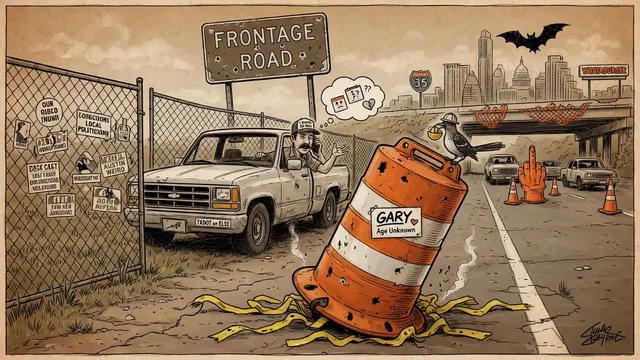
Gary has been leaning eleven degrees toward Riverside since sometime in the spring, when a box truck clipped him on the way to a Rainey Street load-in. Nobody has stood him back up. Nobody has to. He's held the line at that angle so long that the lane stripes look crooked, not Gary.
He is a traffic drum. Orange and white, four reflective bands, a black rubber base with a sandbag on it like a paperweight on a very important memo. He stands at the head of a lane shift on the southbound I-35 frontage road, which has shifted so many times since they started tearing the upper decks off the highway that the original lane is mostly a rumor.
I walk past him most mornings. I have started saying hello. This is not a cry for help. It's a neighborly gesture toward the most dependable resident of my end of downtown.
Early Life
Gary's origins are murky, as they are for most drums. He may have come from a staging yard off the access road near Oltorf. He may have been born on a flatbed. What I know is that one morning the lane was a lane, and the next morning it was a suggestion, and Gary was standing at the front of it like a maître d' at a restaurant you didn't book.
The project he works for is TxDOT's I-35 Capital Express Central, a multibillion-dollar plan to lower the highway through downtown and pull down the old upper decks, with completion projected for the early 2030s. That's real and public. Gary's role in it isn't documented anywhere, which is how you know he's essential. The essential people never make the press release.
Career
A drum's job description is a single sentence: Be orange where the road isn't.
Gary does this with tremendous dignity. He gets hit by side mirrors. He absorbs the wind blast of every 18-wheeler doing 50 in a zone posted 40, and he rocks back on his base and returns to center like a man who has heard every insult and decided none of them was about him. Once a week or so someone leaves a Whataburger cup on his head. He wears it until the next good gust, then sets it down in the gutter without comment.
The lane shift he guards has moved four times since I started paying attention. Each time, a crew arrives before dawn, sprays fresh lines over old lines, and relocates Gary roughly eighteen inches. Commuters then spend three weeks driving the old stripes out of muscle memory while the GPS insists, with total serenity, that they are currently in the river.
Gary never complains. Gary has been moved eighteen inches four times, and that is still more career mobility than anyone renting in the 78701 has had since 2019.
Personal Life
Gary is not alone out there. There's a cluster of drums down by the Cesar Chavez exit that I think of as the Cousins. They're newer, brighter, less sun-bleached, and constantly getting knocked over, which tells you something about youth. There's a single Jersey barrier near the Seventh Street turnaround that has been tagged so many times it reads like a bathroom stall at a club on Red River. There is, at the end of the shift, a sign that says LANE ENDS MERGE LEFT, and there has never been a lane to its left. Gary and the sign do not speak.
A Lime scooter spent most of August leaned against him. I don't know whose it was. I don't think the scooter knew either. It was a quiet companionship, two pieces of transportation infrastructure abandoned by the same civic optimism, sharing the shade of a highway that was busy being demolished on top of them. In September the scooter was gone. Gary did not seem upset. Drums are not built for grief. They are built for being run into.
The Neighbors Moved In
Here's the part where it stops being cute.
Across the frontage road, a sales office opened this summer for a tower that isn't built yet, and the banner on its fence promises "Future Cap Park Views." The city has been pursuing deck parks, which it calls caps and stitches, to lay over the lowered highway downtown, and some of that is planned and some of it is still waiting on money, as civic plans tend to. The sales office has rounded up. Their renderings show couples in linen walking dogs across manicured lawn above the interstate. Kids fly kites over what is presently a hole with a backhoe in it.
There is no Gary in the renderings. There are no drums at all. The future is depicted as a place where the road simply agreed to go underground and nobody had to stand in the gap for eight years holding the line in the sun.
I find this offensive on his behalf. You can sell a condo on a park that doesn't exist yet. Fine. That's Austin real estate's whole business model, selling the brochure of a thing to people who will later be annoyed at the thing. But you should at least acknowledge the help. Somebody put on the hi-vis vest every day of this decade so you could charge $1,400 a square foot for the view of a future lawn. That somebody was a plastic barrel with a sandbag on its foot.
Legacy
Drums don't retire. They get scuffed down to a dull peach, the reflective tape peels into little silver flags, and one day a truck from the contractor shows up and tosses them in the back with the others, and that's it. No plaque. No mural on the side of a brewery. Somewhere, maybe, a stack of them in a yard by the airport, nested like Solo cups, waiting for the next billion-dollar project to need someone to stand very still in traffic.
When the highway's finally done, assuming it's done before Gary fades to the color of a pale cantaloupe, the frontage road will be smooth and straight and permanently striped, and the cap park will or will not exist, and some kid on a scooter will glide right through the spot where Gary leaned toward Riverside for years, and they will have no idea that place was ever held.
That's how this city treats its longest-serving residents. Ask anybody who used to have a lease in Clarksville.
Tonight
This morning, I said my hello and noticed a kid on the sidewalk with his mom, maybe six years old, dressed in an orange poster-board tube with four strips of white duct tape around the middle. A traffic drum. He'd even taped a little sandbag to one sneaker.
He stopped right next to Gary, and the two of them stood there for a second, matching, while southbound traffic crawled past at a speed you could have trick-or-treated alongside.
The kid's mom said he picked the costume himself because "the orange things are everywhere and nobody ever gives them candy."
For one day a year, someone in this town finally dressed up as the only thing in it that's never changed.
Keep reading Lane Closure Report
Sidewalk Closed, Use Other Sidewalk
On East Cesar Chavez, a SIDEWALK CLOSED sign points across the street to another SIDEWALK CLOSED sign pointing back. A field guide to walking anywhere near a tower going up.
5 min read
Gary Has Been Waiting to Turn Left Onto Burnet Since Spring
A profile of one patient man, one 2004 Corolla and one unprotected left onto Burnet Road, where four gaps a week are now considered a rich season.
5 min read
“Is This the Line for the Line?”
Saturday of ACL weekend two, reported from the shuttle queue, a closed Barton Springs Road that suddenly belongs to pedestrians, and the long walk home that no app wanted to discuss.
6 min read
Follow the Grouch
Email subscriptions are unavailable. Follow new complaints in your RSS reader instead. We do not collect an email address here.
Open the RSS feedAdd this feed’s address to your reader. Opening the link does not subscribe you automatically.