
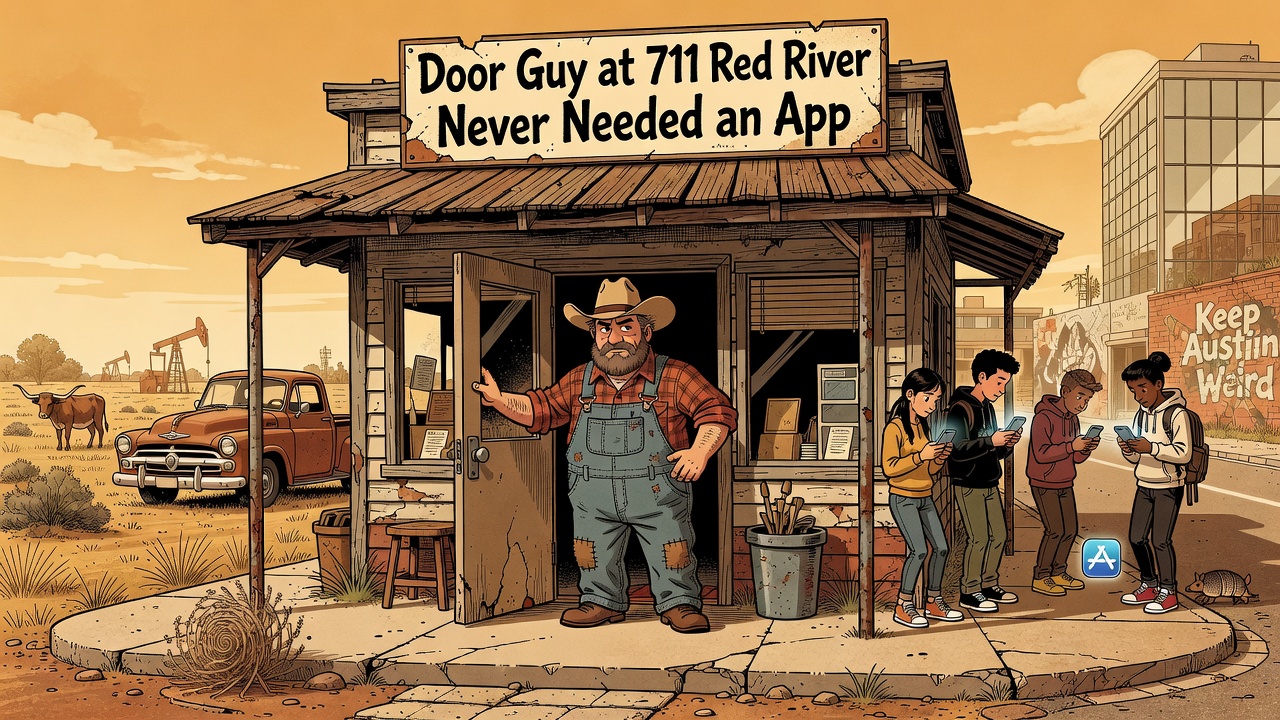
Door Guy at 711 Red River Never Needed an App
Beerland let you pay five bucks at the door, drink $2.50 PBRs until the band quit, and stand close enough to read the setlist Sharpied on the drummer's forearm; the address now houses a "music-forward experiential lounge" that texts you a QR code, charges $14 for a can of the same beer, and employs a "guest experience coordinator" who once asked if the guitar player could turn down so the brand activation wouldn't get drowned out.
The door at 711 Red River opened the same way for twenty years: a heavy black slab with a peephole that hadn't worked since Clinton was president. On any given Tuesday you'd knock, the slot would slide open, and a voice that sounded like it gargled gravel would say either "yeah" or "not tonight, chief."
Most nights it was yeah. No ticket link. No waitlist. No Venmo request for a "suggested donation."
I walked in on one of those humid April nights in 2009 and the first thing that hit me was the smell—stale beer, old cigarettes clinging to the walls even after the ban, and whatever industrial cleaner they used that never quite won the war. The second thing was the volume. Some four-piece from Denton was already murdering their instruments in the back room and the sound guy, half-asleep on a barstool, had the levels so hot the kick drum felt like a heart attack.
That was the entire business model. Loud, cheap, indifferent to trends.
Carla behind the bar kept a running tab in her head for half the room. She remembered you liked Shiner in the bottle, not the can, and that you tipped better after the second round. No tablet screen shoved in your face. No "add a gratuity" prompt. Just a quiet understanding that if you drank there regularly you weren't there to make trouble.
The place was narrow as a railroad car. Left side: bar with duct tape on the stools where the vinyl had given up. Right side: a few tables that wobbled if you looked at them hard. Back: a stage so low the bass player kept kicking over his own beer. Between songs you'd hear the cash register clang like it was 1978 and the low murmur of people actually talking between sets instead of staring at their phones.
I saw a hundred bands there that never got famous and a few that did. One night a then-unknown outfit from Brooklyn played to thirty-five people and the guitar player later told me it was the best room he'd hit on the whole tour because "nobody was performing being at the show." They just were at the show.
The regulars formed their own ecosystem.
There was Dale, the retired railroad worker who wore the same faded Willie Nelson shirt every Friday and would shout "Hell yes" at the start of every solo regardless of genre. He kept a flask in his jacket that everyone pretended not to notice. There was the cluster of bike mechanics from the shop on 4th who showed up smelling like chain lube and always requested the same Minutemen cover. There was the quiet woman in the corner who turned out to be a legendary tattoo artist and would occasionally hand you a Sharpie drawing if she liked your vibe.
Nobody was performing authenticity. They were too busy living it.
The sound guy—everyone just called him "Board"—ran the board from the bar because there wasn't a proper booth. He'd adjust levels between sips of whiskey and somehow the mix was always better than the polished rooms on 6th that spent thousands on gear. When the power went out during a particularly sweaty set by the Austin Psych-Out collective in 2012, the band kept playing unplugged. Forty people stayed for two more hours. Board bought a round with his own money. That was the house policy on nights the universe interfered.
Then the rent started doing what Austin rent does.
First the increases were gradual. Then the building sold. Then the new owners decided the sticky floors and the honest stench didn't match their "vision for a revitalized Red River cultural corridor." Last time I checked, the address shows up on booking sites as "The Current," complete with bottle service, a lighting rig that costs more than most bands used to make in a year, and a staff member whose entire job is "artist liaison."
I wandered past last month. The black door is gone, replaced by frosted glass with a minimalist logo that looks like it was designed by someone who has never been sweaty in public. A sign outside invites you to "reserve your listening pod." A listening pod. At the address where I once watched a man play a guitar made of a shovel while the crowd chanted along to lyrics about bankruptcy and bad tattoos.
The new beer costs $14. They pour it into a branded glass and tell you about the "local hop collective" that grew it. The old PBR came in a can that had been sitting in the same fridge since 2006 and tasted like freedom and mild regret.
The worst part isn't even the money, though Lord knows $14 beer in a town that once ran on $2.50 domestics feels like a personal insult. It's the self-consciousness. The new place keeps trying to remind you that you're having an authentic Austin experience. The old place never had to say it out loud because the evidence was all around you: the bathroom graffiti that updated in real time, the mysterious leak in the ceiling that only dripped during fast songs, the way every employee seemed one bad decision away from becoming a local legend themselves.
They host "listening experiences" now. Curated. With tasting notes. The last time someone tried to hand me tasting notes at a live show I told them exactly where they could file them.
I miss the honest transaction of it. You gave them five bucks. They gave you a room where music could happen without a safety net. Sometimes it was transcendent. Sometimes it was terrible. Both outcomes were acceptable.
These days the music has to fill out a form first.
The other night I ran into Board at the new location down the street that still lets humans make mistakes. He was nursing a whiskey and staring at his phone like it had personally betrayed him. We didn't talk about the old room. We didn't have to. The silence between us said everything necessary about what Austin lost when it decided every dive needed a mission statement and every stage needed a sponsor.
Some places aren't supposed to be elevated. Some places are supposed to stay right at ground level where the beer gets warm too fast and the guitar player can look you dead in the eye while he breaks a string and keeps going anyway.
711 Red River understood that. The new tenant never will.