
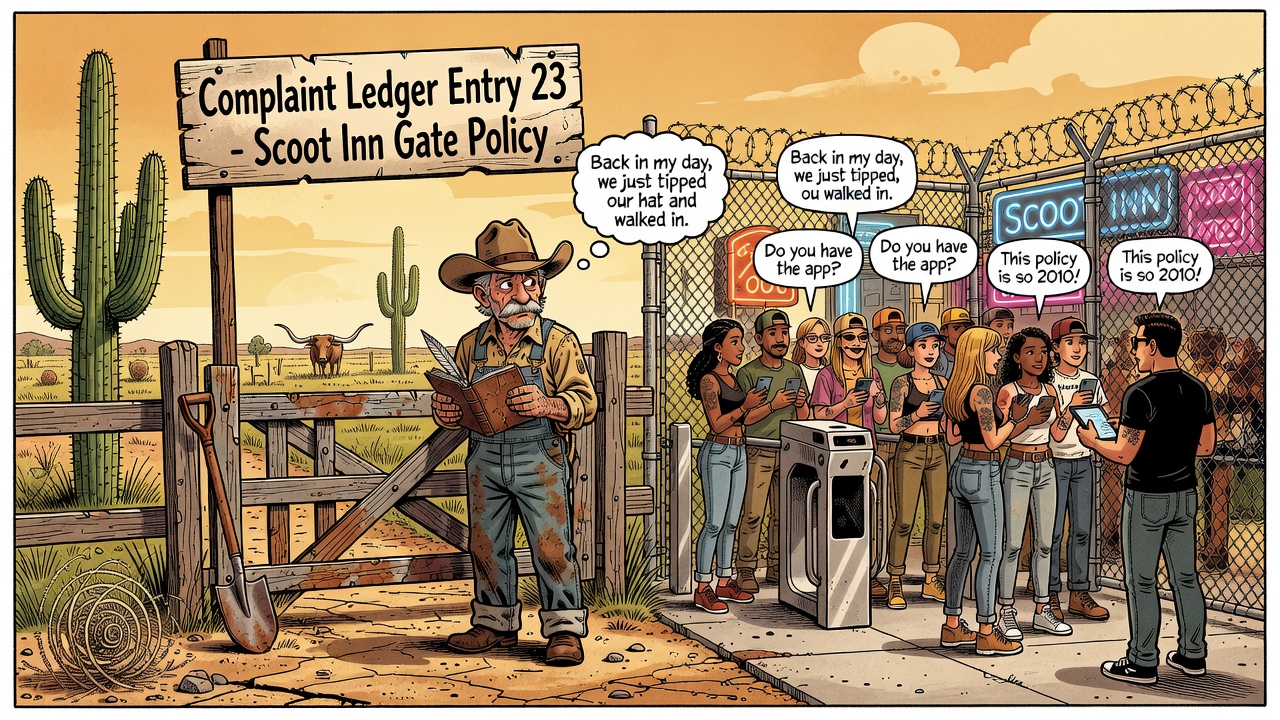
Complaint Ledger Entry 23 - Scoot Inn Gate Policy
Three crumpled dollars got you past the chain-link gate at 1308 East Cesar Chavez for Lone Stars at $2.50 and whatever local band was murdering covers until 2 a.m.; the current operation demands $28 online tickets, a QR code for drink service, and a bouncer who checks your ID against a tablet while a sponsored banner flaps overhead.
The guy working the gate back in 2004 barely glanced up from his plastic cup. He took my three singles, folded them once like they were going in a church collection plate, and waved me through with the same motion he'd use to shoo a stray cat. No app. No wristband. No email confirmation. Just the sudden wall of cigarette smoke, fried pickles, and a guitar chord that sounded like it had already survived three divorces.
That was the Scoot Inn on a random Thursday. The dirt yard behind the low-slung building off Cesar Chavez still had pecans rotting underfoot. You'd step on one, feel it give like a bad heel, and keep walking toward the stage that looked assembled from shipping pallets and hope. The Christmas lights sagged between two hackberry trees that had probably witnessed the whole history of East Austin bad decisions. Nobody was curating anything. The only "experience" on offer was whether the headliner showed up sober.
I still remember the smell like it was last night: burnt motor oil from the mechanics shop next door mixing with cheap keg beer and the particular tang of sweat on leather jackets. The sound guy ran everything through a board older than most of the audience. When the band hit the distortion pedal, the speakers would rattle the metal roofing and send a fine rain of rust down on anyone standing too close. People just brushed it off their shoulders and ordered another round. No one filed a complaint.
Parking was a contact sport. You'd circle the block twice, then wedge your Civic between a rusted El Camino and a motorcycle that definitely wasn't street legal. The attendant was a retired biker named Junior who sat on a cooler and accepted five bucks or a cold six-pack, whichever you had. He once let me leave my truck overnight because the band from Lubbock was "actually pretty good for West Texas boys." In the morning he was still there, same cooler, different beer, waving like we'd served together.
The crowd itself operated on an unspoken contract. Longhairs, off-duty cooks, bike messengers, a few UT dropouts, and the occasional lawyer who kept his tie in the glove compartment. Everyone minded their own business until the third set when the whole yard turned into one swaying, yelling organism. I once watched a man in his sixties teach a twenty-year-old how to two-step during a Doug Sahm cover. No phones out. No content capture. Just boots on dirt and the shared understanding that this was as good as the night was going to get.
Now the gate looks like it was designed by someone who studied at festival school. The chain link is still there but painted matte black and wrapped in twinkle lights that change color to match the band's Instagram aesthetic. The guy taking tickets wears a black shirt with a tiny logo instead of a faded Metallica tee. He holds an iPad that beeps every time someone scans the code they bought for twenty-eight dollars plus fees. Last month I stood behind a woman in designer overalls arguing that her digital ticket wouldn't load because of "poor cell service in this part of town." The bouncer offered her the WiFi password. The WiFi password. At the Scoot Inn.
Inside, the dirt has been replaced with permeable pavers that probably cost more per square foot than my first apartment. The Christmas lights are gone, replaced by those Edison bulbs that make everyone look like they're in a whiskey commercial. The stage is sturdy, well-lit, and professionally sound-checked. All improvements on paper. All of them missing the point.
The bar menu now features something called the Cesar Chavez Mule. It comes in a copper mug with a sprig of mint that costs fifteen dollars and arrives with a QR code on the napkin so you can "learn the story behind the ingredients." I asked the bartender if they still served Lone Star. He gave me the look usually reserved for people who order off-menu at molecular gastronomy places, then pointed to the can in the cooler like it was a museum piece.
The bands still play, sure. But the crowd spends half the set curating their view. Phones up, lights on, filming vertical video that will get fourteen likes from people who weren't there. The overheard conversation has changed too. Instead of "these guys rip" you get "their manager went to Oberlin with my roommate" and "are they on the Spotify playlist yet?"
The prices tell the real story. Three dollars in 2004. Twenty-eight dollars now. That's not inflation. That's a tax on remembering. Add the three-dollar "convenience" fee, the five-dollar suggested donation for the "venue preservation fund," and the nine-dollar sparkling water that somehow replaced PBR, and you've got yourself an eighty-dollar night before the first guitar solo.
I drove past the place last Tuesday at dusk. The new sign out front uses that minimalist sans-serif font every rebranded Austin business adopts, like they're all consulting the same branding shaman. It advertised an "intimate listening experience" with some act I'd never heard of and ticket tiers including "VIP Yard Access." The yard. The same dirt patch where people used to pass a joint and argue about Willie Nelson's tax problems. Now it has tiers.
The worst part is how hard they're trying to keep the ghost of the old place around. They kept the rusty metal rooster on the roof. They left the crooked wooden bar top that got carved up with pocket knives over thirty years. They even named one of the cocktails after the original owner's dog. It's like watching someone stuff your childhood pet and mount it in a diorama.
Junior died a few years back. Someone told me his cooler went with him. I like to think he's parked somewhere better now, waving people into a dirt lot with no dynamic pricing and no QR codes. Probably still arguing about the Astros.
The new management swears they're preserving the spirit. They've got the photos on the wall, the black-and-white ones of the old crowd looking mean and happy. But spirit isn't something you can hang next to the merch table. Spirit was three dollars, bad lighting, and the knowledge that nobody important was watching.
These days the only thing watching is the algorithm.
At least the beer still gets cold. Small mercies in the graveyard of things that used to be simple.