
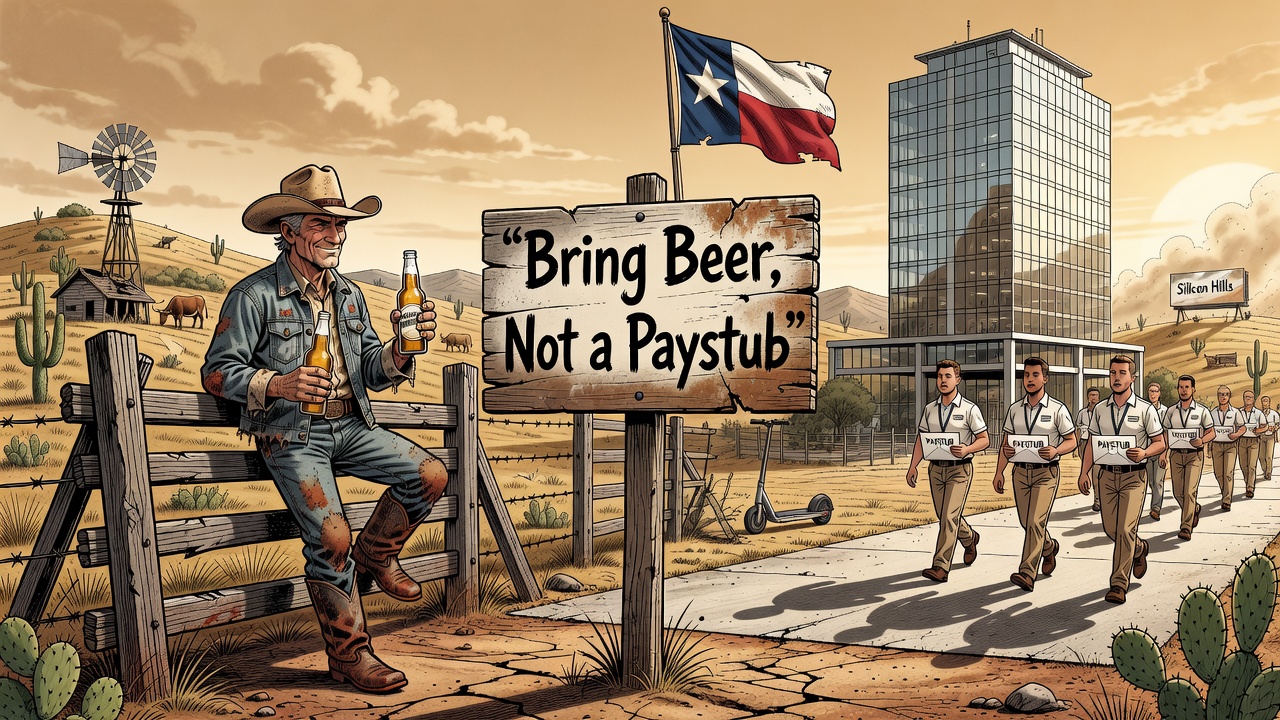
Bring Beer, Not a Paystub
The fourplex at 1701 Chicon split $2,200 rent in 2011 with no credit checks or apps, just cash and backyard barbacoa; now as Chicon Row it demands $2,950 for 680 sq ft, amenity fees, paystubs, and a vibe assessment from tenants.
The backhoe showed up Tuesday and the first thing it did was clip the low branch of the pecan tree that used to drop nuts onto the hoods of whatever beaters were parked half on the grass. I stood across the street holding a lukewarm Whataburger cup like an idiot, watching the metal teeth take a bite out of the carport where Manuel from 2B kept his motorcycle tools in a coffee can.
That carport was the unofficial office for half the block. You could drop off a busted lawnmower on Wednesday and pick it up running on Friday, no paperwork, no Venmo request, just a cold Modelo pressed into your hand and a story about the time the mower threw a belt and nearly took out Mrs. Garcia's roses. The new rendering on the construction fence shows a row of identical two-story boxes with matte-black porch rails and a "lounge pod" where that carport stood. The lounge pod has string lights in the diagram. Of course it does.
In 2011 the whole building ran me and three roommates $2,200 split four ways. That left enough for beer, truck repairs, and the occasional run to the tamale lady who parked her cooler at the corner of Chicon and 2nd every Friday after five. The landlord was Mr. Delgado, retired from the post office, lived two doors down in the house with the Virgin on the front window. He collected rent in cash, in a Folgers can on his porch. If you were short he let you slide till the fifteenth and didn't tack on late fees or send it to collections. He did, however, expect you to eat a plate of his wife's carnitas when she brought them over. That was the entire lease agreement.
The place smelled like a specific cocktail that no longer exists in Austin: dryer sheets, mesquite smoke, and the faint electrical tang of the window-unit ACs that dripped rust onto the sidewalk. On Saturday nights the backyard filled with lawn chairs and one guy who always brought his own speaker because he didn't trust anyone else's playlist. Cops came exactly twice that I remember. Both times they killed the music, accepted a paper plate of food, and left without writing anything down. One of them went to high school with Delgado's daughter. Small town rules still applied in the city limits back then.
Now the sign on the fence calls it Chicon Row and promises "thoughtfully curated residences." I watched a woman in white sneakers and a crossbody bag that cost more than my first car try to explain the concept to a prospective tenant yesterday. She kept using the phrase "intentional community" while standing in the exact rectangle of dirt where we once found a feral cat giving birth under the hibachi grill.
The new units want first and last, a credit score over 720, income three times the rent, a background check, pet DNA on file, and—I'm not making this up—a "vibe assessment" that involves liking three photos on an iPad. The photos were of succulents, an exposed brick wall, and a pour-over coffee setup. I assume failing the vibe assessment gets you gently escorted back to your 2012 Corolla and told the market is very competitive right now.
The parking situation is its own special hell. We used to fit seven cars in the dirt and gravel if everyone angled right and nobody minded walking over to the Valero for cigarettes at 2 a.m. The new plan shows eight dedicated spots, two of them marked for "EV priority," each carrying a $175 monthly upcharge if you want guaranteed access. The rest of the neighborhood can fight for street parking between the new bollards and the delivery drivers circling for Doordash drop-offs. The bollards are connected to an app. Naturally.
I keep thinking about the sound the screen door on unit 1A made—that metallic thwack when it slammed shut. You could hear it three houses away. It announced arrivals, departures, someone coming outside to yell that the ribs were ready, or that the game was on. The new doors will be silent. They'll close with the hushed certainty of money. No one will hear their neighbor come home. That's probably listed as a feature.
Last month I ran into Delgado's grandson at the H-E-B on Airport. He told me the family sold because the property taxes tripled and the city kept citing the place for "deferred maintenance" on the 1940s plumbing. The buyer paid cash in a deal that closed in eleven days. Some LLC with a name that sounds like a law firm and a meditation app had a baby. The grandson said they lowballed them by about forty percent of what the land was worth if it stayed a fourplex. Then they doubled it the week after closing when they put the condos on the market.
The new website has a slider with lifestyle photos: a bearded white guy in expensive headphones staring at a laptop on what used to be the shared porch, a woman doing yoga where the barbacoa pit was, a golden retriever that definitely never dug up the utility line in the backyard. The copy talks about "honoring the rich history of the East Side." They spelled it "Eastside" as one word, which tells you everything you need to know.
I finished my Whataburger and crossed the street to read the fine print on the construction sign. Permitted uses now include a 1,200-square-foot "maker space" in the basement. I laughed out loud—the only making that used to happen in that basement was a guy named Ricky rebuilding carburetors at 11 p.m. while blasting Stevie Ray. The new maker space will probably have WiFi that costs extra and a rule against solvents that smell like progress.
The pecan tree is still standing for now, though half its canopy is gone. Some optimistic fool has tied a little orange ribbon around the trunk like that's going to matter when the final grading starts. I hope the new residents like picking pecans out of their Allbirds. I hope they figure out that the tree drops them in late October whether the algorithm says it's vibing or not.
Some losses you can measure in dollars. Others you measure in the sound a screen door makes at 7:15 on a Thursday when the first batch of brisket hits the grill and the whole block knows it's welcome. They're building over that sound right now, pouring smooth new concrete where the grease spots used to live.
The silence is going to be expensive. But the real gut punch isn't just the price jump from $550 a head to nearly three grand for a slice of the same dirt. It's the way every interaction now routes through a portal. No more knocking on Delgado's door with a six-pack as apology for the busted water heater. Instead you submit a maintenance ticket through an app that assigns you a case number and estimates resolution in two to five business days, pending approval from corporate.
I walked the block again at dusk yesterday. The taqueria on the corner that used to sling breakfast tacos for two bucks until the health department finally noticed the extension cord running across the sidewalk is now a "concept cafe" with cold brew on tap and a mural celebrating the neighborhood's "gritty past." The mural includes a stylized version of the old fourplex, except in the painting the carport looks clean and the cars are Teslas. They even got the pecan tree right, though in the artwork it's perfectly symmetrical and not half-chewed by heavy equipment.
A couple of guys in matching joggers were taking photos of the construction fence for their stories. One said something about how exciting it is to see "activation" on Chicon. I wanted to ask him if he knew the difference between activation and a Saturday night where the music got turned down but never off. But I kept walking. Some conversations require context that won't fit in a caption.
The thing that sticks is how fast the texture vanishes. One day you're arguing over whose turn it is to mow the patch of grass that technically belongs to unit 3 but everyone uses. Next day it's sod from a pallet, pre-cut to fit between concrete borders, and a sign warning against unauthorized gatherings. The old crew scattered: Manuel's in San Marcos now, Ricky's back in Laredo, the night nurse from unit 4 moved to a place off Rundberg that hasn't been "discovered" yet. We still have a group text but it mostly sends memes about how much our old rent would cost today. The jokes aren't funny after the third time.
Mr. Delgado passed last year. His daughter told me at the service that he kept the Folgers can on the shelf in his garage until the end. It still had a few envelopes in it from tenants who never paid that last month. He never threw them away. Said it reminded him that trust used to run both directions. The new owners wouldn't know what to do with a Folgers can except maybe mount it in the leasing office as ironic decor next to the QR code for virtual tours.
By next spring the first tenants will move in. They'll complain about the lack of shade once the remaining pecan limbs come down for the utility easement. They'll pay the amenity fee and use the lounge pod and never know that the spot where they plug in their laptop once held a 1987 Honda motorcycle in various stages of repair. The grease stains will be pressure-washed into history. The only thing left might be the faint smell of mesquite on certain windy evenings, if the new HVAC systems don't scrub it out completely.
That's the part the renderings never show: the way a place can be erased so thoroughly that even the ghosts start forwarding their mail. Bring beer, not a paystub, used to be enough. Now it takes an approved application, a portfolio of references, and the willingness to pretend that curated string lights improve on what was already perfect in its chaos. The backhoe keeps digging. The price keeps climbing. And somewhere under all that fresh concrete, the old screen door is still trying to slam one last time.