
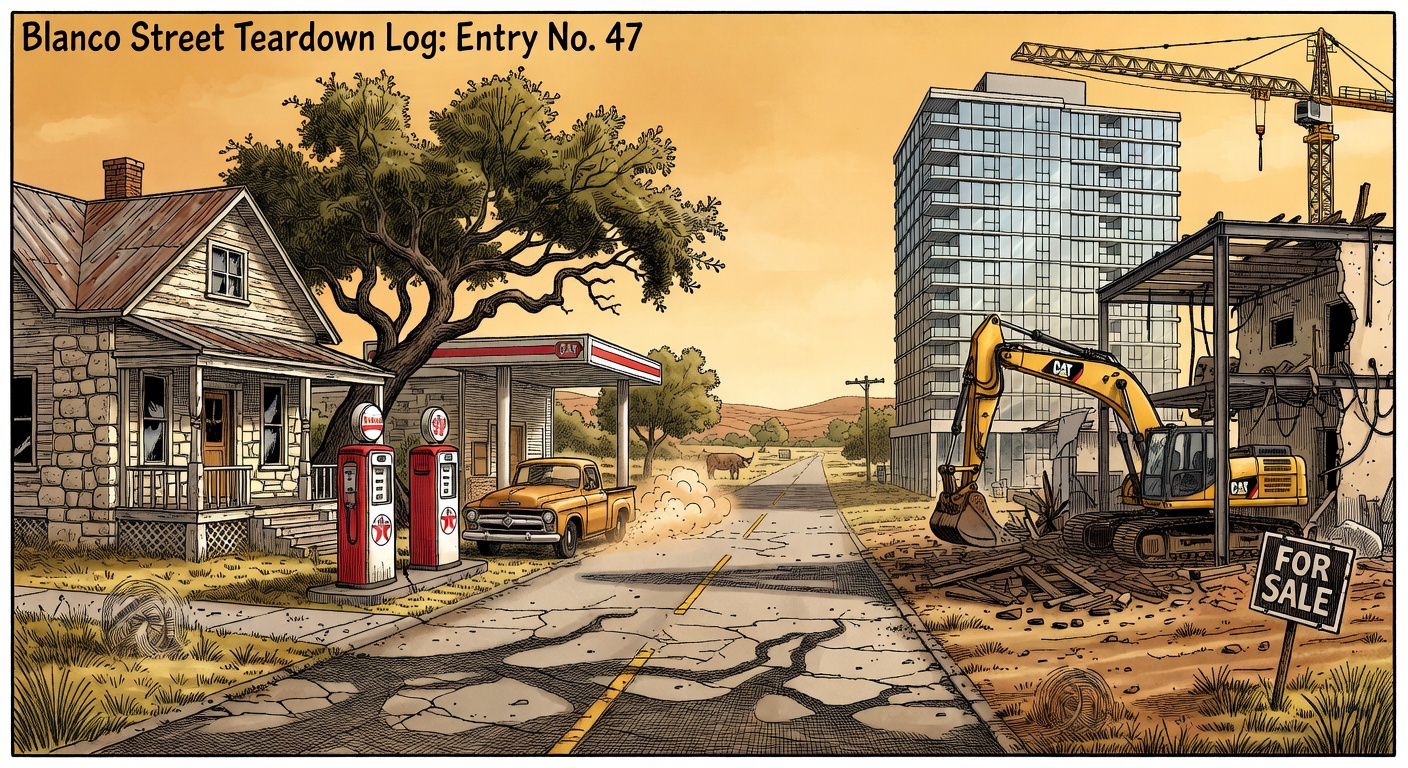
Blanco Street Teardown Log: Entry No. 47
The 1924 bungalow on Blanco where Miss Etta kept a red porch chair, a cooler of Shiner, and an open invitation for anyone carrying an instrument is now a bare lot with a $1.2M listing that brags about 'preserving neighborhood character' while the render shows a three-story glass box and a two-car Tesla charger.
The realtor kept saying "potential" like it was a prayer. He stood in the dirt where Miss Etta's front steps used to be, waving a tablet at a couple in identical navy vests. The air still smelled like fresh cedar from the live oak they'd taken down the week before. That tree shaded three generations of Sunday pickers. Now it was two-by-sixes stacked for some architect who probably thinks "Hill Country" is a Figma template.
I slowed my walk but didn't stop. Been doing these loops for thirty years. The route used to take forty minutes because every block wanted to talk. Today I was averaging twelve because most of the porches are empty or fenced off with those wire barriers that look like they were ordered from the same catalog as the minimalist mailboxes.
Blanco between 10th and 12th used to be the place you landed when Sixth Street got too loud and South Congress got too self-aware. Freedmen's town roots, then musicians dodging cheap rent in the '70s, then the spillover from the Armadillo crowd who wanted to sit outside without being sized up. The houses sagged in the middle like old sofas. Nobody minded. The sag meant the floor was level enough for a upright bass.
Entry No. 12 from my mental log: the night in '99 when four of us ended up on Etta's porch after the Blue Flamingo closed. She didn't know any of us. Didn't matter. She handed out Lone Stars, complained about the new stoplight on Lamar, and told the banjo player he needed to learn some Lightnin' Hopkins before she let him play another note. That was the price of admission. Knowledge and cold beer.
The new owners don't charge that toll. They don't charge any toll because they don't open the door. Last month I watched a woman in Lululemon yell at a DoorDasher for stepping on the new drought-resistant grass. Same patch of yard where we used to set up kegs for block birthdays. The grass didn't survive those either, but nobody filed a complaint.
The prices are the part that still makes my jaw tighten. That teardown at 1106 Blanco? Listed at $1.25 million as a "builder's opportunity." In 1994 you could have bought the whole damn block, three houses and the vacant lot where the roosters lived, for less than that. The property taxes alone on these new builds now run what a working musician paid in annual rent back then. So the musicians left. First to East Austin, then to Manor, then to Bastrop until the same wave followed them there.
I kept walking. Passed the place that used to be a duplex with one side occupied by a guitar tech who ran a side business fixing tube amps. You'd hear test riffs of "Purple Haze" at all hours. Sounded better than most paid shows. Now it's one sleek box painted the approved shade of "greige." The owner works from home doing something with APIs. I know this because he told the neighborhood Slack he was "passionate about curation" and wanted to start a book club focused on business memoirs. The Slack is Entry No. 39 in the log. I joined just to watch the corpse twitch.
They love the word curate around here now. Used to be we just had taste. The difference is curation comes with sponsors.
The new houses all face the street like they're posing for a magazine. Old Clarksville houses faced each other, porches angled for conversation. You could sit on yours and be part of six different discussions without raising your voice. Front doors stayed unlocked until midnight. The only security system was the collective knowledge of who belonged and who was up to no good. That system worked better than the $8,000 camera doorbells that now ping every time a delivery guy hesitates.
One new arrival tried to ban roosters last year. The remaining old-timers lost their minds in the HOA meeting. The newcomer said the crowing interfered with his mindfulness practice. Someone pointed out the roosters had been there since before mindfulness was a business model. The rooster faction won that round. Barely. But the birds are down to two houses now. Their days are numbered like everything else that can't be optimized.
The sounds have changed. Used to be you could stand in the middle of the street at dusk and hear at least three different genres leaking from open windows and screen doors. Pedal steel, hip-hop, the clack of a manual typewriter from the lady who wrote zines, arguing, laughing, the wet pop of another Shiner cap hitting the porch floor. Now it's mostly the low hum of central air and the occasional algorithmic playlist leaking through triple-paned glass. The playlists are fine. They are also the sonic equivalent of elevator music with better production.
I stopped at the empty lot that used to hold Dale's bike repair shed. Dale kept the place open until his hands gave out in 2018. Never advertised. Never needed to. If your bike was sick, you brought it to Dale. He'd fix it and tell you a story about racing bikes in the '60s before Austin decided it needed bike lanes designed by people who don't ride. The new render on the construction fence shows a "wellness studio" with an infrared sauna. The only sweat that place will see is from rich people pretending to work out.
They keep the street names. They keep a couple of the older oaks when the city makes them. They keep the historic plaque near the corner that talks about Clarksville's Black history like it's ancient Rome instead of living memory for some folks still here. What they don't keep is the mix. The retired Black schoolteacher who still lives three houses down watches these changes with the kind of quiet that comes from having seen this movie before.
The realtor was closing his pitch as I looped back. "This is the last affordable pocket of Old Austin," he said, gesturing at dirt that costs twelve hundred dollars a square foot. The couple nodded like they'd just been handed holy relics.
I almost laughed out loud. Almost.
The affordable pocket is now a memory you can visit in old photos or in the head of anyone who lived here before the city decided its soul was worth more as a branding exercise. The rest is just square footage with better Wi-Fi.
They call these teardown logs "progress." I call them the slow replacement of a neighborhood that knew your name with one that only knows your credit score.
The red chair is gone. The cooler is gone. The invitation is gone.
But the log keeps growing. Entry No. 48 is already scheduled for next month on the next block over. Same story, different address, higher asking price.