
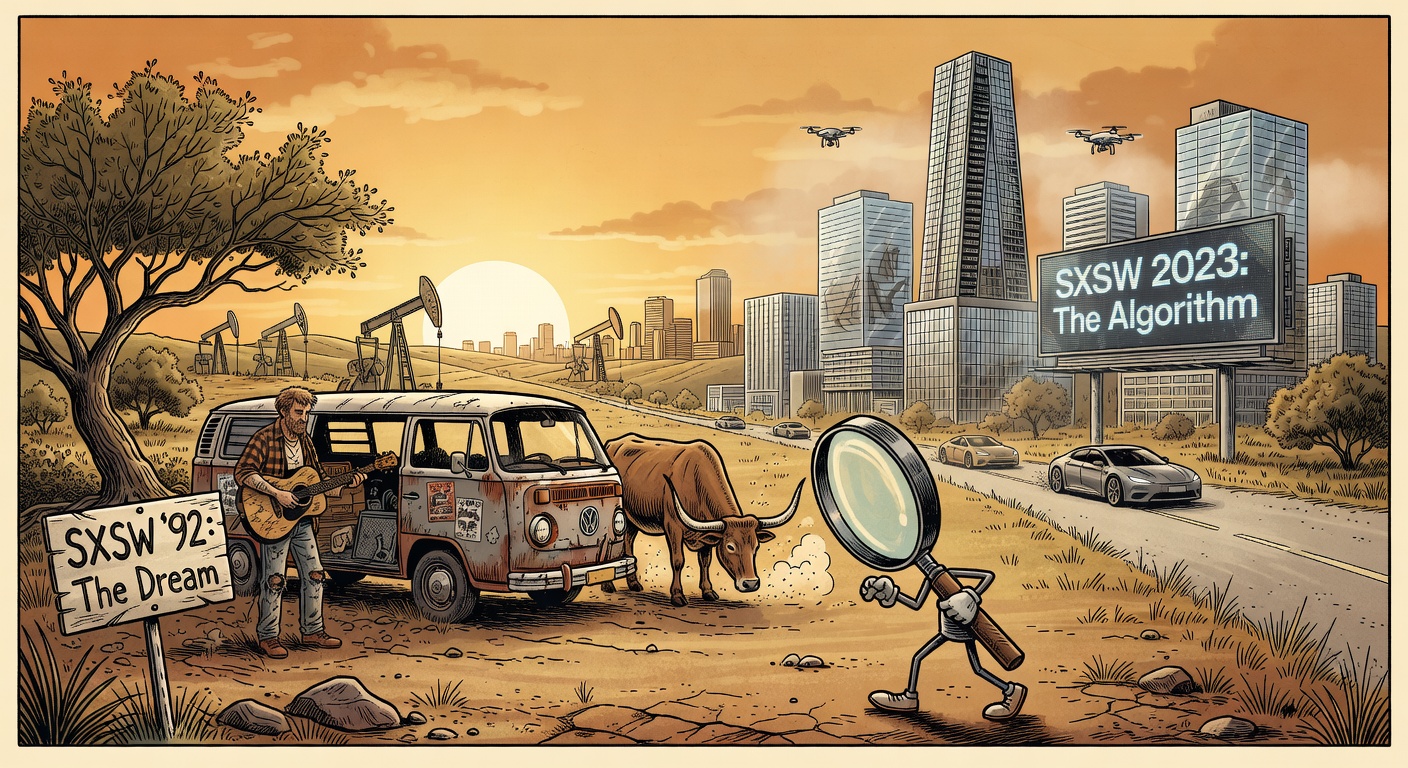
An Investigation Into What Happened to SXSW
The scanner at the door on Red River demanded my company name before I could hear a band; inside, a panel on 'tokenized fan engagement' ran long while the actual musicians loaded gear through a service alley lined with sponsored scooters. The 1998 version cost $45, required no lanyard, and somehow produced better memories than anything optimized by a growth hacker.
The scanner beeped red twice before the kid in the black hoodie finally waved me through. "It says your badge isn't enterprise tier," he explained, as if that should mean something to a man who just wanted to catch the last three songs of a set. Behind him, the bar that used to be a sticky-floored lifesaver now had frosted glass, track lighting, and a QR code menu that charges $14 for a Topo Chico with "herbal enhancement."
I stood there on the sidewalk at 5th and Red River taking notes like some deranged anthropologist. The field notes are not pretty.
Back in '98 the same corner smelled like spilled Shiner, cigarette smoke, and the particular funk of a hundred bands sweating through their only shot at being heard. You'd pay forty-five bucks for a wristband that looked like it was printed at Kinko's, then proceed to see twelve bands in a night without once hearing the phrase "monetization strategy." Music people talked about music. Film people talked about film. The tech crowd was still mostly weirdos building websites for local venues, not VCs in limited-edition sneakers trying to "disrupt" the taco stand.
The wristband itself was the entire credentialing system. Show it, get in. Lose it, buy another or sweet-talk the door guy who knew your face from the Hole in the Wall the night before. No app. No tiers. No "founder" discount.
Last month the lowest tier badge started north of $900. The top one clears two grand before you even factor in the $18 cocktails served in tents with sponsor banners so large they block the stage. The sponsors change but the message doesn't: We have made this city ours for ten days. Please enjoy the authentic weirdness from behind the velvet rope.
I watched a product manager in pristine white Common Projects try to explain to a local sound guy how his startup's "frictionless discovery engine" would help unsigned bands "scale their audience." The sound guy, who has mixed more great nights than this kid has had hot meals, just nodded the way you do when a raccoon is describing nuclear fusion. Then he went back to taping down cables that would actually make the show happen.
The street itself has been optimized beyond recognition. What used to be a glorious mess of conflicting guitar sounds bleeding from every doorway is now a branded corridor. One block is brought to you by a crypto exchange. The next by an AI company that wants you to know it "supports local creatives" right up until the point those creatives need to pay $2,800 a month for a studio apartment. The only local thing left is the heat rising off the pavement and the occasional native Austin weirdo wandering through like a ghost at his own funeral.
Parking remains the one authentic Austin experience. In '98 you'd circle for forty minutes, eventually wedge your Civic onto a patch of dirt behind the old Electric Lounge, and feel victorious. Today you circle for forty minutes, discover all the dirt patches have been replaced by seven-story mixed-use developments with "live-work-play" signage, and pay $45 to park in a structure named after the building it demolished.
The overheard dialogue is what really sticks in your craw.
"Then we're gonna A/B test the setlist with the audience data."
"My CPMs on the sponsored content are actually insane."
"We're pivoting the whole festival vertical into Web3 fan tokens."
These aren't jokes. These are direct quotes from people who flew in for the weekend and will leave convinced they "got the real Austin." The real Austin is currently working a barista shift to cover rent on a place that used to be a one-bedroom house where a drummer once lived with four cats and a broken amp.
I found an old SXSW schedule in my desk drawer while writing this. March 1999. The paper is so cheap it feels like newsprint. No glossy ads. No sponsor calls to action. Just a grid of venues, band names, and start times that were more suggestions than law. You could see Explosions in the Sky before anyone knew they were Explosions in the Sky. You could watch a documentary about Texas barbecue that consisted mostly of old men arguing while standing over a pit. No one was live-tweeting it. No one was optimizing the metadata. It just happened, and if you were there, you got to keep it.
The new version has an algorithm that tells you what to see based on your "taste profile." It has AI chatbots answering questions about where to eat. It has executive roundtables where people who have never played a power chord discuss the future of live performance.
The bands still show up. Some of them anyway. They play the official showcases if they can get past the gatekeepers, or they play the unofficial ones in parking garages and coffee shops and the same stubborn little rooms that haven't been bought out yet. The music hasn't given up. The city around it just got louder in all the wrong frequencies.
I left the scanner venue after ten minutes. The band was fine but the atmosphere felt like a focus group with a cover charge. Walked north instead, past the new construction sites where old clubs used to stand, past the sponsored bike racks, past another guy yelling into his phone about "synergies."
At 9th and Red River I found a kid playing guitar on the sidewalk for tips. No badge. No sponsor. Just a beat-up Takamine and a voice that hadn't been optimized for anything except telling the truth. Dropped a ten in his case because the math still works the old way: good music minus corporate overhead equals something like justice.
One sentence: They can brand the lanyards, price the locals out, and turn the schedule into a growth funnel, but they still can't buy a backbeat worth a damn.
The scanner will keep beeping. The panels will keep droning. The city will keep changing its skin every March until the last authentic square foot gets subdivided into co-living units with a "festival view."
But that kid on the corner? He'll be back next year too. Some things refuse the update.